Loading…
Loading video…

4,094 views
Ever wonder why bridges sometimes collapse despite appearing structurally sound? Eccentric loading occurs when forces don't act through a column's center, creating both compression and bending—like pushing on one side of a drinking straw. The Golden Gate Bridge's towers must withstand eccentric loading from wind and traffic loads that don't align perfectly with their centerlines. Understanding what is eccentric loading reveals how engineers analyze critical failure points and maximum stress conditions in structural members. Watch the full video on JoVE Coach to master this concept with expert-led visuals and step-by-step explanations.
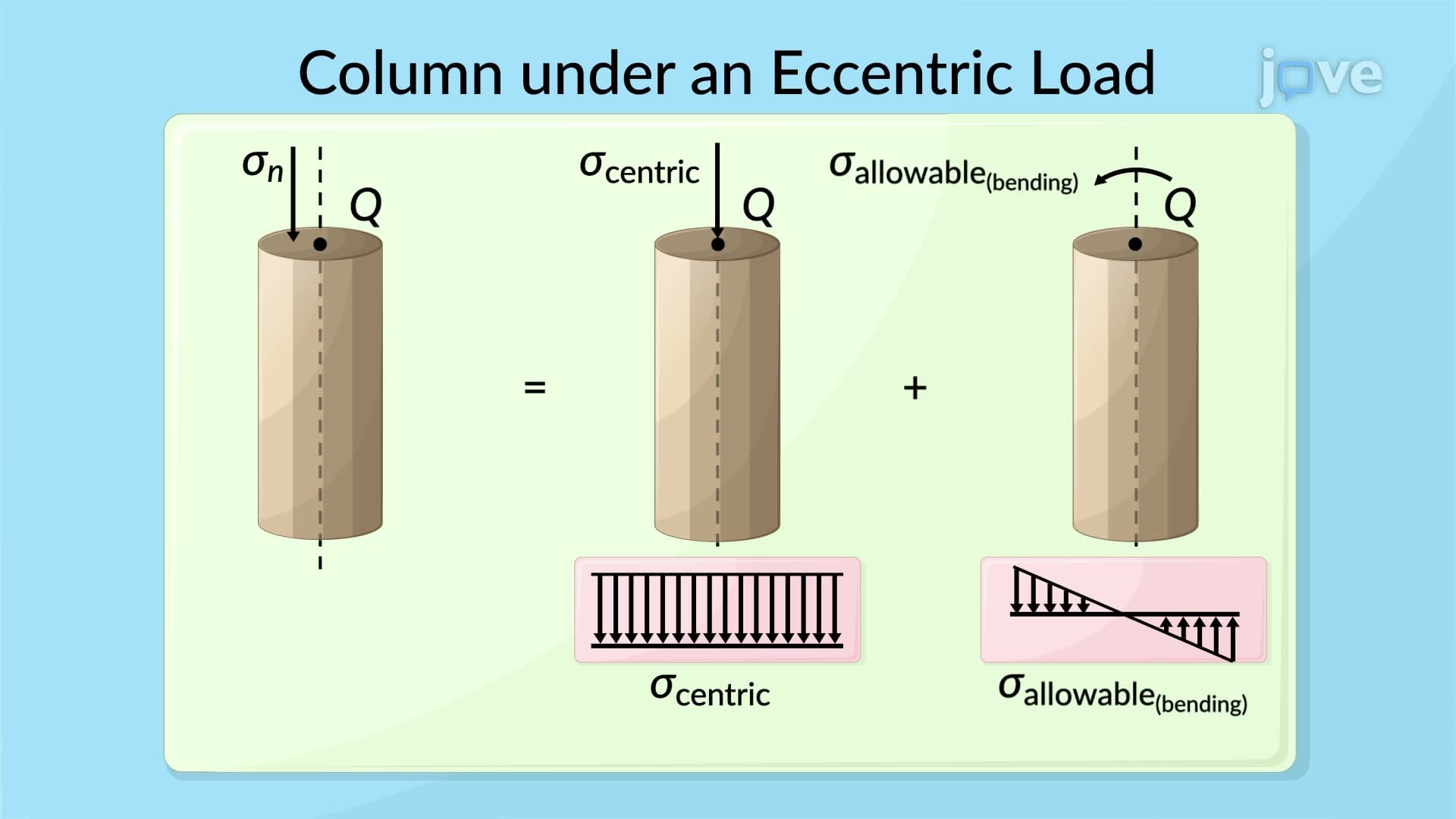
Eccentric loading represents a fundamental concept in structural engineering where applied forces act at a distance from the centroidal axis of a structural member. Unlike centric loading, where forces align perfectly with the member's center, eccentric loading creates a more complex stress distribution that combines axial compression (or tension) with bending moments.
When engineers analyze eccentric loading, they recognize that any off-center force can be mathematically replaced by an equivalent system: a centric force of the same magnitude plus a couple moment. This couple moment equals the original force multiplied by its eccentricity distance from the centroidal axis. This transformation simplifies analysis while revealing the true nature of stress distribution within the loaded member.
The elastic curve differential equation becomes crucial when solving eccentric loading problems. Engineers substitute the couple moment into the standard beam deflection equation, then apply boundary conditions specific to the column's end supports. For a typical column with pinned ends, these boundary conditions require zero deflection at both supports, allowing calculation of integration constants.
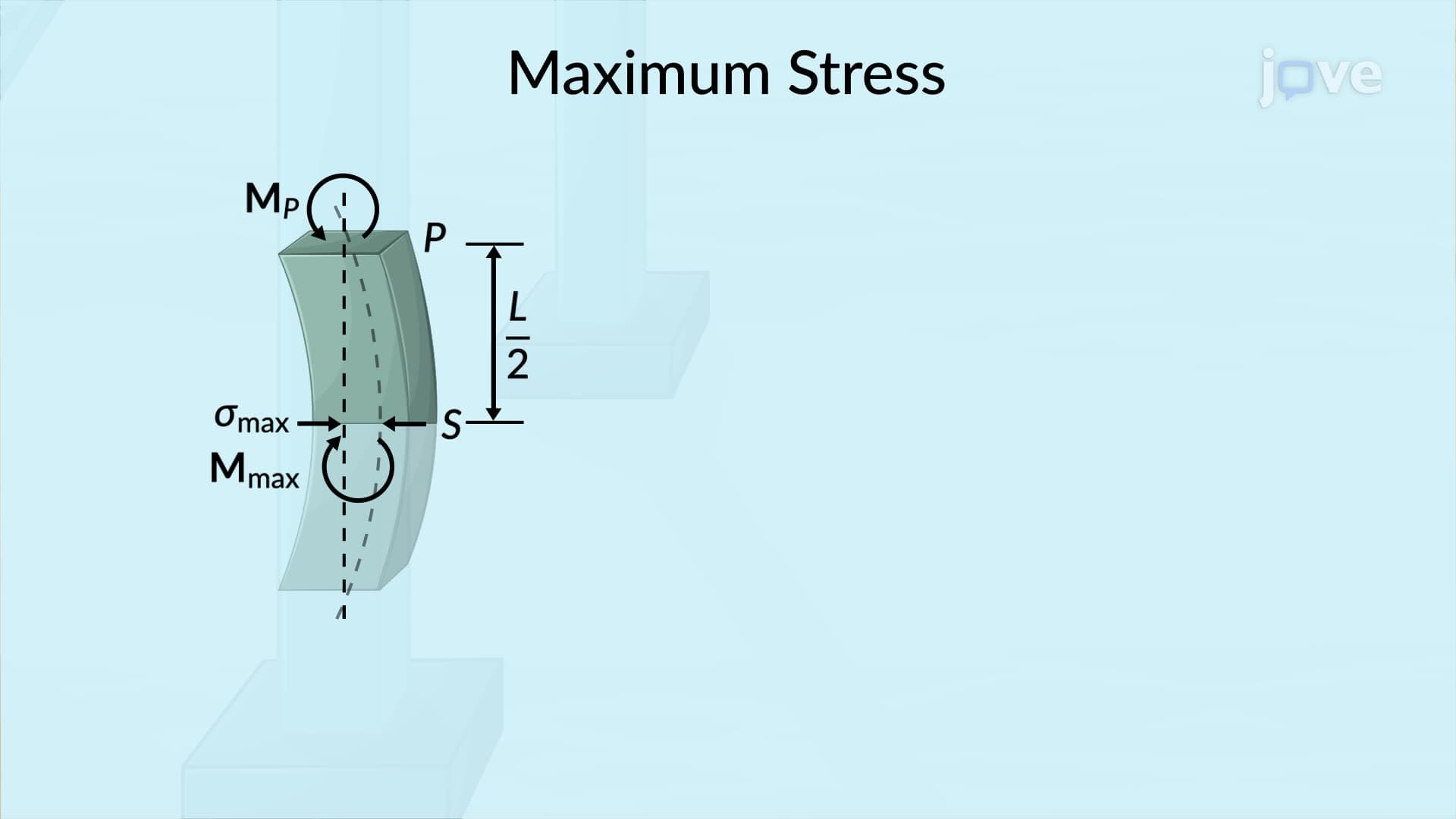
The solution reveals that maximum deflection occurs at the column's midpoint, where bending effects reach their peak. This mathematical relationship proves essential for structural design, particularly in determining safe load limits and preventing catastrophic failure modes.
A fascinating aspect of eccentric loading analysis involves the critical loading condition. When the applied load approaches a specific threshold value, the deflection equation's secant term approaches infinity, theoretically producing infinite deflection. This critical loading represents the Euler buckling load modified for eccentric conditions, marking the boundary between stable and unstable column behavior.
In practice, structures never actually achieve infinite deflection—they fail before reaching this mathematical limit. However, understanding this critical threshold helps engineers establish appropriate safety factors and design margins for real-world applications.
American engineers encounter eccentric loading in numerous applications. High-rise buildings in cities like New York and Chicago must account for wind loads that create eccentric forces on vertical columns. The Willis Tower's structural system, for example, incorporates analysis of eccentric loading from both wind and seismic forces acting on its bundled tube design.
Bridge engineering provides another critical application area. The cable-stayed Sunshine Skyway Bridge in Florida experiences eccentric loading on its towers from unbalanced traffic loads and wind forces. Engineers must ensure these eccentric conditions don't exceed critical loading thresholds that could compromise structural integrity.
This concept frequently appears in AP Physics C mechanics problems, college-level statics and mechanics of materials courses, and professional engineering (PE) exam questions focusing on structural analysis and design principles.
Frequently Asked Questions
Eccentric loading occurs when forces act away from a structural member's centerline, creating both compression and bending effects simultaneously. Unlike centric loading where forces align with the center axis producing only compression or tension, eccentric loading generates additional couple moments that cause the member to bend while carrying axial loads, resulting in more complex stress distributions.
In structural engineering, eccentric loading represents a critical design consideration where applied forces create both axial stress and flexural stress within columns, beams, and other members. The analysis involves converting the eccentric force into an equivalent centric force plus couple moment, then solving differential equations with appropriate boundary conditions to determine deflections, stresses, and potential failure modes.
AP Physics C and college statics exams typically present eccentric loading through column stability problems, requiring students to analyze free-body diagrams, apply equilibrium equations, and calculate maximum stresses or deflections. Common problem types include determining critical loads for buckling, finding maximum bending moments, and comparing eccentric versus centric loading scenarios in structural members.
Yes, the Fundamentals of Engineering (FE) and Professional Engineer (PE) exams frequently include eccentric loading problems within structural analysis sections. These questions test candidates' ability to analyze combined axial and bending stresses, determine critical loading conditions, and apply appropriate safety factors in structural design applications.
Eccentric loading appears throughout US infrastructure, from skyscraper columns experiencing wind loads in Chicago and New York to bridge towers handling unbalanced traffic forces on structures like the Golden Gate Bridge. Power transmission towers, crane supports, and even residential foundation columns must account for eccentric loading effects in their design and analysis phases.
While eccentric loading involves some advanced mathematics, high school students can grasp the fundamental concept with proper introduction to basic statics and geometry. The key lies in understanding that off-center forces create both pushing and bending effects, which students can visualize through simple demonstrations like pushing on a ruler or pencil at different positions.
Focus on mastering free-body diagram construction, equilibrium equations, and the relationship between eccentric forces and equivalent force-couple systems. Practice converting eccentric loading scenarios into mathematical expressions, then work through boundary condition applications and differential equation solutions systematically to build confidence with these multi-step problems.
After understanding eccentric loading fundamentals, explore advanced topics like combined loading analysis, plastic hinge formation in steel structures, P-delta effects in tall buildings, and nonlinear buckling analysis. These concepts build directly on eccentric loading principles while introducing more sophisticated design considerations for complex structural systems.
Related Micro-courses
Related Subjects
 Civil Engineering 30 micro-courses›Electrical Engineering 33 micro-courses›