Loading subject page…

- Mechanical Engineering
- Kinematics of a Particle
- Motion of a Projectile
Micro-course: Kinematics of a Particle
3,836 views
Learn key concepts and earn your certificate.

Motion of a Projectile

00:00
01:23
Video Summary: What Is Motion of a Projectile
Ever wonder why a basketball follows a curved arc when shooting a free throw? The motion of a projectile describes this elegant curved path that objects follow when launched into the air under gravity's influence alone. From a quarterback's spiral pass in the NFL to NASA's rocket launches from Cape Canaveral, projectile motion governs countless real-world scenarios. Watch the full video on JoVE Coach to master this concept with expert-led visuals and step-by-step explanations.
- Understand what is motion of a projectile and identify its two independent components: horizontal and vertical motion
- Analyze how launch angle affects the trajectory and range of projectiles in real-world scenarios
- Apply kinematic equations to solve horizontal motion problems where velocity remains constant
- Evaluate vertical motion calculations using gravitational acceleration and kinematic principles
- Recognize how horizontal and vertical components combine to create the resultant velocity vector
- Compare different launch angles to determine optimal conditions for maximum range
- Explore practical applications of projectile motion in sports, engineering, and space exploration
- Apply projectile motion concepts to solve AP Physics and college-level physics problems
Understanding What is Motion of A Projectile
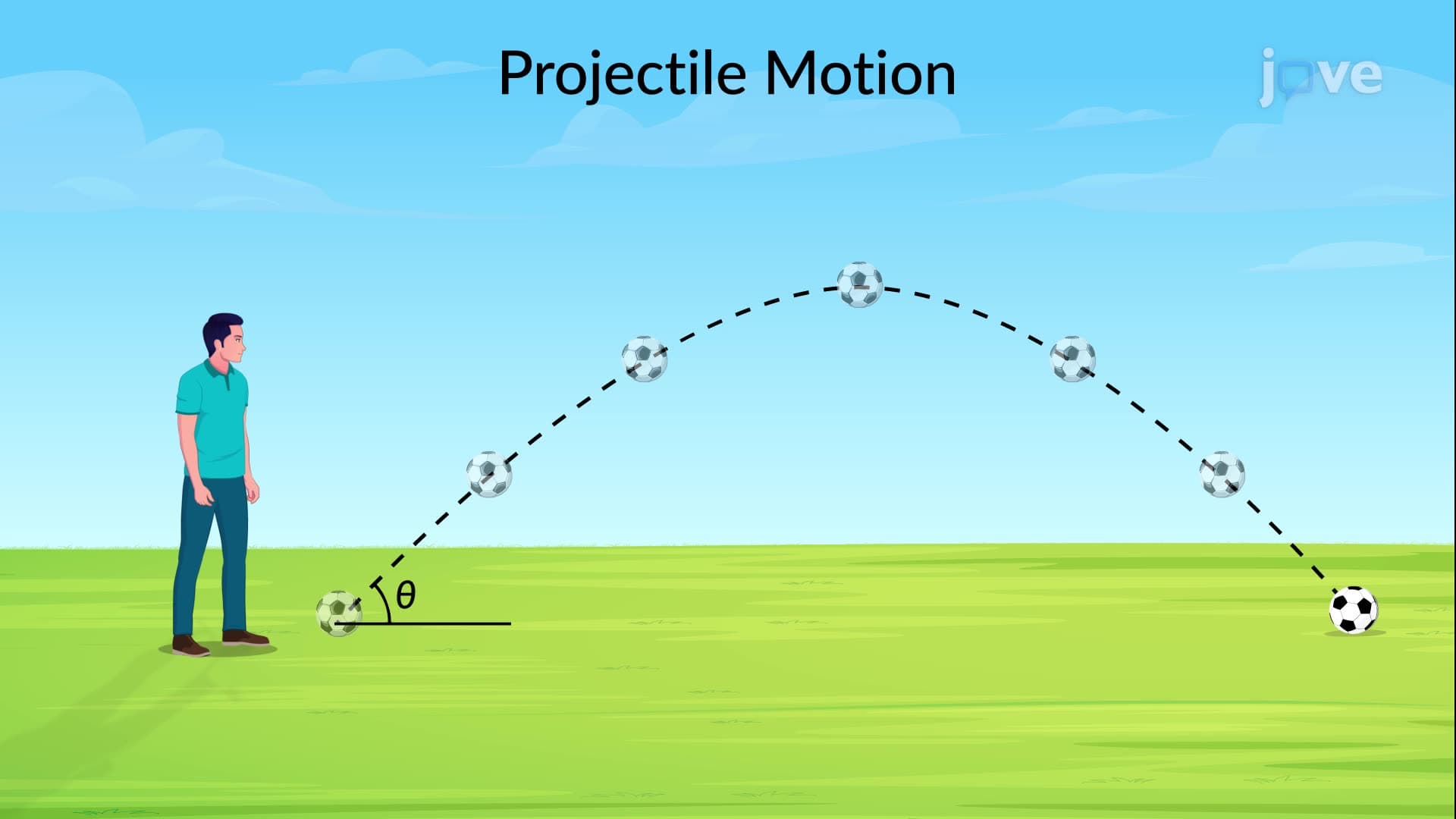
Motion of a projectile represents one of physics' most elegant demonstrations of how multiple forces create complex trajectories. When an object moves through the air influenced solely by gravitational force, it follows a predictable parabolic path. This fundamental concept appears everywhere from military ballistics calculations at West Point to NASA's mission planning for Mars rovers.
The Two-Component Nature of Projectile Motion
The genius of projectile motion analysis lies in recognizing its dual nature. Horizontal motion occurs independently of vertical motion, allowing physicists to solve complex problems by breaking them into manageable parts. In the horizontal direction, no forces act on the projectile after launch (ignoring air resistance), so velocity remains constant throughout flight. Meanwhile, vertical motion follows standard free-fall principles, with gravitational acceleration constantly pulling the object earthward at 9.8 m/s².
This separation principle helps explain why a baseball thrown horizontally from the pitcher's mound follows the same vertical drop pattern whether thrown fast or slow, only the horizontal distance changes. Students preparing for AP Physics exams frequently encounter problems exploiting this independence, making it crucial to master both components separately before combining them.
Launch Angle and Maximum Range Optimization
Launch angle dramatically affects projectile performance, with 45 degrees providing maximum range under ideal conditions. However, real-world applications often require different angles. Basketball players shooting free throws use approximately 50-degree launch angles to clear defenders and optimize scoring probability. Military artillery specialists calculate precise angles considering terrain, wind, and target distance.
The maximum range formula, R = (v₀² × sin(2θ))/g, reveals why 45 degrees works best: sin(90°) equals 1, the maximum possible value. Students tackling SAT Physics or college mechanics courses should memorize this relationship, as it frequently appears in standardized testing scenarios.
Real-World Applications and Problem-Solving Strategies
Projectile motion problems appear throughout American education, from high school physics to engineering graduate programs. NASA engineers use these principles designing spacecraft trajectories, while sports analysts employ projectile calculations analyzing football field goals and baseball home run distances. Understanding these applications helps students connect abstract equations to tangible outcomes, improving retention and problem-solving confidence.
Frequently Asked Questions
Motion of a projectile is the curved path an object follows when launched into the air and influenced only by gravity. It combines constant horizontal motion with accelerating vertical motion, creating the familiar arc shape seen in thrown balls, arrows, and rockets.
For AP Physics, projectile motion is defined as two-dimensional motion where an object experiences constant horizontal velocity and uniform vertical acceleration due to gravity. Students must analyze both components independently, then combine them to find resultant velocity, range, and flight time using kinematic equations.
The MCAT tests projectile motion through physics passages involving sports medicine, biomechanics, or medical device trajectories. Questions typically require calculating launch angles, maximum heights, or flight times using kinematic equations, often within biological or medical contexts.
Americans encounter projectile motion in NFL football spirals, NBA basketball shots, baseball home runs, golf drives, and even water fountains in city parks. Military applications include artillery at bases like Fort Bragg, while NASA demonstrates it spectacularly with rocket launches from Kennedy Space Center.
Projectile motion builds naturally on basic kinematic concepts most students already know from earlier physics units. The key insight, treating horizontal and vertical motions separately, makes complex problems manageable once students practice the systematic approach consistently.
Master the independence principle first: horizontal velocity stays constant while vertical motion follows free-fall rules. Practice drawing trajectory diagrams, identifying given variables, and systematically applying kinematic equations. Focus on word problems involving sports scenarios since they're common on standardized tests.
Students should progress to circular motion and rotational dynamics, which share mathematical similarities with projectile motion. Advanced topics include air resistance effects, projectile motion on inclined planes, and orbital mechanics, all building naturally from fundamental projectile principles.
College courses introduce air resistance, projectile motion in different gravitational fields, and three-dimensional trajectories. Engineering programs apply these concepts to missile guidance systems, sports equipment design, and aerospace applications requiring sophisticated mathematical modeling beyond basic parabolic motion.
Related Micro-courses

12 Concepts

13 Concepts