Loading subject page…


17,829 views


Video Summary: What Is Production Possibility Frontier Ppf
Ever wonder why the U.S. government must choose between funding military defense or education programs? The production possibility frontier PPF illustrates this fundamental economic reality-societies face unavoidable trade-offs when allocating limited resources. For instance, during World War II, American factories shifted from producing cars to manufacturing tanks, demonstrating how What is Production Possibility Frontier Ppf concepts apply to real economic decisions. Watch the full video on JoVE Coach to master this concept with expert-led visuals and step-by-step explanations.
The production possibility frontier PPF represents one of economics' most powerful visual tools for understanding fundamental concepts that shape every economy. This curved or straight line on a graph shows the maximum combination of two goods or services that an economy can produce when all resources are fully and efficiently employed. The PPF assumes fixed resources, unchanging technology, and for simplicity, only two goods-making it an ideal starting point for students beginning their economics journey.
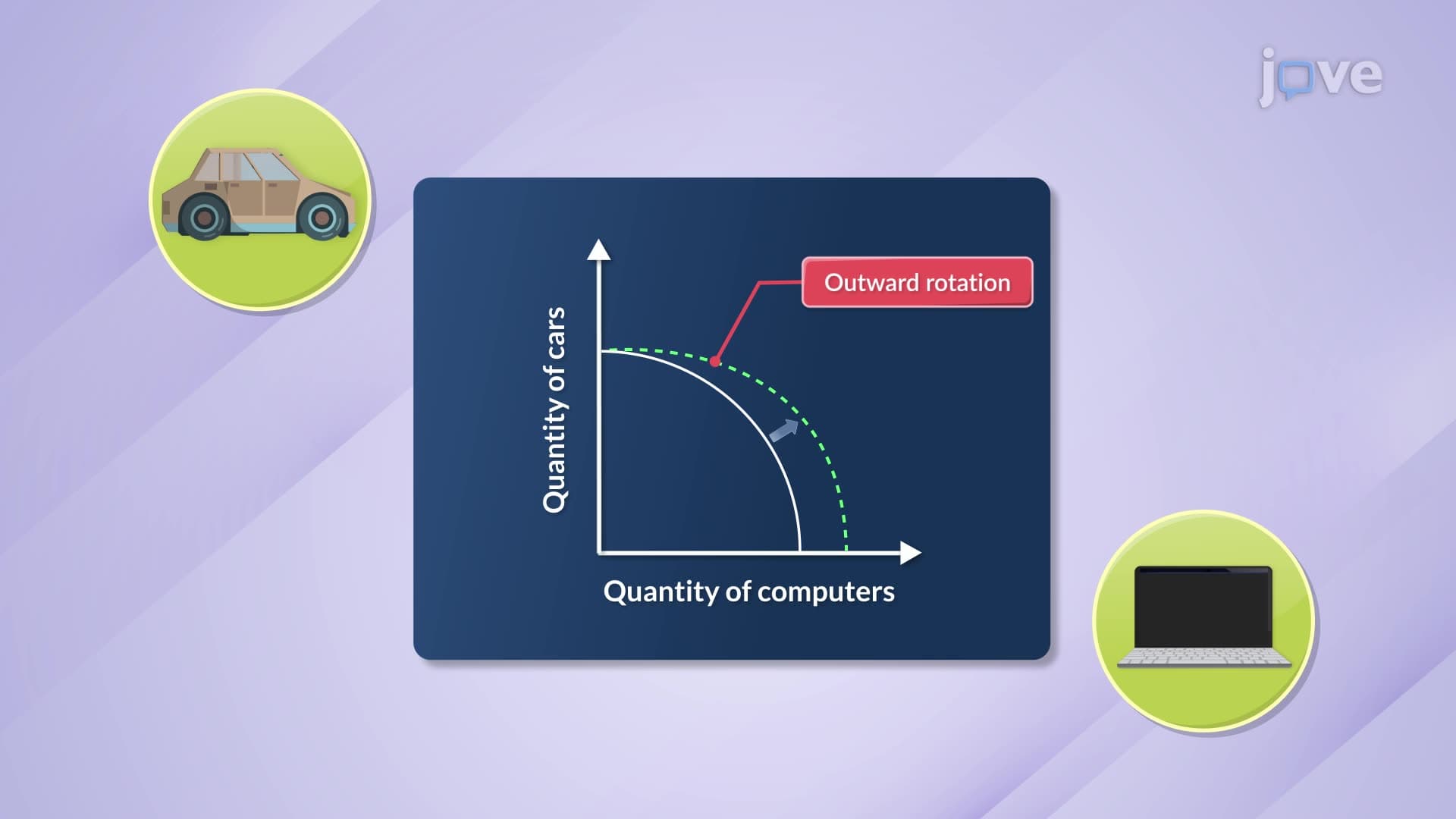
A typical production possibility frontier appears as a downward-sloping curve on a coordinate plane. Each axis represents one good or service-for example, the x-axis might show computers while the y-axis displays automobiles. Points directly on the curve represent productive efficiency, where the economy operates at maximum capacity. Moving from one point to another along the curve illustrates the fundamental economic concept of opportunity cost-to produce more of one good, society must sacrifice some quantity of the other.
Points inside the curve indicate productive inefficiency or unemployment of resources. For instance, during the 2008 recession, the U.S. economy operated inside its PPF due to high unemployment and underutilized factories. Conversely, points outside the curve remain unattainable with current resources and technology, though economic growth can shift the entire frontier outward over time.
The production possibility frontier PPF concept appears frequently in AP Economics courses and college-level microeconomics classes. Students encounter this model when analyzing government budget decisions-should taxpayer money fund more highways or schools? During the COVID-19 pandemic, hospitals faced PPF decisions between treating coronavirus patients versus providing routine medical care, demonstrating how limited resources force difficult choices.
Businesses also apply PPF thinking when allocating production capacity. Tesla, for example, must decide how to distribute manufacturing resources between Model 3 sedans and Cybertruck production. Understanding these trade-offs helps explain why companies cannot simply "do everything" simultaneously.
Production possibility frontiers can appear as straight lines (constant opportunity cost) or curved lines (increasing opportunity cost). Most real-world PPFs curve outward because resources are not perfectly adaptable between different uses. A farmer's land might excel at growing corn but struggle with apple production, creating increasing opportunity costs as more resources shift toward apple farming. This concept frequently appears on SAT Subject Tests and college midterm examinations, making it essential knowledge for academic success.
Related Micro-courses