Loading video…


 10 Concepts
 17.8K views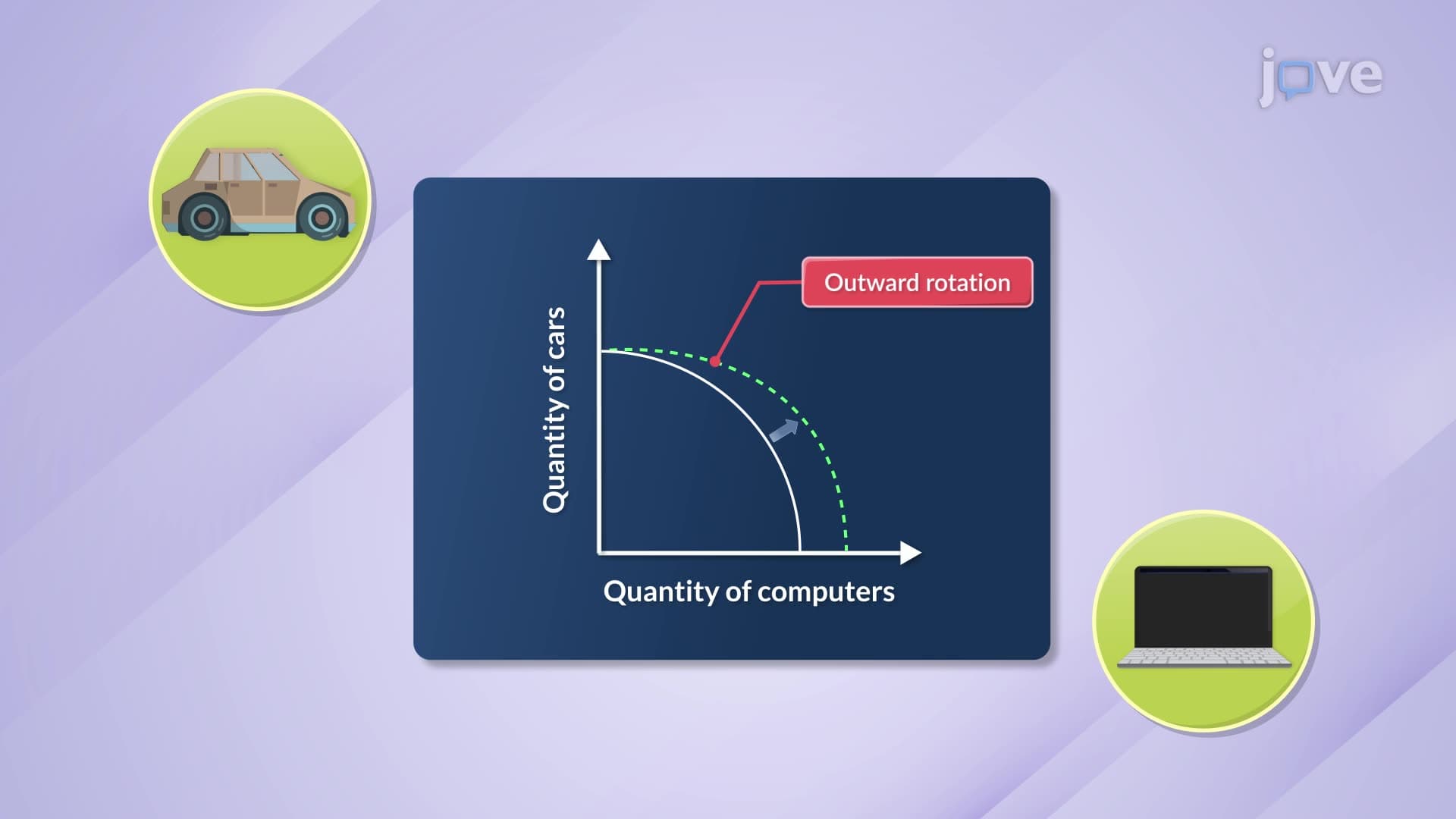

Video Summary: What Is Rotations in Ppf
Ever wonder how Silicon Valley tech companies can boost computer chip production without cutting back on manufacturing cars in Detroit? Rotations in PPF occur when an economy can increase production of one good while maintaining constant output of another, fundamentally reshaping production possibilities. Unlike parallel shifts that affect all goods equally, rotations specifically target one sector-like when breakthrough semiconductor technology allows the US to produce more microprocessors using the same resources, rotating the production possibilities frontier outward for tech goods while keeping automobile production steady. Watch the full video on JoVE Coach to master this concept with expert-led visuals and step-by-step explanations.
Rotations in PPF represent a fundamental shift in how economists analyze production capabilities when technological or resource changes affect specific sectors differently. Unlike parallel shifts where the entire frontier moves uniformly, rotations pivot around one axis, indicating that productivity gains (or losses) occur in just one area of the economy.
The mathematical foundation involves changing the slope of the production possibilities frontier. When the US experiences breakthroughs in renewable energy technology, for example, the PPF rotates outward along the energy axis while maintaining the same maximum potential for traditional manufacturing. This creates a new, steeper (or flatter) curve that expands possibilities in one direction.
Several factors drive outward rotations in real US economic contexts. Technological advancement stands as the primary catalyst-consider how fracking technology revolutionized American oil production after 2008, dramatically increasing energy output without affecting agricultural capacity. Innovation in production methods also creates rotations, such as when Amazon's fulfillment automation increased logistics efficiency while leaving manufacturing unchanged.
Resource discoveries provide another rotation trigger. The development of rare earth mineral deposits in California's Mountain Pass mine expanded America's capacity for electronics production without impacting other sectors. Additionally, workforce skill development through targeted education programs can rotate the PPF outward-specialized training in biotechnology has enhanced pharmaceutical production capabilities in Boston and San Diego without affecting other industries.
Inward rotations signal sector-specific decline. Resource depletion can cause inward rotation, as seen when coal reserves diminish in Appalachian regions, reducing energy production capacity while other sectors remain stable. Technological regression or regulatory constraints may also trigger inward rotations-environmental regulations that limit certain manufacturing processes can rotate the PPF inward for affected industries.
Natural disasters provide clear examples of temporary inward rotations. Hurricane Katrina severely impacted Gulf Coast oil refining capacity, rotating the PPF inward for petroleum products while leaving agricultural production in other regions unaffected.
Students encounter PPF rotations frequently in AP Economics courses, where exam questions test understanding of how sector-specific changes affect national production possibilities. College-level intermediate microeconomics courses explore mathematical modeling of rotations using linear programming techniques.
Professional economists use rotation analysis to evaluate policy impacts-trade specialists assess how tariffs on specific imports might rotate domestic production possibilities, while development economists study how infrastructure investments create outward rotations in targeted sectors.
Related Micro-courses