Loading subject page…


17,829 views


Video Summary: What Is Shifts in Ppf
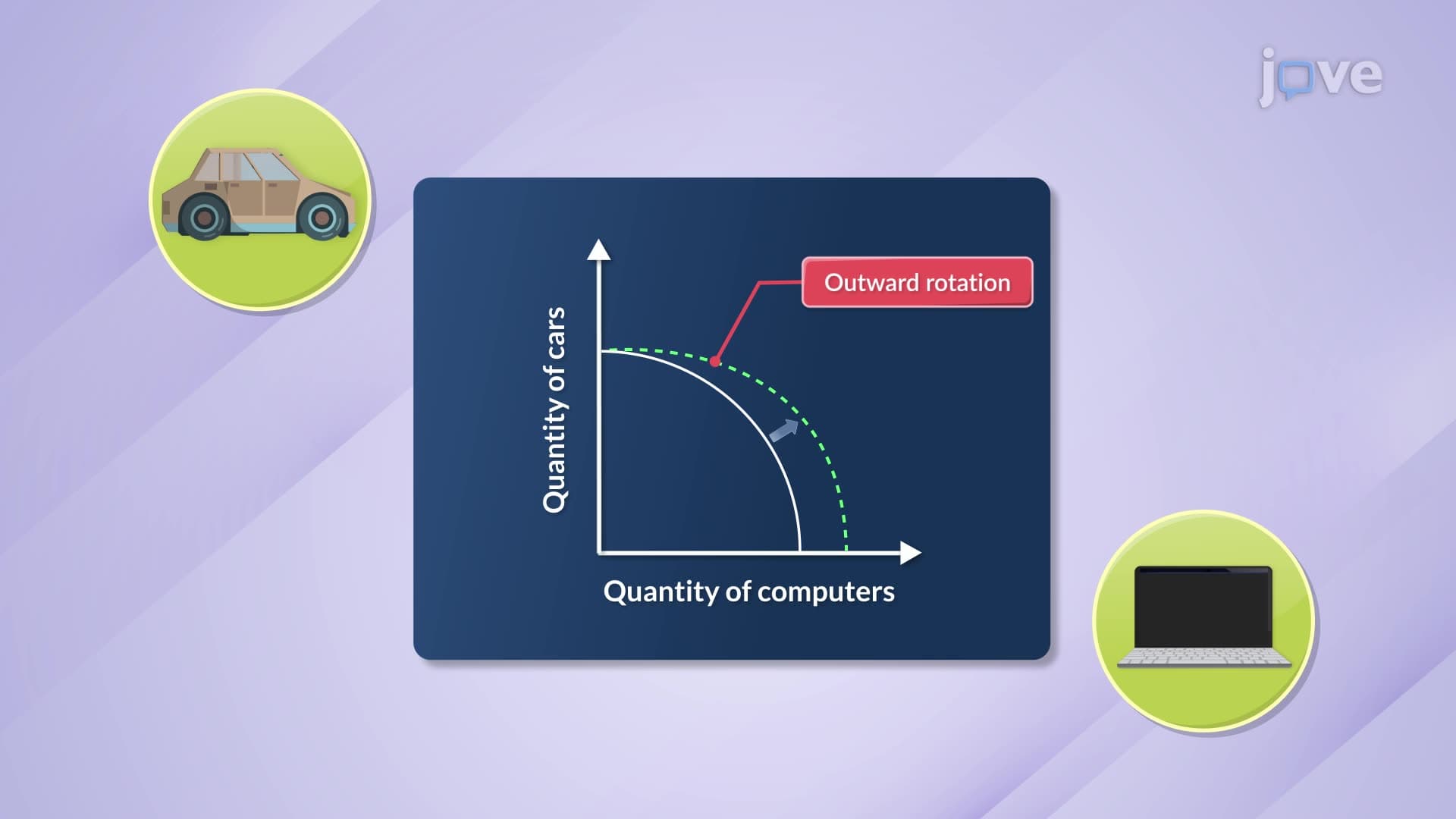
Did you know that when Hurricane Katrina devastated New Orleans in 2005, it didn't just destroy homes-it actually shifted America's entire economic production capacity? Shifts in PPF occur when an economy's total production possibilities change due to resource availability or technological advances. Unlike rotations that affect efficiency for one good, shifts in PPF move the entire production possibilities frontier, indicating changes in overall economic output. For instance, the 2008 financial crisis caused a leftward shift as unemployment reduced available human capital across all sectors. Watch the full video on JoVE Coach to master this concept with expert-led visuals and step-by-step explanations.
Shifts in PPF represent fundamental changes in an economy's total production capacity, moving the entire production possibilities frontier either inward or outward. Unlike movements along the curve or rotations affecting specific goods, shifts indicate economy-wide changes in the ability to produce all goods and services. This concept forms a cornerstone of macroeconomic analysis, helping economists and policymakers understand how various factors influence national productivity and economic growth potential.
Rightward (outward) shifts in PPF signal economic growth, demonstrating increased production capacity across all sectors. Several factors drive these positive shifts. Technological advancement stands as the primary catalyst-consider how the internet revolution of the 1990s expanded productivity across virtually every American industry, from banking to retail to manufacturing. The discovery of new natural resources also triggers rightward shifts, as seen when hydraulic fracturing technology unlocked vast shale oil reserves in North Dakota and Texas, boosting America's energy production capacity.
Population growth through immigration or higher birth rates increases available labor resources, shifting the PPF outward. The post-World War II baby boom exemplifies this phenomenon, as millions of new workers entered the American workforce in the 1960s and 1970s. Additionally, improvements in education and training enhance human capital quality, effectively expanding production possibilities even without increasing worker quantity.
Leftward (inward) shifts indicate reduced production capacity, often resulting from resource depletion, natural disasters, or economic disruptions. The 2008 financial crisis demonstrated how banking system failures could shift America's PPF inward as unemployment soared and productive capacity remained underutilized. Natural disasters create immediate leftward shifts-Hurricane Sandy's impact on Northeast manufacturing facilities in 2012 temporarily reduced regional production capacity.
Resource depletion can gradually shift the PPF inward, though technological advances often offset this effect. The decline of coal mining in Appalachia illustrates resource exhaustion, while automation in manufacturing shows how technology can maintain production capacity despite job losses in specific sectors.
Understanding shifts in PPF proves essential for AP Economics students, particularly on free-response questions requiring graphical analysis of economic scenarios. College microeconomics and macroeconomics courses extensively cover this topic, with professors often using current events to illustrate concept applications. Business students encounter shifts in PPF when studying strategic planning and market analysis, while public policy students examine how government investments in infrastructure and education can drive rightward shifts in national production possibilities.
Related Micro-courses