Loading subject page…

- Molecular Biology
- Biochemistry of the Cell
- Intermolecular Forces
Micro-course: Biochemistry of the Cell
320,100 views
Learn key concepts and earn your certificate.


Intermolecular Forces

00:00
03:13
Video Summary: What are Intermolecular Forces
Ever wonder why water beads up on a waxed car but spreads on glass? Intermolecular forces are the attractive forces between molecules that determine these everyday behaviors and control whether substances are gases, liquids, or solids at room temperature. These forces explain why pharmaceutical companies at Johnson & Johnson must carefully consider molecular interactions when designing new medications. Understanding what are intermolecular forces reveals the invisible attractions that govern everything from DNA structure to ice formation. Watch the full video on JoVE Coach to master this concept with expert-led visuals and step-by-step explanations.
- Understand what are intermolecular forces and distinguish them from intramolecular bonds within molecules
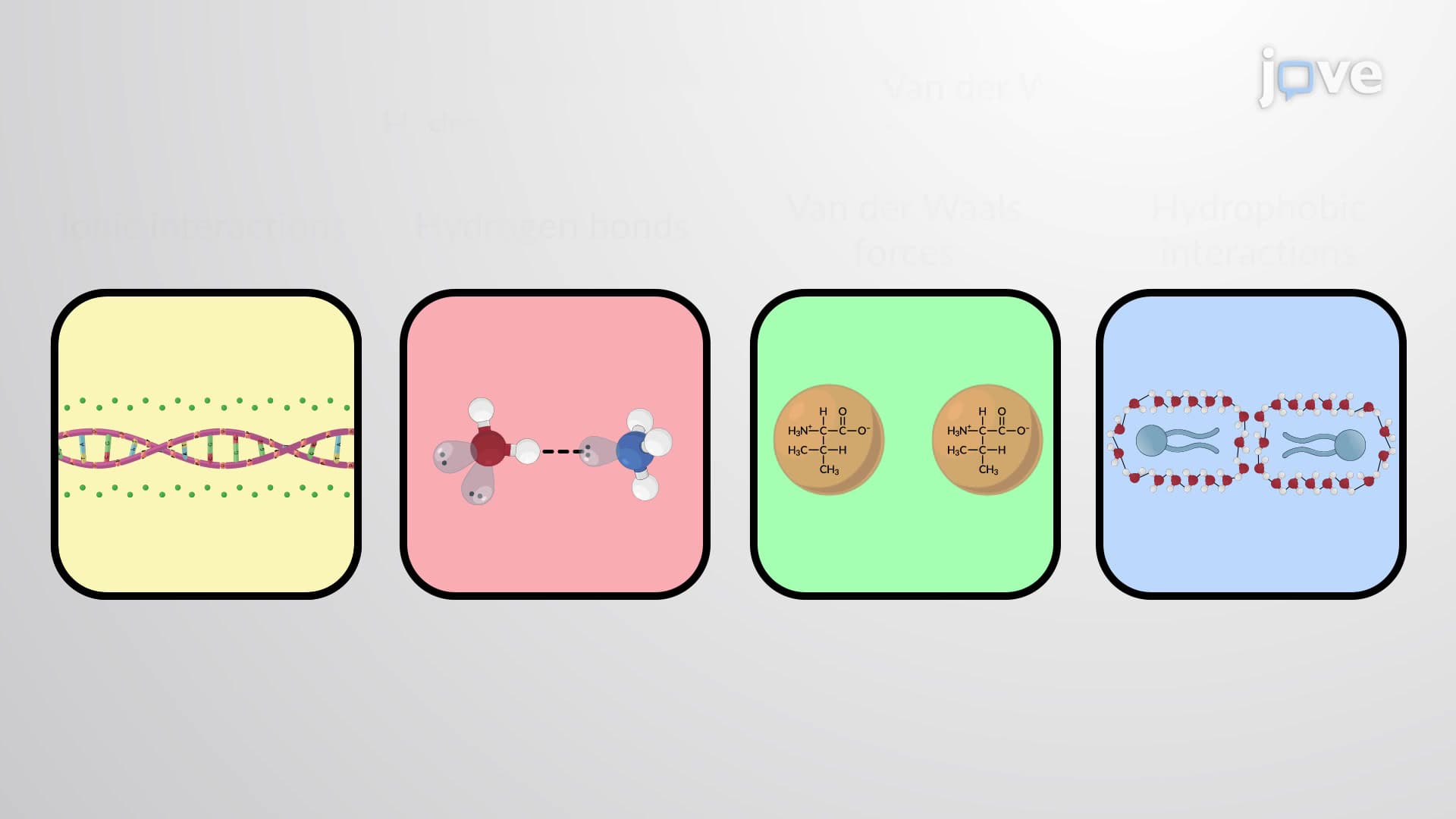
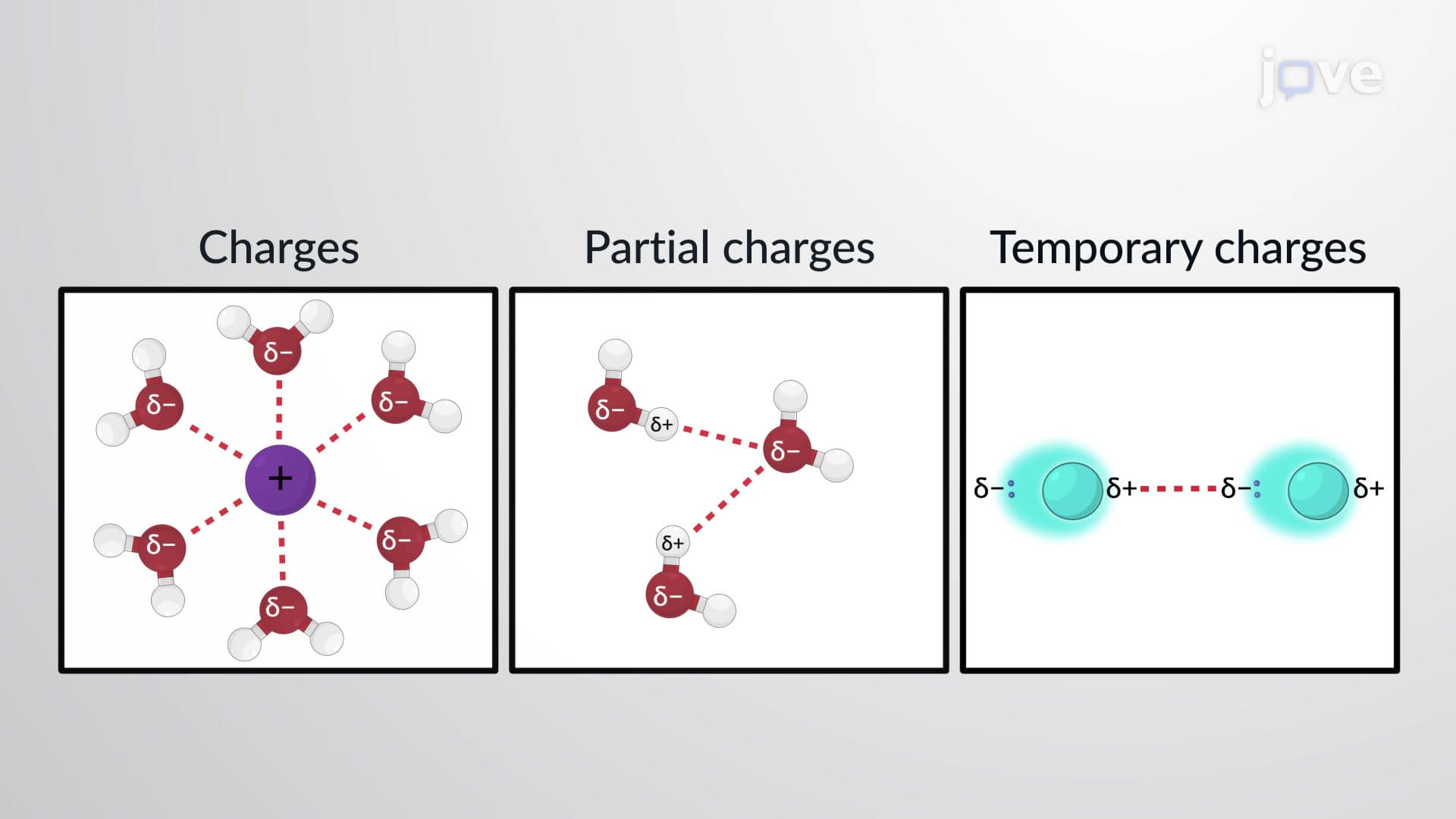
- Identify the four main types of intermolecular forces: London dispersion forces, dipole-dipole interactions, hydrogen bonding, and ion-dipole forces
- Analyze how molecular polarity and electronegativity differences determine the strength and type of intermolecular attractions
- Compare the relative strengths of different intermolecular forces and predict their effects on physical properties
- Evaluate how intermolecular forces influence boiling points, melting points, solubility, and viscosity of common substances
- Apply intermolecular force concepts to explain real-world phenomena like surface tension, capillary action, and protein folding
- Recognize the role of intermolecular forces in biological systems, including enzyme-substrate binding and membrane formation
- Explore how understanding these forces enables advances in materials science, drug design, and nanotechnology applications
Understanding What Are Intermolecular Forces
Intermolecular forces are the attractive interactions that occur between separate molecules, fundamentally different from the covalent or ionic bonds that hold atoms together within molecules. These forces are generally weaker than intramolecular bonds but play crucial roles in determining physical properties like phase behavior, solubility, and biological function. Students preparing for AP Chemistry or college general chemistry courses must master these concepts, as they frequently appear on exams and form the foundation for understanding more complex topics like phase diagrams and biochemical interactions.
Types of Intermolecular Forces and Their Characteristics
London dispersion forces represent the weakest intermolecular attractions, arising from temporary fluctuations in electron density that create instantaneous dipoles. Present in all molecules, these forces become stronger with increasing molecular size and surface area. This explains why butane (C4H10) is a gas at room temperature while octane (C8H18) is a liquid.
Dipole-dipole interactions occur between polar molecules with permanent charge separations. The positive end of one molecule attracts the negative end of another, creating directional forces stronger than London dispersion forces. For example, hydrogen chloride (HCl) molecules align with the hydrogen of one molecule pointing toward the chlorine of another.
Hydrogen bonding represents a special case of dipole-dipole interaction involving hydrogen atoms bonded to highly electronegative atoms (nitrogen, oxygen, or fluorine). This force explains water's unusually high boiling point of 100°C compared to hydrogen sulfide's -60°C, despite hydrogen sulfide's larger molecular weight.
Real-World Applications and Significance
Understanding intermolecular forces proves essential in numerous fields. Pharmaceutical companies like Pfizer rely on these principles when designing drugs that must bind specifically to target proteins. The gecko's ability to climb smooth surfaces results from London dispersion forces between millions of tiny hairs on its feet and the surface. In materials science, controlling intermolecular forces enables the development of everything from stronger adhesives to more efficient solar cell materials.
Students encountering these concepts on standardized tests like the MCAT or AP Chemistry exam should focus on predicting relative boiling points, explaining solubility patterns ("like dissolves like"), and identifying hydrogen bonding capabilities. Practice problems often involve comparing substances with similar molecular weights but different intermolecular forces, making this a high-yield topic for exam success.
Frequently Asked Questions
Intermolecular forces are attractive interactions between separate molecules that determine physical properties like boiling point and solubility. Unlike chemical bonds within molecules, these forces are weaker and can be broken by thermal energy. They're responsible for phenomena like water's surface tension and why oil doesn't mix with water.
From strongest to weakest: ion-dipole forces > hydrogen bonding > dipole-dipole interactions > London dispersion forces. However, London dispersion forces can become very strong in large molecules like proteins. This ranking helps predict boiling points and other physical properties on chemistry exams.
AP Chemistry frequently tests intermolecular forces through boiling point comparisons, solubility predictions, and phase diagram analysis. Students must identify force types from molecular structures and explain physical property trends. These concepts appear in both multiple-choice and free-response questions, making them essential for exam success.
The MCAT emphasizes hydrogen bonding in biological systems, London dispersion forces in hydrophobic interactions, and dipole interactions in protein folding. Understanding these forces helps explain enzyme function, membrane structure, and drug-protein binding mechanisms critical for medical school preparation.
Cosmetic companies like L'Oréal use intermolecular force principles to create products with desired textures and performance. Moisturizers rely on hydrogen bonding to attract water to skin, while waterproof mascara uses hydrophobic interactions. Hair conditioners work through electrostatic attractions between positively charged polymers and negatively charged damaged hair.
Most students find intermolecular forces manageable with proper visualization and practice. The key is connecting molecular structure to force type systematically. Start with identifying polar vs. nonpolar molecules, then progress to predicting dominant intermolecular forces. Regular practice with boiling point trends builds confidence quickly.
Create a systematic approach: first identify molecular polarity, then determine possible intermolecular forces, and finally predict physical properties. Practice with molecule pairs having similar molecular weights but different forces. Use memory devices like "NOF" (nitrogen, oxygen, fluorine) for hydrogen bonding capability.
Understanding intermolecular forces prepares students for physical chemistry topics like thermodynamics, kinetics, and spectroscopy. In biochemistry, these concepts explain protein structure, enzyme mechanisms, and membrane dynamics. Materials science applications include polymer chemistry, crystallography, and nanotechnology-all requiring solid intermolecular force foundations.
Related Micro-courses