Loading subject page…

- Organic Chemistry
- Acids and Bases
- Solvating Effects
Micro-course: Acids and Bases
117,401 views
Learn key concepts and earn your certificate.

Solvating Effects

00:00
02:12
Video Summary: What Is Solvating Effects
Ever wonder why rubbing alcohol (isopropanol) behaves differently than ethanol in chemical reactions? Solvating effects explain how solvent molecules interact with dissolved particles, dramatically influencing acid strength and chemical stability. In pharmaceutical manufacturing across the US, understanding these molecular interactions determines drug solubility and bioavailability in medications like acetaminophen tablets. What is solvating effects becomes crucial when predicting how steric hindrance around conjugate bases affects their stability through solvent-particle interactions. Watch the full video on JoVE Coach to master this concept with expert-led visuals and step-by-step explanations.
- Understand what is solvating effects and how polar solvents stabilize charged species through charge-dipole interactions
- Identify the relationship between steric hindrance and solvation efficiency in alcohol conjugate bases
- Analyze how solvating effects influence pKa values and relative acid strengths in organic compounds
- Compare solvation patterns between ethoxide, isopropoxide, and tert-butoxide ions based on molecular structure
- Evaluate how bulky substituents decrease conjugate base stability by limiting solvent accessibility
- Apply solvating effects principles to predict relative acid strengths in homologous alcohol series
- Recognize the connection between molecular geometry and solvation energy in acid-base equilibria
- Explore how solvating effects impact drug design and pharmaceutical solubility in biological systems
Understanding Solvating Effects in Acid-Base Chemistry
Solvating effects represent the stabilizing interactions between solvent molecules and dissolved ionic or polar species. These molecular-level attractions play a fundamental role in determining chemical behavior, particularly in acid-base reactions where conjugate base stability directly influences acid strength.
The Mechanism Behind Solvating Effects
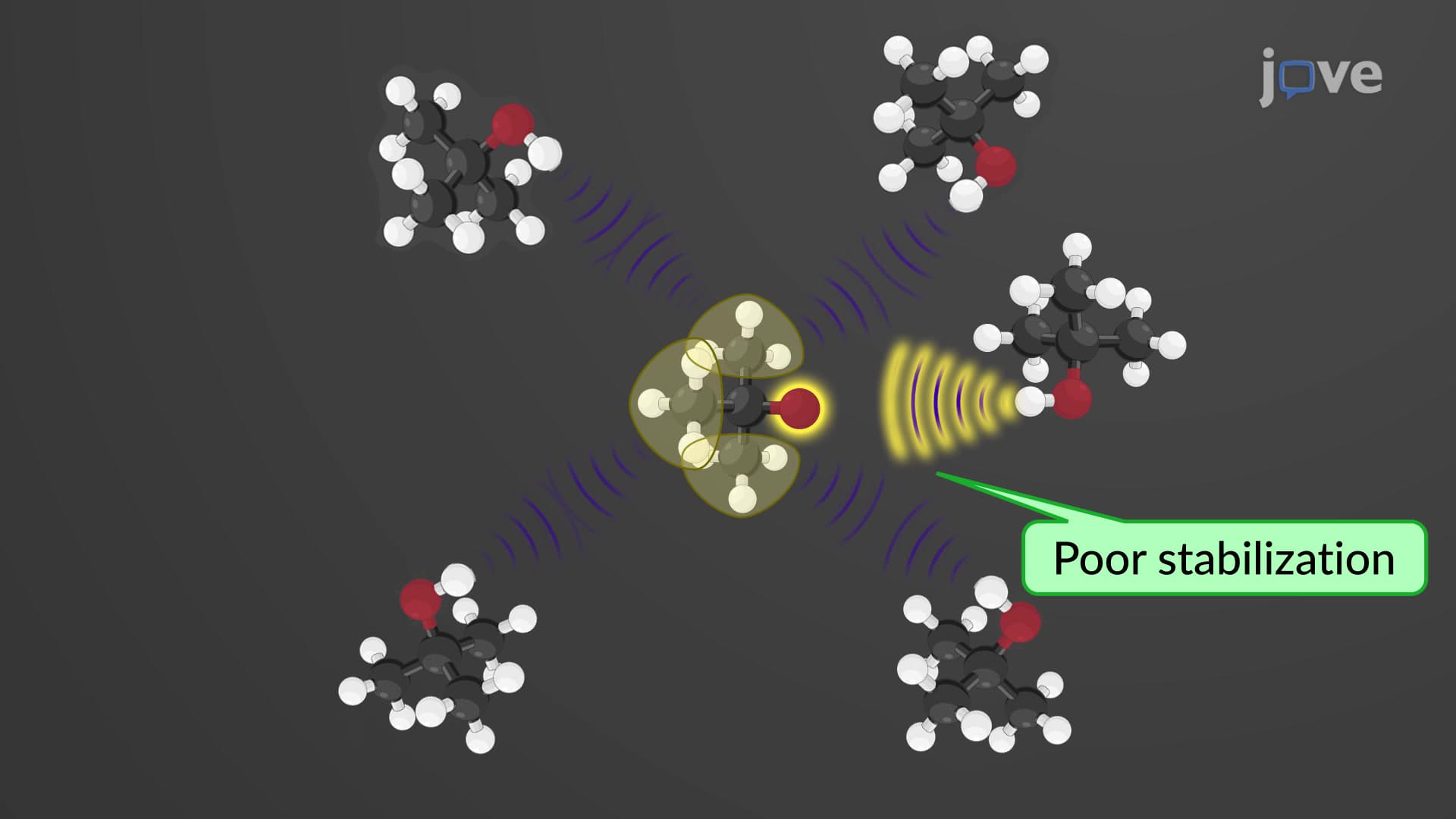
When acids dissociate in polar solvents like water or alcohols, the resulting anions (conjugate bases) become surrounded by solvent molecules. The positive end of polar solvent molecules orient toward the negative charge of the anion, creating stabilizing charge-dipole interactions. This solvation shell effectively disperses the negative charge, making the conjugate base more thermodynamically stable.
The extent of solvation depends critically on molecular accessibility. Smaller, less sterically hindered anions allow more solvent molecules to approach closely, resulting in stronger stabilization. This principle explains why ethoxide ion (from ethanol) experiences extensive solvation, contributing to ethanol's relatively high acidity (pKa = 15.5) among alcohols.
Steric Hindrance and Solvation Efficiency
As molecular bulk increases around the anionic center, fewer solvent molecules can effectively interact with the charge. Isopropoxide ion, with its additional methyl group, experiences reduced solvation compared to ethoxide. This decreased stabilization makes isopropanol a weaker acid than ethanol. The effect becomes even more pronounced with tert-butoxide ion, where three bulky methyl groups severely restrict solvent access, making tert-butanol the weakest acid in this series.
Applications in US Academic and Professional Contexts
Understanding solvating effects proves essential for AP Chemistry students tackling acid-base equilibria problems and organic chemistry mechanisms. Pre-med students encounter these concepts on the MCAT when analyzing biological buffer systems and enzyme active sites. In pharmaceutical research across US companies like Pfizer and Merck, chemists leverage solvating effects to optimize drug formulations, ensuring proper dissolution rates and bioavailability in aqueous biological environments.
Frequently Asked Questions
Solvating effects describe how solvent molecules surround and stabilize dissolved charged particles through attractive interactions. This process significantly impacts chemical properties like acid strength, solubility, and reaction rates. The more effectively a solvent can surround an ion, the more stable that ion becomes in solution.
AP Chemistry frequently tests solvating effects through acid strength comparisons and equilibrium problems. Students analyze how molecular structure affects conjugate base stability and predict relative pKa values. Practice problems often involve ranking alcohols by acidity or explaining solubility patterns based on solvation principles.
Absolutely - solvating effects are fundamental to MCAT success in both general and organic chemistry sections. These concepts underlie reaction mechanisms, solvent effects on reaction rates, and biological system behavior. Strong mastery helps with amino acid properties, enzyme function, and drug-receptor interactions.
US pharmaceutical companies use solvating effects principles to formulate medications with optimal bioavailability. For example, choosing appropriate solvents for drug synthesis affects yield and purity, while tablet formulations consider how excipients influence active ingredient dissolution rates in stomach acid.
Not at all - solvating effects rely primarily on conceptual understanding of molecular interactions rather than complex calculations. Basic knowledge of electronegativity, molecular geometry, and acid-base concepts provides sufficient foundation. Focus on visualizing molecular interactions and charge distributions.
Create comparison charts showing how steric hindrance affects solvation in alcohol series, practice predicting relative acid strengths, and work through mechanism problems involving charged intermediates. Drawing molecular structures with solvation shells helps visualize these invisible interactions during problem-solving.
Solvating effects drive protein folding by influencing how amino acid side chains interact with water. Hydrophobic residues avoid water contact while polar residues seek solvation, creating the complex three-dimensional structures essential for enzyme function and drug binding in human physiology.
Advanced study includes solvent effects in reaction kinetics, ionic strength impacts on equilibria, and supramolecular chemistry. Graduate-level topics explore solvation thermodynamics, computational modeling of solvent-solute interactions, and applications in materials science and nanotechnology research.
Related Micro-courses

7 Concepts
15 Concepts