Loading video…


 7 Concepts
 94.4K views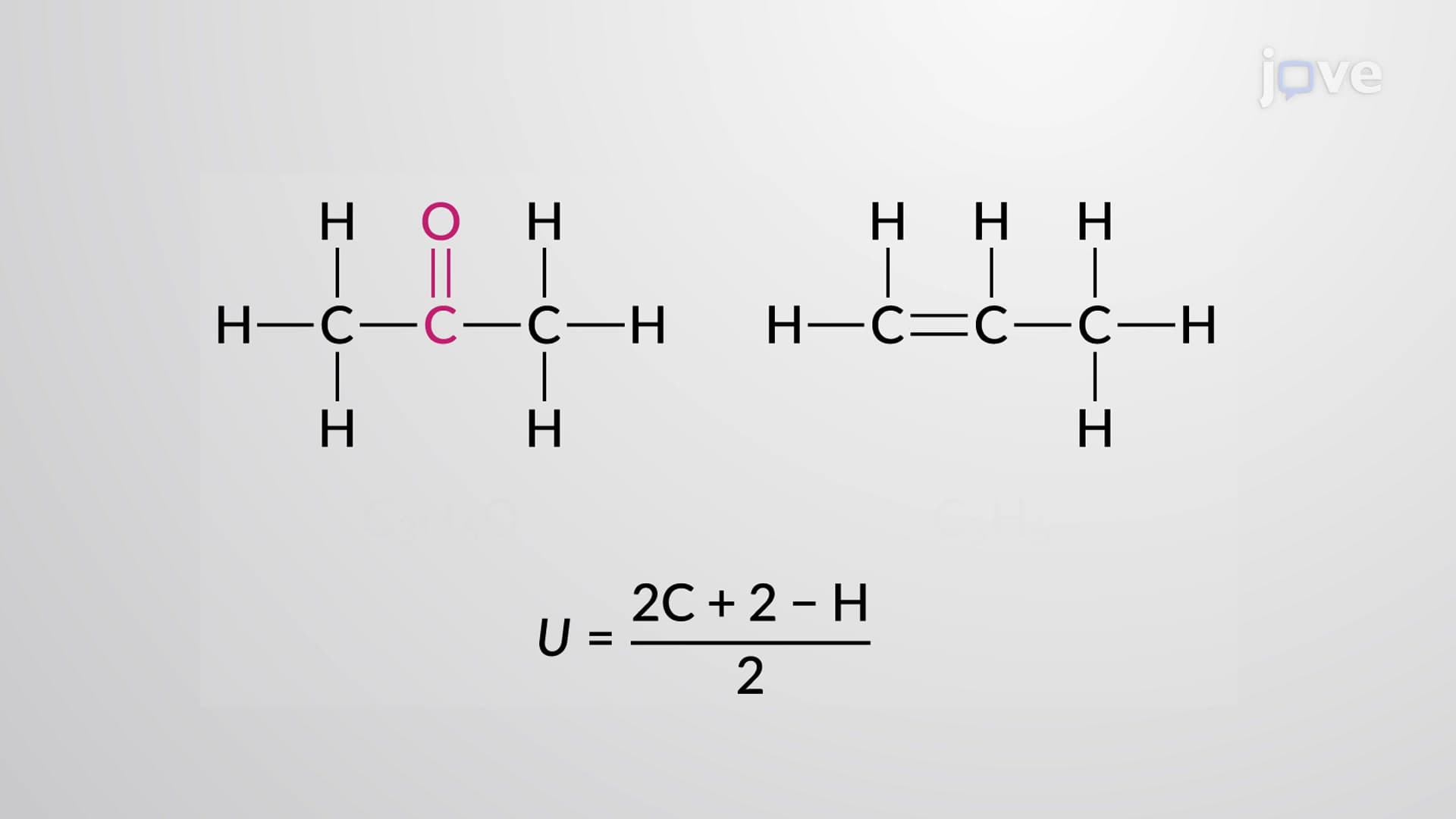

Video Summary: What Is Degree of Unsaturation
Ever wondered why some organic molecules smell different or react uniquely during lab experiments at your high school chemistry class? The degree of unsaturation reveals the hidden structural secrets behind molecular behavior by counting double bonds, triple bonds, and rings in compounds. For example, benzene's distinctive properties in pharmaceutical manufacturing stem from its specific degree of unsaturation value. Watch the full video on JoVE Coach to master this concept with expert-led visuals and step-by-step explanations.
Degree of unsaturation, also known as the index of hydrogen deficiency, serves as a powerful tool for determining molecular structure in organic chemistry. This concept quantifies how many pairs of hydrogen atoms are "missing" compared to a fully saturated hydrocarbon with the same carbon skeleton. Each degree of unsaturation corresponds to either one double bond, one ring, or half of a triple bond.
The fundamental principle stems from alkanes, which represent the most hydrogen-rich hydrocarbons possible. For any alkane with n carbon atoms, the maximum hydrogen count follows the formula 2n + 2. When organic molecules contain fewer hydrogens than this maximum, they possess structural features that create unsaturation.
The standard formula for calculating degrees of unsaturation is: DU = (2C + 2 - H)/2, where C represents carbon atoms and H represents hydrogen atoms. This calculation becomes essential for students preparing for AP Chemistry exams and college organic chemistry courses, where structure determination problems frequently appear.
Consider a practical example: C4H6 has a degree of unsaturation of 2, calculated as (2×4 + 2 - 6)/2 = 2. This molecule could contain two double bonds, one triple bond, two rings, or one double bond plus one ring. Understanding these possibilities proves crucial for pharmaceutical chemists determining drug structures.
When heteroatoms appear in molecular formulas, specific adjustments ensure accurate calculations. Halogens (F, Cl, Br, I) count as hydrogen equivalents since they're monovalent. Oxygen atoms don't affect the calculation because they're divalent. Nitrogen atoms require adding one to the hydrogen count before calculating, accounting for their trivalent nature.
These adjustments become particularly important in pharmaceutical chemistry, where drug molecules often contain multiple heteroatoms. For instance, aspirin (C9H8O4) and other common medications require these modified calculations for accurate structural analysis.
Degree of unsaturation calculations play vital roles in American petroleum refining, where engineers determine hydrocarbon compositions in crude oil. Pharmaceutical companies like Pfizer and Merck routinely use these calculations during drug discovery and quality control processes. Understanding this concept prepares students for MCAT organic chemistry sections and advanced coursework in chemical engineering programs at institutions like MIT and Stanford.
Related Micro-courses