Loading subject page…


161,501 views

Video Summary: Free Radical Chain Reactions and Alkene Polymerization
Ever wonder how the plastic in your water bottle or the rubber in basketball sneakers gets made? Free radical chain reactions drive the polymerization process that transforms simple alkene molecules into the polymers surrounding us daily. From low-density polyethylene packaging to polypropylene car parts manufactured across the US, Free Radical Chain Reactions and Alkene Polymerization represents one of chemistry's most industrially valuable processes. Watch the full video on JoVE Coach to master this concept with expert-led visuals and step-by-step explanations.
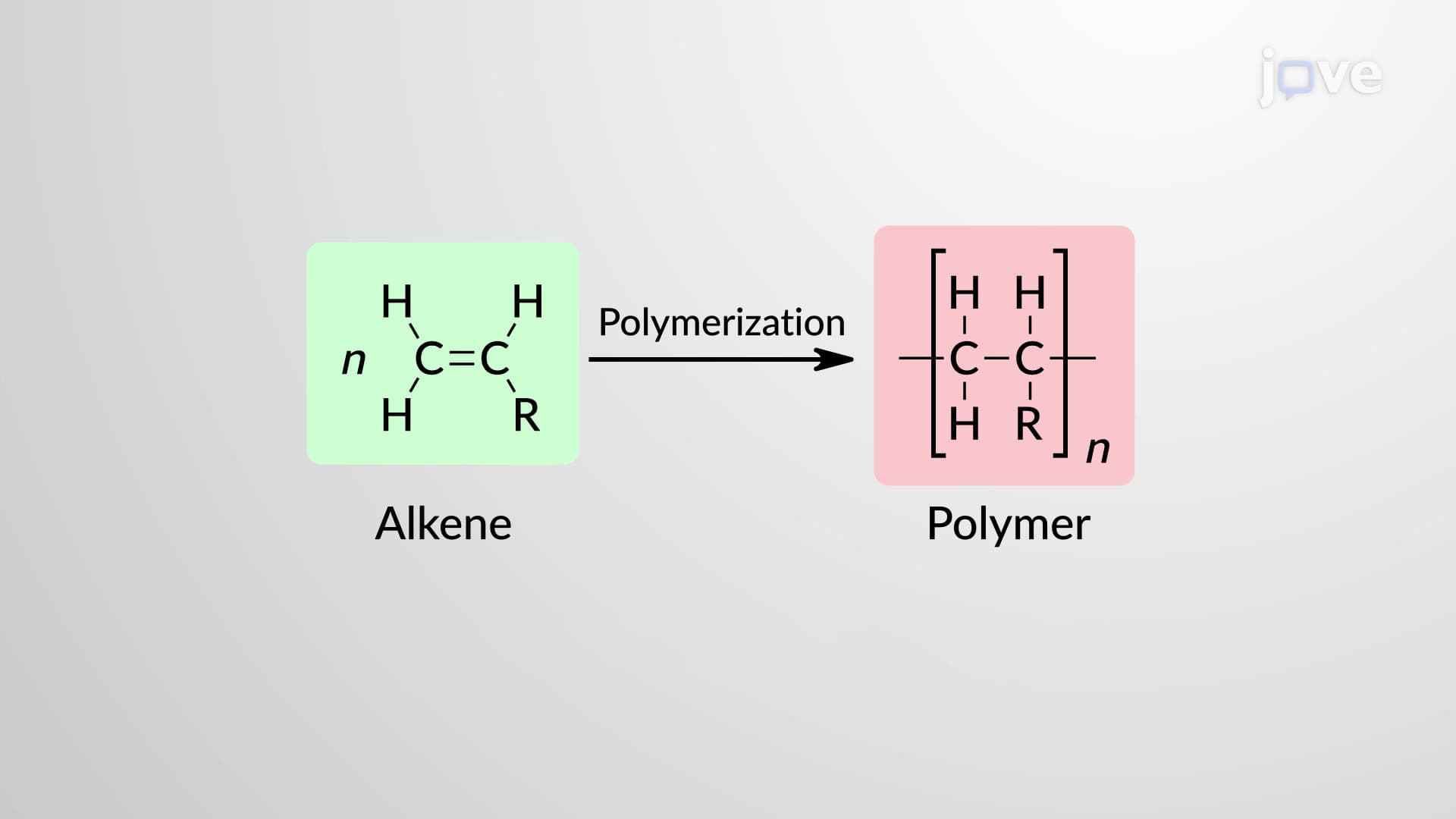
Free radical chain reactions represent the cornerstone mechanism for converting simple alkene monomers into high-molecular-weight polymers that define modern materials science. This process transforms everyday compounds like ethylene and propylene into the plastics, fibers, and elastomers essential to American industry and commerce.
The polymerization journey begins with radical initiation, where specialized compounds generate the reactive species needed to start polymer chain growth. Benzoyl peroxide, a common industrial initiator, undergoes homolytic cleavage of its oxygen-oxygen bond when heated, producing benzoyloxy radicals. These radicals further decompose, releasing phenyl radicals and carbon dioxide. Alternatively, azo initiators like azoisobutyronitrile (AIBN) decompose through entropy-driven pathways, yielding isobutyronitrile radicals and nitrogen gas.
This initiation chemistry appears frequently on AP Chemistry exams and college organic chemistry courses, where students must identify radical-generating conditions and predict decomposition products. Understanding these mechanisms helps explain why polymerization requires specific temperature and light conditions in industrial settings.
Once initiated, chain propagation drives continuous polymer growth through sequential monomer addition. The radical adds across the alkene double bond, generating a new radical site that immediately attacks another monomer molecule. This process exhibits remarkable regioselectivity-monomers add in a head-to-tail fashion to create the most stable, highly substituted radical intermediates.
For propylene polymerization, this selectivity produces polypropylene with consistent structural regularity, explaining why this polymer maintains predictable mechanical properties in applications ranging from automotive components manufactured by Ford and GM to medical devices produced by US companies like Medtronic.
Chain termination occurs through two primary mechanisms that significantly impact final polymer properties. Radical coupling creates head-to-head linkages between growing chains, while hydrogen abstraction generates non-radical products through alpha-hydrogen transfer. In ethylene polymerization, 1,5-hydrogen abstraction creates branched structures through a chair-like transition state, producing the low-density polyethylene (LDPE) used in grocery bags and food packaging across American supermarkets.
This branching concept frequently challenges students on MCAT organic chemistry sections, where understanding structure-property relationships becomes crucial for predicting material behavior.
Related Micro-courses