Loading video…


 15 Concepts
 161.5K views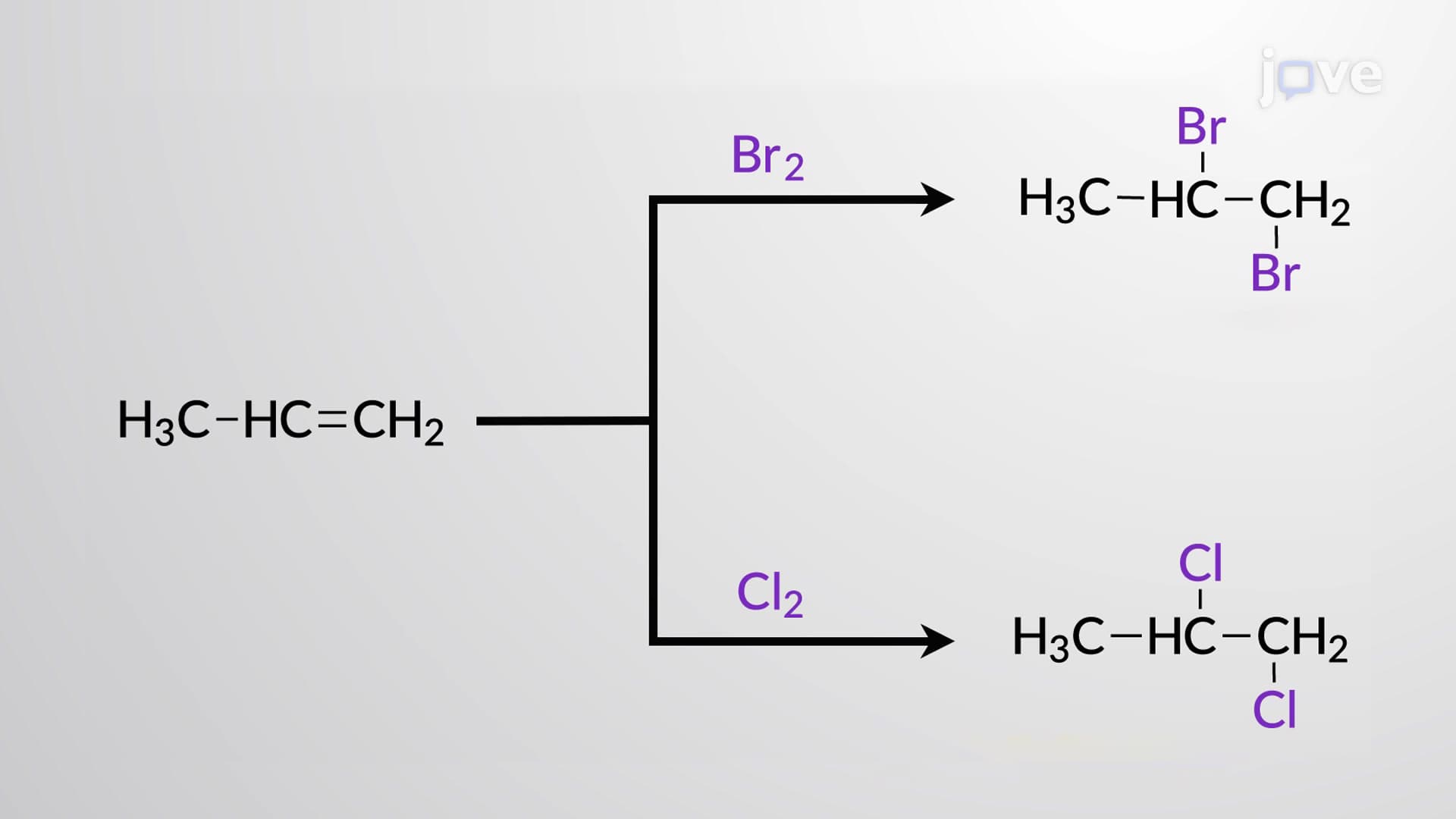

Video Summary: What are Halogenation of Alkenes
Ever wonder why bromine water changes from deep red to colorless when testing for double bonds in organic chemistry lab? Halogenation alkenes reactions explain this dramatic color change that's become a standard qualitative test in US high school and college chemistry courses. This fundamental organic chemistry process involves adding halogens like bromine or chlorine across alkene double bonds, creating useful 1,2-dihalide products essential for pharmaceutical synthesis at companies like Pfizer and Merck. What are halogenation of alkenes becomes clear through understanding the unique bromonium ion mechanism that ensures anti-addition stereochemistry. Watch the full video on JoVE Coach to master this concept with expert-led visuals and step-by-step explanations.
Halogenation of alkenes represents one of the most synthetically important addition reactions in organic chemistry, involving the addition of molecular halogens (X₂) across carbon-carbon double bonds. This transformation converts alkenes into vicinal dihalides (1,2-dihalides), compounds where two halogen atoms occupy adjacent carbon atoms. The reaction proceeds through a unique mechanism that sets it apart from other electrophilic addition reactions, making it a cornerstone topic in AP Chemistry, college organic chemistry courses, and MCAT preparation.
The halogenation alkenes mechanism begins when the electron-rich π-bond of an alkene interacts with molecular bromine, inducing polarization of the Br-Br bond. Unlike simple carbocation intermediates formed in other addition reactions, halogenation proceeds through a cyclic bromonium ion intermediate. This three-membered ring structure contains a positively charged bromine atom bonded to both carbons of the former double bond.
The bromonium ion's stability exceeds that of typical carbocations because all atoms achieve filled octets through covalent bonding. However, ring strain and the positive charge on the electronegative bromine atom create electrophilic character, making the intermediate susceptible to nucleophilic attack by the bromide ion (Br⁻) generated during the initial polarization step.
The geometry of the bromonium ion dictates the stereochemical outcome through enforced anti-addition. The cyclic intermediate blocks one face of the molecule, forcing the incoming nucleophile to approach from the opposite side. This backside attack occurs at the antibonding orbital, leading exclusively to trans-dihalide products rather than cis isomers.
This stereoselectivity proves crucial for synthetic applications in pharmaceutical manufacturing. For example, when US pharmaceutical companies synthesize steroid intermediates or prepare chiral building blocks, the predictable anti-addition pattern allows chemists to control product stereochemistry reliably.
The halogenation of alkenes definition explained extends beyond academic study to practical laboratory applications. The bromine test serves as a standard qualitative method for detecting C=C bonds in unknown organic compounds. When bromine water contacts an alkene, the characteristic red-orange color disappears as bromine adds across the double bond, providing immediate visual confirmation of unsaturation.
This test appears frequently on AP Chemistry exams and college organic chemistry assessments, where students must predict reaction outcomes and explain color changes. Understanding this concept proves essential for success on standardized tests like the MCAT, where organic chemistry comprises approximately 15% of the chemical and physical foundations section.
Related Micro-courses