Loading video…


 15 Concepts
 161.5K views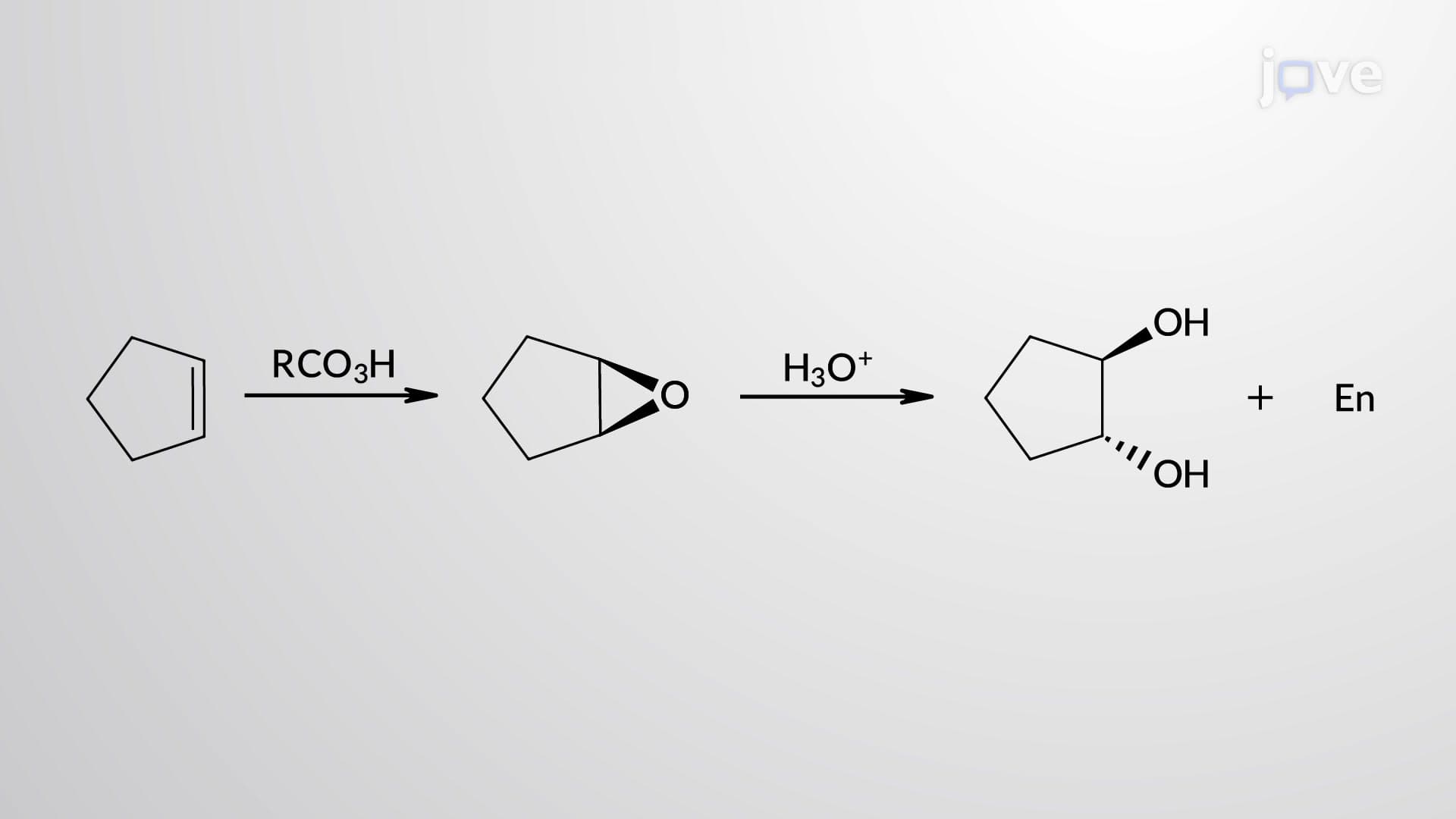

Video Summary: Oxidation of Alkenes Anti Dihydroxylation Explained
Ever wonder how pharmaceutical companies create life-saving drugs with precise 3D structures? Oxidation alkenes anti dihydroxylation is a powerful organic chemistry reaction that adds two hydroxyl groups to opposite sides of a double bond, creating molecules essential in drug manufacturing. For instance, this reaction helps produce intermediates for cardiovascular medications at companies like Pfizer in New York. Understanding oxidation of alkenes anti dihydroxylation explained reveals how chemists control molecular geometry with surgical precision. Watch the full video on JoVE Coach to master this concept with expert-led visuals and step-by-step explanations.
Oxidation of alkenes anti dihydroxylation represents a cornerstone reaction in organic synthesis, enabling chemists to introduce two hydroxyl groups on opposite faces of a carbon-carbon double bond. This transformation occurs through a two-step process: initial epoxide formation followed by acid-catalyzed ring opening, ultimately yielding trans diols with predictable stereochemistry.
The reaction begins when an alkene encounters a peroxycarboxylic acid, such as m-chloroperoxybenzoic acid (mCPBA), commonly used in undergraduate laboratories across US universities. The alkene's π electrons attack the electrophilic oxygen of the peracid, breaking the O-O bond through a concerted mechanism. This creates a highly strained three-membered epoxide ring, where the oxygen delivery occurs to the same face of the alkene (syn addition initially).
Students preparing for the MCAT or AP Chemistry exams should note that epoxides possess significant ring strain-approximately 27 kcal/mol-making them exceptionally reactive toward nucleophiles. This reactivity drives the subsequent ring-opening step that defines the overall stereochemical outcome.
The second phase involves protonation of the epoxide oxygen under acidic conditions, creating a more electrophilic carbon framework. Water then attacks the epoxide through an SN2 mechanism, causing ring opening with stereochemical inversion. Since the initial epoxide forms on one face and water attacks from the opposite face, the final product exhibits anti stereochemistry-both hydroxyl groups end up on opposite sides of the original alkene plane.
For college organic chemistry courses, understanding regioselectivity becomes crucial. Primary and secondary carbons favor attack at the less-substituted position due to steric factors, while tertiary carbons experience attack at the more-substituted site due to electronic stabilization of the developing positive charge.
Major pharmaceutical companies utilize this reaction for synthesizing complex drug intermediates. For example, companies in New Jersey's pharmaceutical corridor employ anti dihydroxylation in creating chiral building blocks for HIV protease inhibitors and cardiovascular medications. The reaction's predictable stereochemistry makes it invaluable for producing single-enantiomer drugs required by FDA regulations.
Related Micro-courses