Loading subject page…


161,502 views

Video Summary: Oxidative Cleavage of Alkenes Ozonolysis Explained
Ever wonder how pharmaceutical companies create the aldehydes and ketones needed for life-saving medications? Oxidative cleavage of alkenes ozonolysis breaks carbon-carbon double bonds completely, transforming single molecules into two distinct carbonyl compounds. This powerful reaction uses ozone gas followed by reducing agents like dimethyl sulfide to cleave alkenes precisely. Companies like Pfizer rely on ozonolysis to synthesize complex drug intermediates in their New Jersey facilities. Watch the full video on JoVE Coach to master this concept with expert-led visuals and step-by-step explanations.
Oxidative cleavage of alkenes ozonolysis represents one of the most powerful methods for completely breaking carbon-carbon double bonds in organic chemistry. Unlike other oxidation reactions that simply add functional groups, ozonolysis literally cuts molecules in half, making it invaluable for structural determination and synthetic applications.
The reaction proceeds through a well-defined two-step mechanism. Initially, ozone (O₃) undergoes electrophilic addition across the alkene double bond, forming an unstable molozonide intermediate. This five-membered ring quickly rearranges through a [3+2] cycloaddition to produce a more stable ozonide. The ozonide's stability allows chemists to isolate and characterize it, though it remains potentially explosive and requires careful handling.
The choice of workup conditions dramatically influences the final products. Reductive workup using dimethyl sulfide (DMS) or zinc/acetic acid preserves aldehydes while converting the ozonide to carbonyl compounds. This selectivity makes reductive ozonolysis particularly valuable when aldehydes are the desired products.
Conversely, oxidative workup with hydrogen peroxide converts any aldehyde products to carboxylic acids while leaving ketones unchanged. This distinction proves crucial in synthetic planning-pharmaceutical chemists at companies like Merck use oxidative workup when they need carboxylic acid functionalities for subsequent amide bond formation.
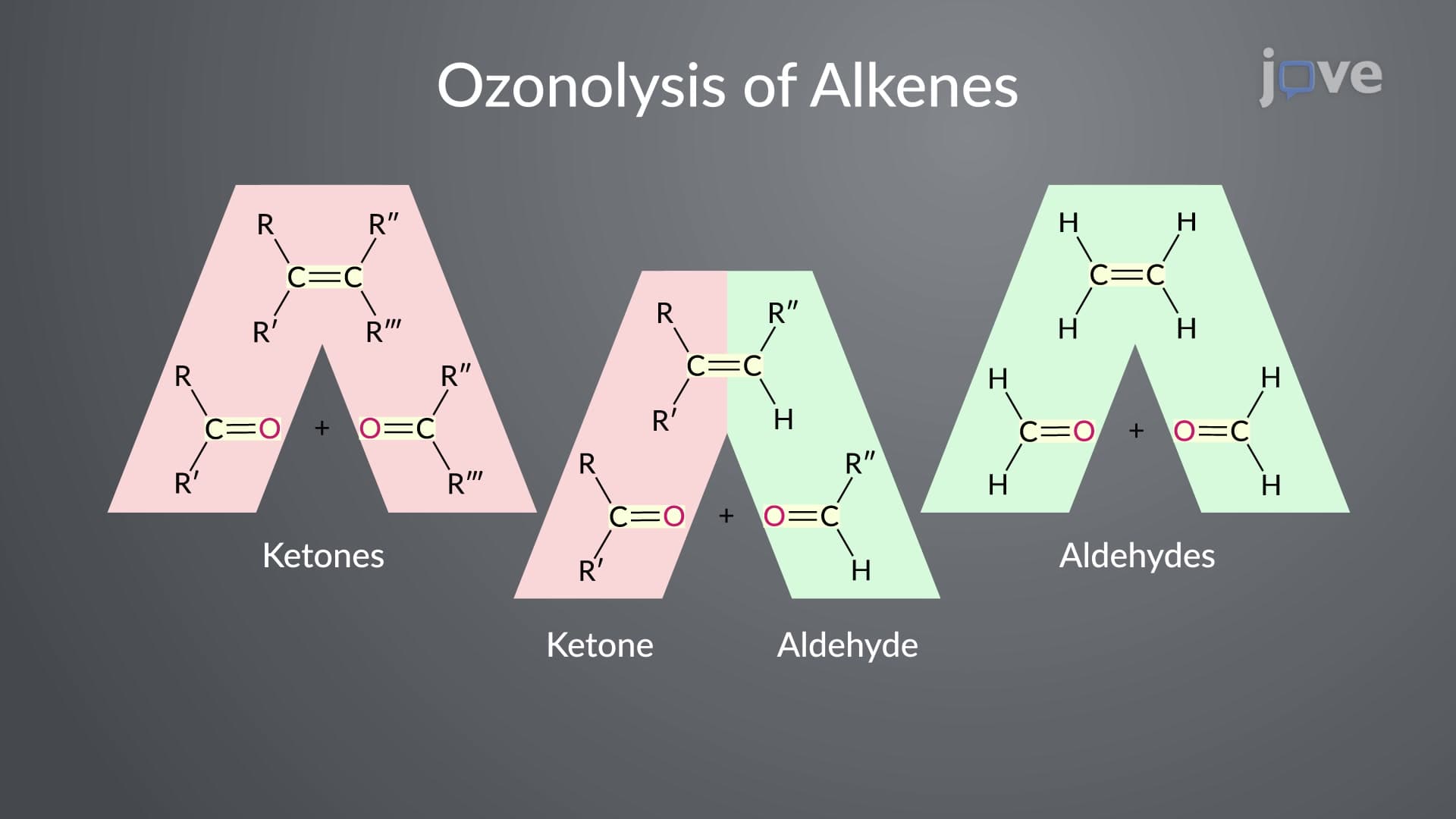
The substitution pattern of the starting alkene directly determines the ozonolysis products. Monosubstituted alkenes like 1-butene yield one aldehyde (formaldehyde) and one higher aldehyde (propionaldehyde). Disubstituted alkenes produce various combinations of aldehydes and ketones depending on their substitution patterns.
Trisubstituted alkenes, such as 2-methyl-2-butene, generate one ketone and one aldehyde. Tetrasubstituted alkenes exclusively form ketones. This predictable pattern makes ozonolysis an excellent tool for structural elucidation-organic chemistry students frequently encounter ozonolysis problems on AP Chemistry exams and college organic chemistry midterms.
Beyond academic exercises, ozonolysis serves critical roles in pharmaceutical manufacturing. The vitamin industry uses ozonolysis to create key intermediates for vitamin A synthesis, while fine chemical companies employ it for producing aldehydes used in fragrance manufacturing. Students preparing for the MCAT often encounter ozonolysis in the context of steroid hormone biosynthesis, where similar oxidative cleavage reactions occur naturally in biological systems.
Related Micro-courses