Loading subject page…


161,501 views


Video Summary: Reduction of Alkenes Catalytic Hydrogenation Explained
Ever wonder how pharmaceutical companies create life-saving medications like cholesterol-lowering statins? The reduction of alkenes catalytic hydrogenation transforms unsaturated compounds into saturated ones by adding hydrogen across double bonds using metal catalysts. This process is essential in manufacturing drugs at companies like Pfizer and Johnson & Johnson, where precise molecular modifications determine therapeutic effectiveness. Understanding reduction of alkenes catalytic hydrogenation explained helps students grasp fundamental organic chemistry transformations. Watch the full video on JoVE Coach to master this concept with expert-led visuals and step-by-step explanations.
Reduction of alkenes catalytic hydrogenation represents one of organic chemistry's most important transformations, converting alkenes (C=C) into alkanes (C-C) through hydrogen addition. This process requires transition metal catalysts because the direct reaction between alkenes and hydrogen gas faces an enormous energy barrier-making it thermodynamically unfavorable under normal conditions.
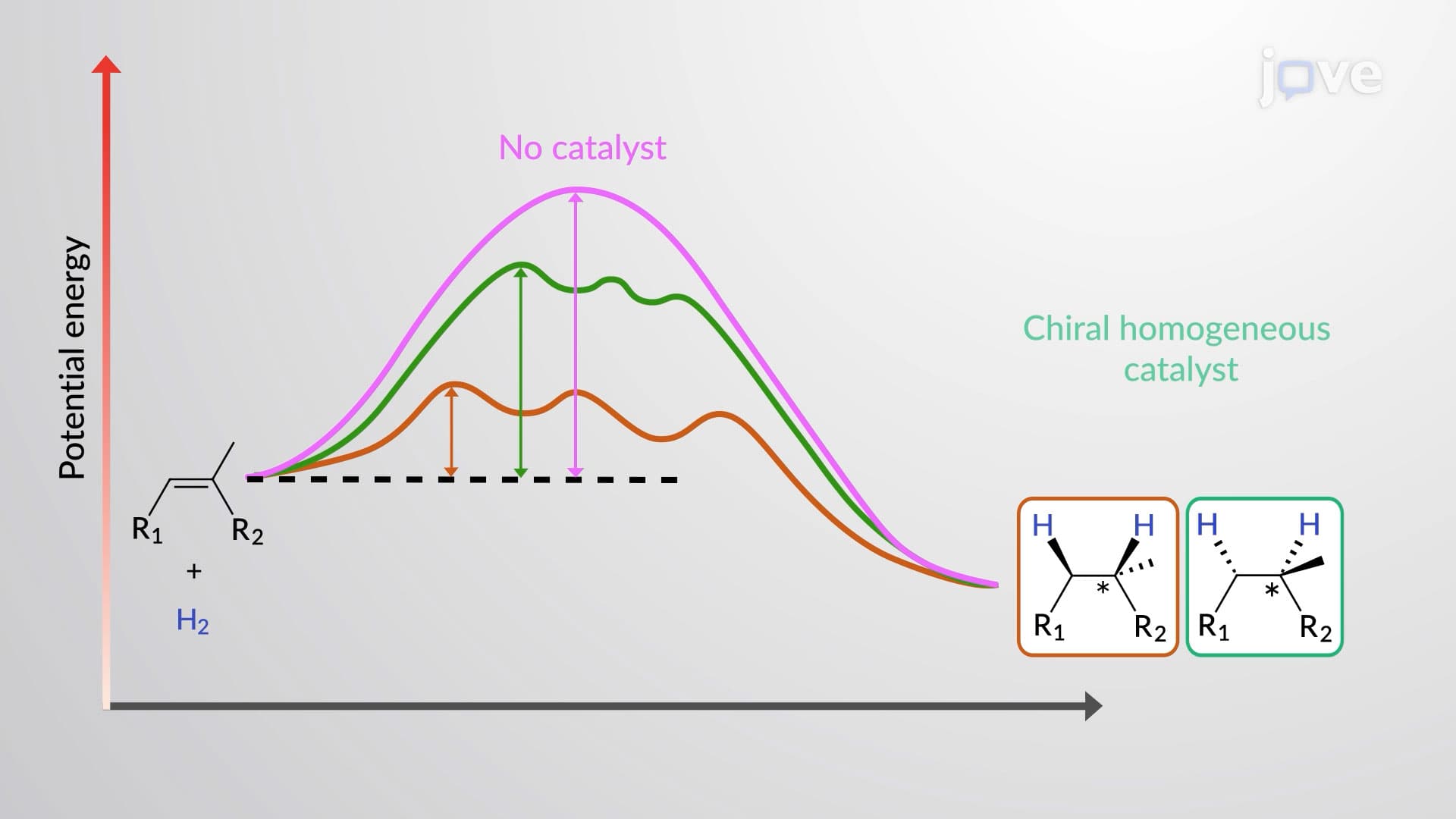
The catalyst's role cannot be overstated. Heterogeneous catalysts like palladium on carbon (Pd/C), platinum oxide (PtO₂), or Raney nickel provide an alternative reaction pathway with significantly lower activation energy. These finely divided metals, typically dispersed on inert supports like activated charcoal, create active surface sites where both hydrogen molecules and alkenes can adsorb simultaneously.
The hydrogenation mechanism proceeds through several distinct steps. Initially, molecular hydrogen (H₂) adsorbs onto the metal surface, where the catalyst cleaves the H-H bond to generate individual hydrogen atoms. Simultaneously, the alkene coordinates to the metal surface through its π-electrons, positioning itself for hydrogen insertion.
The crucial aspect is syn stereochemistry-both hydrogen atoms add to the same face of the double bond. This occurs because once the alkene coordinates to the catalyst surface, both hydrogen atoms transfer sequentially from the same side. For students preparing for the AP Chemistry exam or college organic chemistry courses, understanding this syn addition pattern is essential for predicting stereoisomeric outcomes.
When catalytic hydrogenation creates new chiral centers, the syn addition mechanism dramatically limits stereoisomer formation. Instead of producing all four possible stereoisomers, only one pair of enantiomers typically forms, making the reaction stereospecific.
Steric hindrance plays a critical role in determining which face of the alkene approaches the catalyst. Consider α-pinene, a naturally occurring compound found in pine resins used in US turpentine production. The methyl group attached to the four-membered ring creates significant steric hindrance on one face, forcing hydrogen insertion exclusively from the less hindered bottom face. This selectivity demonstrates how molecular architecture influences reaction outcomes.
Catalytic hydrogenation finds extensive use in pharmaceutical manufacturing across the United States. Companies like Merck and Abbott Laboratories employ this technology to produce saturated drug intermediates with precise stereochemistry. For MCAT preparation, students should recognize hydrogenation's role in biochemical processes, particularly in fatty acid metabolism where unsaturated fats undergo reduction.
In academic settings, mastering this concept prepares students for advanced topics like asymmetric hydrogenation using chiral catalysts-a Nobel Prize-winning advancement that enables enantioselective synthesis of pharmaceutical compounds.
Related Micro-courses