Loading subject page…


147,911 views

Video Summary: Nucleophilic Aromatic Substitution Elimination Addition Explained
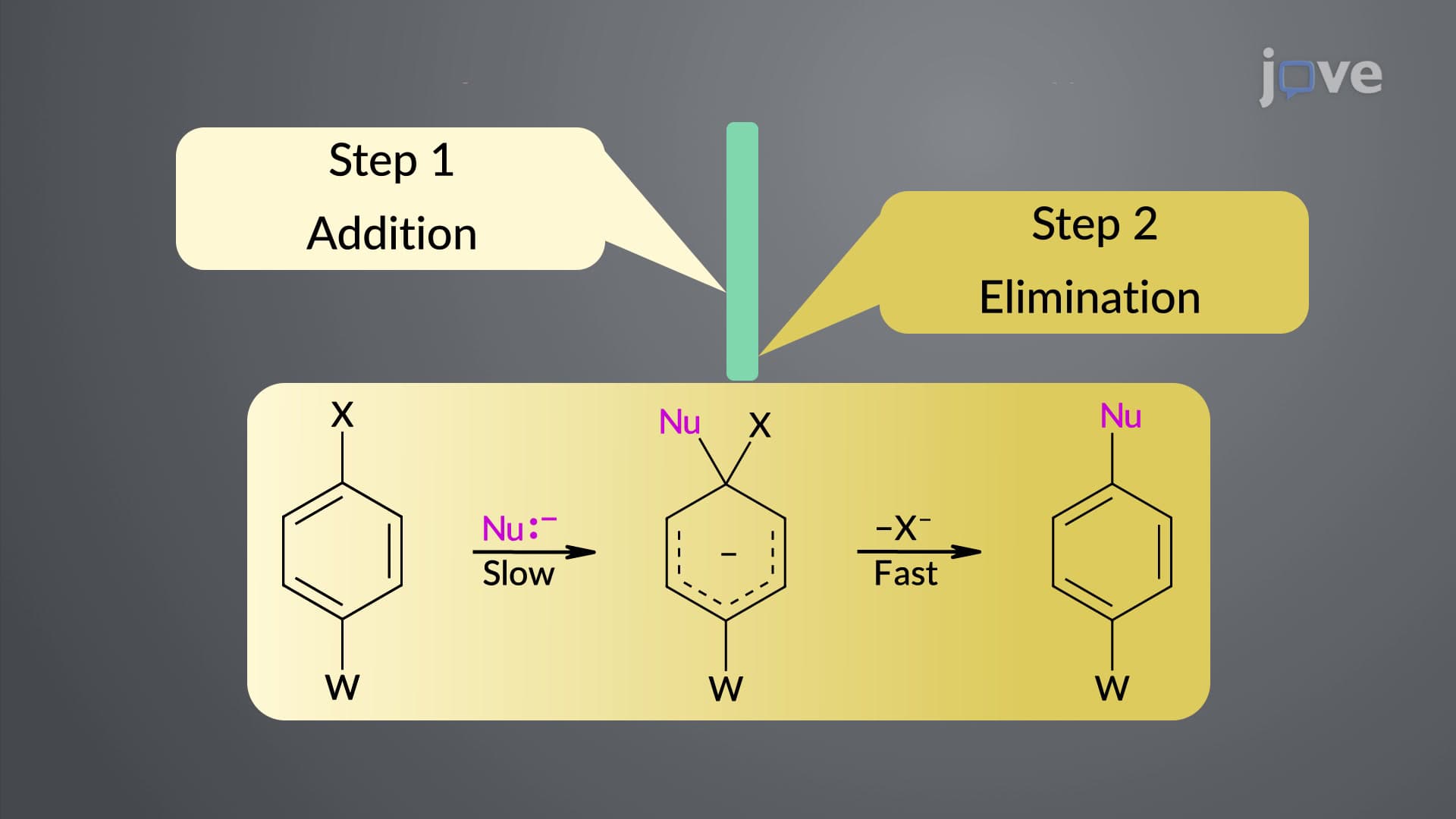
Ever wonder why certain benzene reactions require extreme conditions like 300°C temperatures? Nucleophilic aromatic substitution elimination addition explains this puzzling behavior through a fascinating benzyne intermediate mechanism. Unlike typical aromatic substitutions used in pharmaceutical manufacturing at companies like Pfizer, this process involves eliminating a halide to create a highly strained triple bond, followed by nucleophile addition at either reactive carbon. Watch the full video on JoVE Coach to master this concept with expert-led visuals and step-by-step explanations.
Nucleophilic aromatic substitution elimination addition represents one of organic chemistry's most intriguing mechanisms, explaining how unreactive halobenzenes can undergo substitution under extreme conditions. Unlike electron-deficient aromatic rings that readily accept nucleophiles, simple halobenzenes lack activating groups, making direct nucleophilic attack thermodynamically unfavorable.
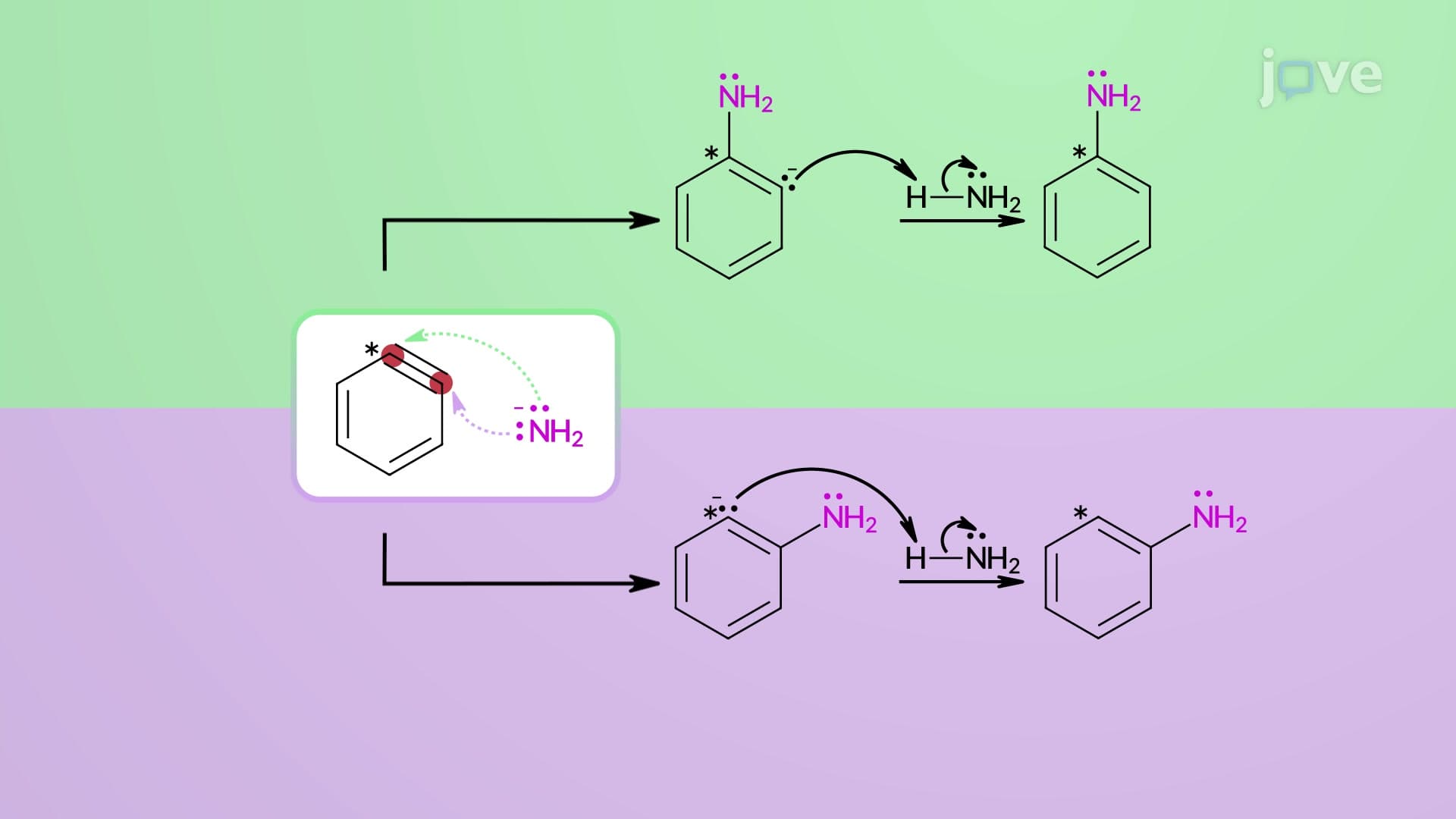
The key to understanding this mechanism lies in the benzyne intermediate-a highly reactive species containing a triple bond within a six-membered ring. This unusual structure creates enormous ring strain because the linear geometry of a triple bond conflicts with benzene's preferred 120° bond angles. The resulting sp2-sp2 orbital overlap is inefficient, making benzyne approximately 200 kJ/mol less stable than benzene itself.
Students preparing for the MCAT or AP Chemistry exam should recognize that this strain energy drives the intermediate's exceptional reactivity. Unlike normal alkynes, benzyne's triple bond readily undergoes addition reactions to relieve structural tension.
The reaction begins when a strong base, typically sodium amide (NaNH2), abstracts a proton adjacent to the halogen substituent. This deprotonation creates a carbanion with the negative charge localized in an sp2 orbital. The subsequent elimination of halide ion forms the strained benzyne intermediate through a concerted or near-concerted process.
Isotopic labeling experiments provide compelling evidence for this mechanism. When researchers use deuterium-labeled starting materials, they observe approximately equal amounts of two products, confirming that nucleophiles attack both ends of the triple bond with similar probability.
This mechanism appears frequently in pharmaceutical synthesis, particularly when harsh conditions are economically viable for high-value products. For example, certain antipsychotic drug precursors utilize similar elimination-addition sequences in their manufacturing processes.
College organic chemistry courses and standardized exams often test students' ability to predict products from isotopic labeling studies and explain unusual reactivity patterns in aromatic systems.
Related Micro-courses