Loading…
Loading video…

43,213 views
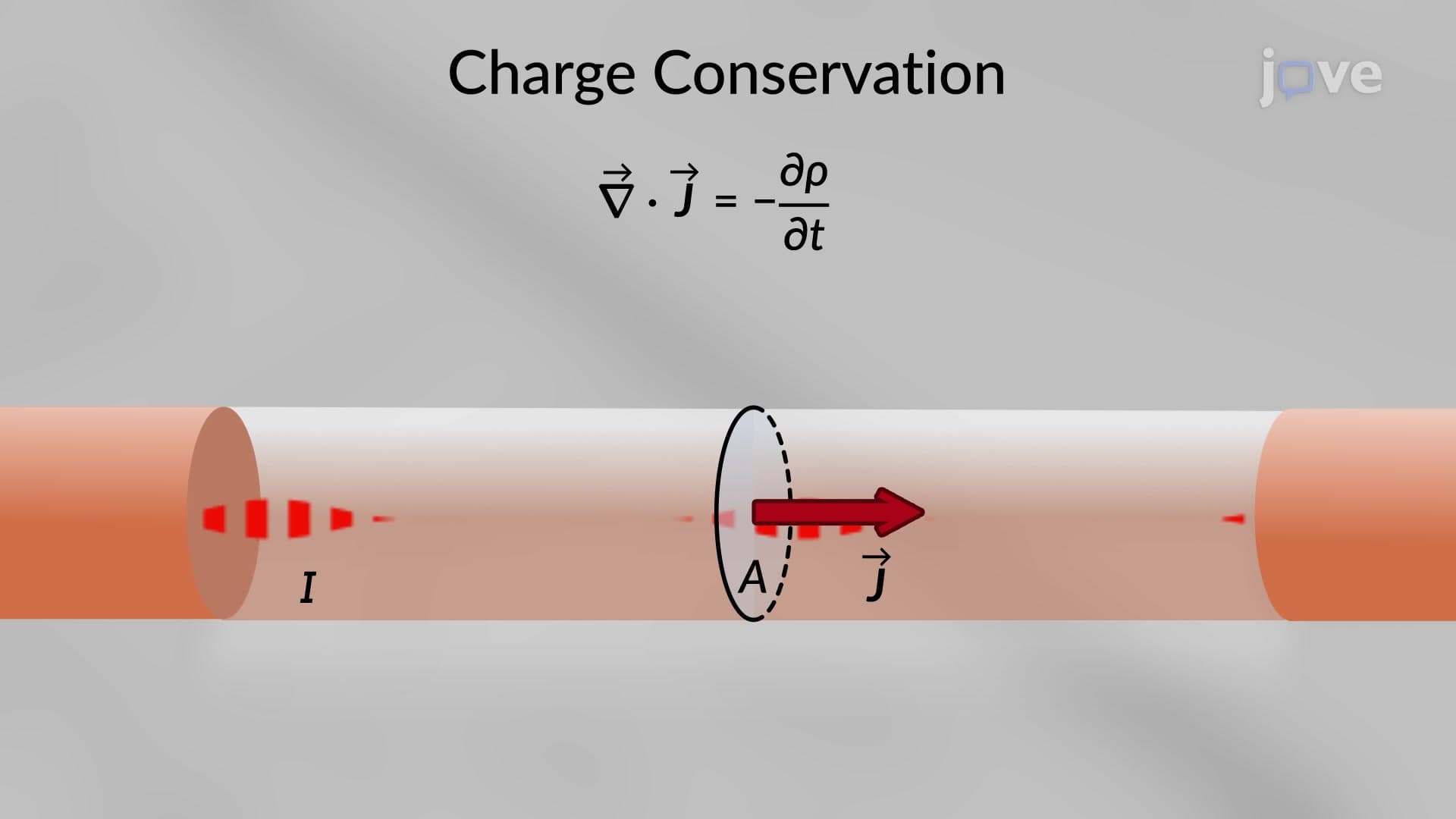
Ever wonder how engineers ensure water flows consistently through the pipes in New York City's massive distribution system? The energy line and hydraulic gradient line principles work hand-in-hand with fundamental conservation laws to govern fluid behavior in complex networks. The continuity equation serves as the mathematical foundation for charge conservation in electrical systems, stating that current flowing out of any volume must equal the rate of charge decrease within that volume. This concept applies directly to analyzing circuit behavior in power grids across states like California and Texas. Watch the full video on JoVE Coach to master this concept with expert-led visuals and step-by-step explanations.
The continuity equation represents one of the most fundamental conservation laws in physics, directly connecting current flow to charge conservation. This mathematical statement emerges from a simple yet profound principle: charge cannot be created or destroyed, only moved from one location to another. In electrical systems, this translates to a precise relationship between the current flowing out of any given region and how the charge density within that region changes over time.
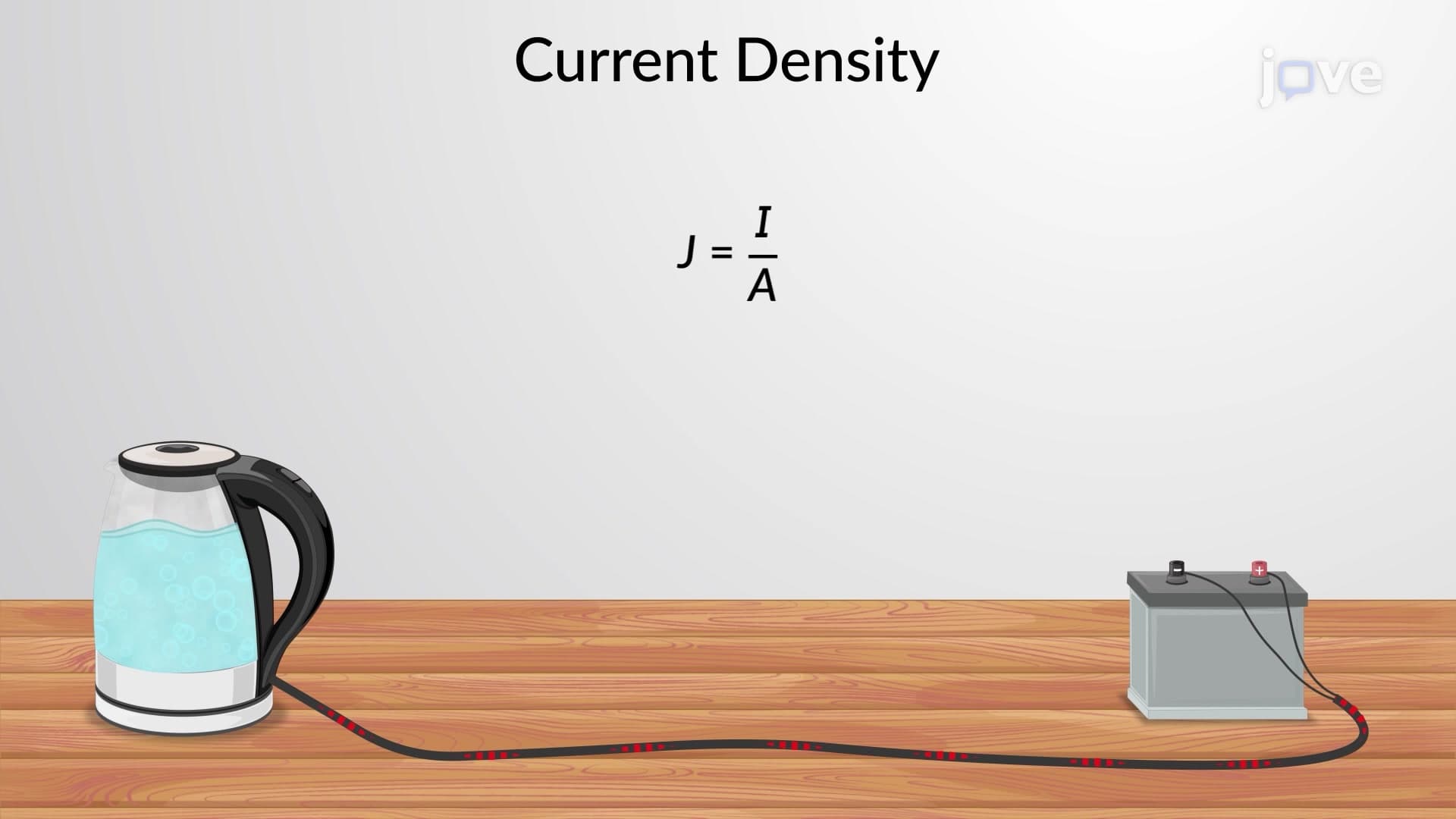
Current density (J) measures the amount of electric current flowing through a unit area perpendicular to the flow direction, typically expressed in amperes per square meter (A/m²). When engineers at companies like General Electric design electrical systems, they must account for how current distributes across different cross-sectional areas of conductors. The total current through any surface equals the surface integral of current density over that area.
The continuity equation emerges through careful application of vector calculus principles. Starting with charge conservation, the total current flowing outward from any closed surface must equal the rate at which charge decreases inside that volume. This physical principle, when expressed mathematically using the divergence theorem, transforms a surface integral into a volume integral.
The Leibniz integral rule plays a crucial role in this derivation, allowing us to move the time derivative inside the volume integral when dealing with charge density as a function of space and time. Students preparing for AP Physics C: Electricity and Magnetism or college-level electromagnetism courses encounter this mathematical technique frequently. The final result, ∇·J = -∂ρ/∂t, elegantly captures how current density divergence relates to charge density changes.
For steady currents—situations where charge density remains constant over time—the continuity equation simplifies dramatically. The time derivative of charge density becomes zero, leading to ∇·J = 0. This condition appears throughout electrical engineering applications, from power transmission systems operated by utilities like Con Edison in New York to electronic circuit design at semiconductor companies such as Intel in California.
Understanding this steady-state condition proves essential for students tackling problems on the MCAT's physics section or engineering coursework. When current density divergence equals zero, it means the same amount of current entering any region must also exit that region, ensuring no charge accumulation occurs anywhere in the system.
Frequently Asked Questions
The continuity equation mathematically expresses charge conservation, stating that current flowing out of any volume equals the rate of charge decrease within that volume. It's fundamental to understanding electrical circuits, electromagnetic theory, and appears frequently on standardized tests like the MCAT and AP Physics C exams. This equation forms the basis for analyzing complex electrical systems from household wiring to power grid networks.
AP Physics C often tests continuity equation concepts through circuit analysis problems and electromagnetic field questions. Students might encounter questions about current density calculations, steady-state current conditions, or applications to Kirchhoff's current law. The equation frequently appears in free-response questions requiring mathematical derivations or practical applications to real-world electrical systems.
Current measures total charge flow through a surface (measured in amperes), while current density represents current per unit area (A/m²). Current density provides more detailed information about how current distributes across different regions of a conductor. On MCAT physics passages, this distinction often appears in questions about nerve conduction or bioelectrical phenomena.
The continuity equation governs current flow in everything from smartphone chargers to electric vehicle charging stations across the United States. For example, when Tesla Supercharger stations distribute power to multiple vehicles simultaneously, the continuity equation ensures current conservation throughout the charging network. This principle also applies to household electrical panels distributing power to different circuits.
While the mathematical derivation involves vector calculus, the core concept is intuitive: charge cannot disappear or appear from nowhere. Students comfortable with basic calculus from AP Calculus AB or BC can grasp the essential ideas. Focus first on understanding the physical principle, then gradually work through the mathematical formulation with practice problems.
Start by practicing current density calculations with simple geometric shapes like cylinders and rectangular conductors. Work through steady-state problems first before tackling time-varying scenarios. Create visual diagrams showing current flow directions and use dimensional analysis to check your mathematical results. Practice with past AP Physics C or college electromagnetism exams for realistic problem formats.
The continuity equation provides essential groundwork for Maxwell's equations, electromagnetic wave propagation, and quantum mechanics current probability densities. Students planning to study electrical engineering or physics at universities like MIT or Stanford will encounter this principle throughout their coursework. It also connects to fluid dynamics through analogous conservation principles.
Electrical engineers at companies like Lockheed Martin use continuity principles for aerospace electrical systems design. Biomedical engineers applying to medical device companies rely on these concepts for understanding neural signal propagation. Power systems engineers at utilities like Pacific Gas & Electric use continuity equation principles for grid stability analysis and load distribution calculations.
Related Micro-courses


Related Subjects
 Math Fundamentals 11 micro-courses›
 Statistics 17 micro-courses›