Loading subject page…


1,097,518 views

Video Summary: Enzyme Kinetics Reaction Rates and Mechanisms
Did you know that a single enzyme molecule can catalyze thousands of reactions per second? Enzyme kinetics: reaction rates reveal how these biological catalysts work at the molecular level. Consider how digestive enzymes like pepsin in your stomach must work efficiently across varying food concentrations to break down proteins from a light snack or Thanksgiving feast. Understanding Enzyme Kinetics: Reaction Rates and Mechanisms helps explain this remarkable adaptability through measurable parameters like Vmax and Km values. Watch the full video on JoVE Coach to master this concept with expert-led visuals and step-by-step explanations.
Enzyme Kinetics: Reaction Rates and Mechanisms represents one of biochemistry's most quantitative and practical concepts. At its core, enzyme kinetics examines how quickly enzymes convert substrates into products under varying conditions. This field emerged from the groundbreaking work of Leonor Michaelis and Maud Menten at Johns Hopkins University, whose 1913 research established the mathematical framework still used today.
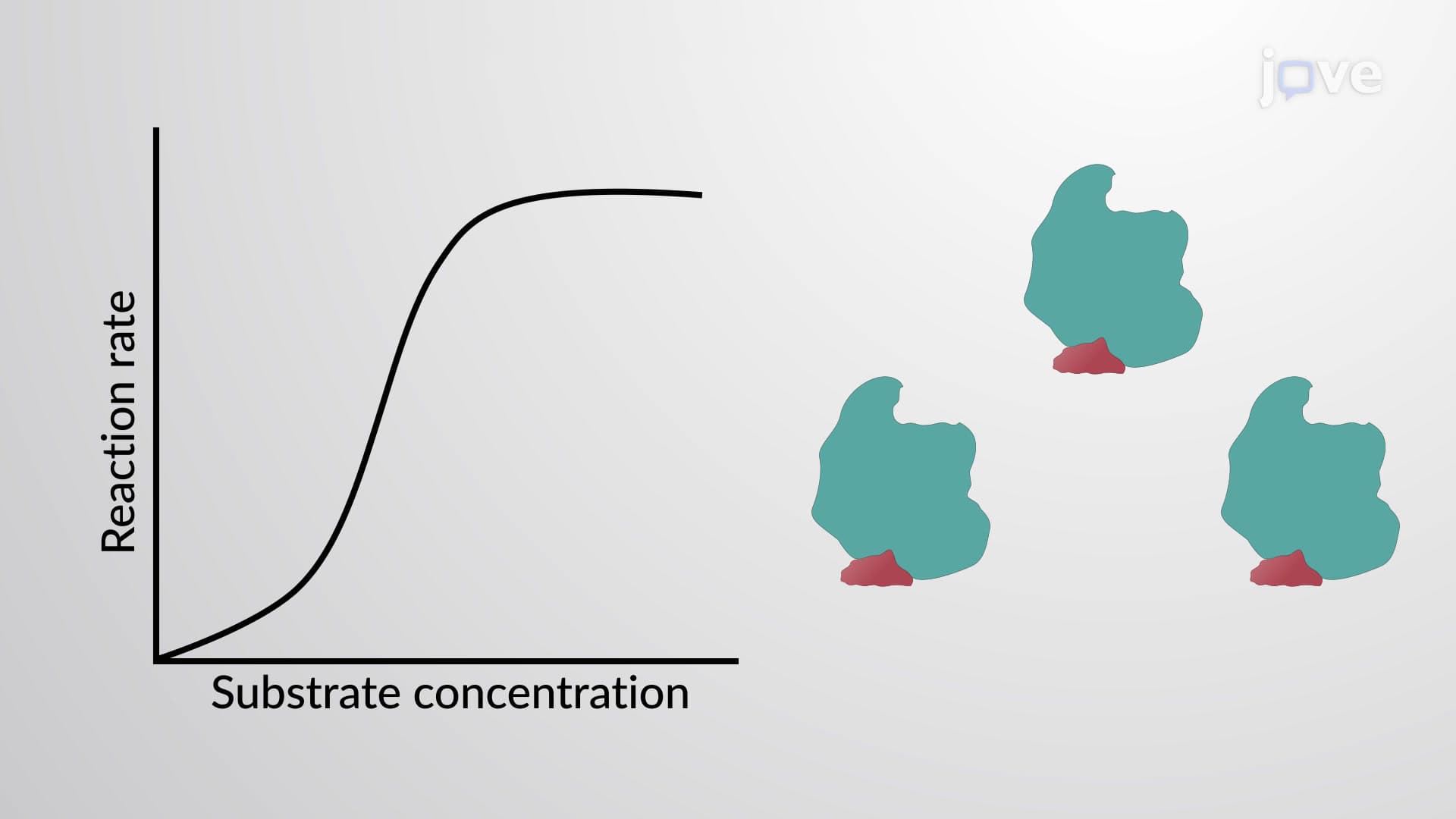
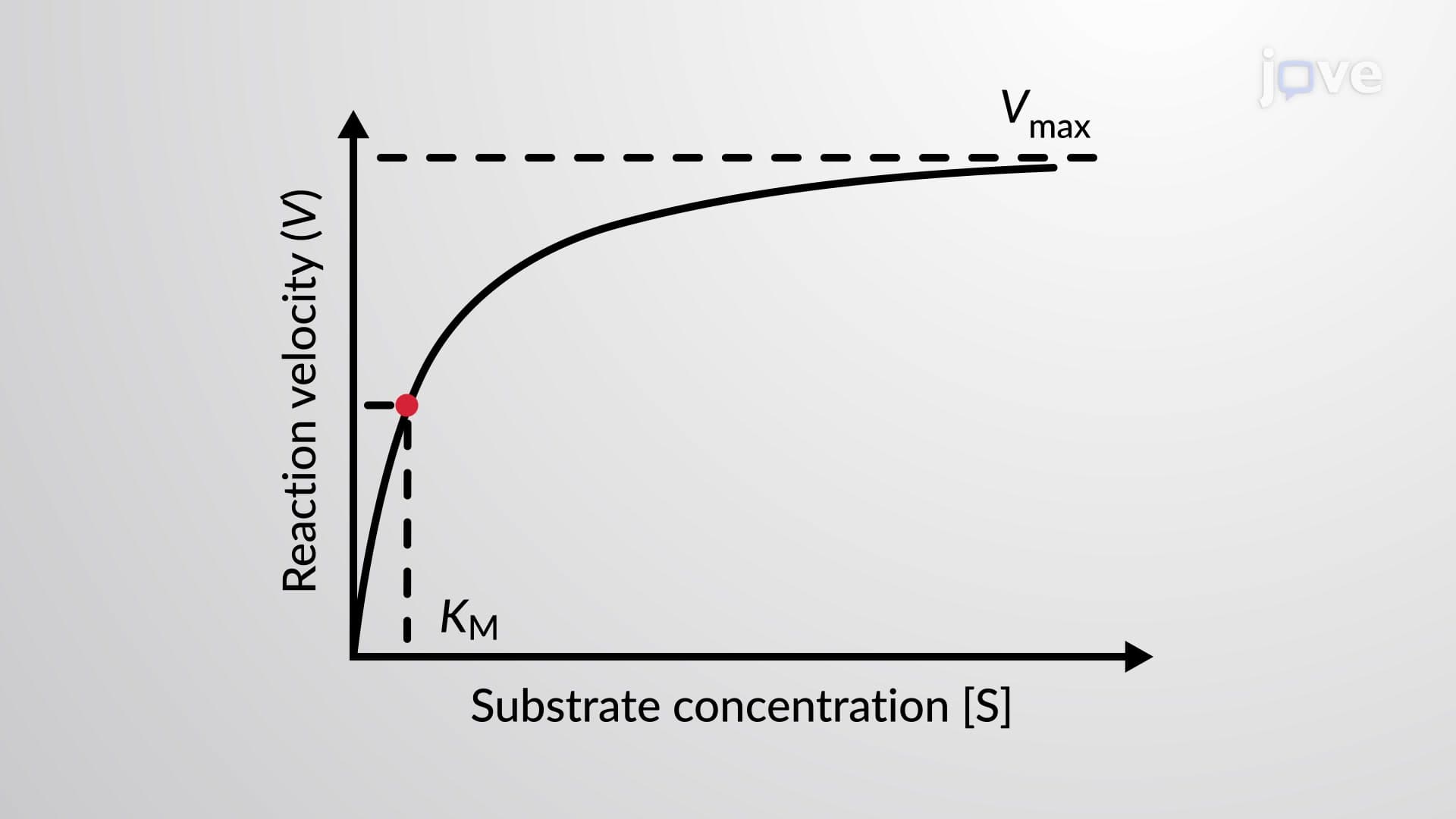
The fundamental principle centers on measuring reaction velocities at different substrate concentrations. When graphed, these measurements reveal a characteristic hyperbolic curve that tells a complete story about enzyme behavior. At low substrate concentrations, the reaction rate increases linearly-every additional substrate molecule significantly boosts the reaction speed. However, as substrate concentration rises, the rate of increase slows, eventually reaching a plateau.
The maximum velocity (Vmax) represents the theoretical upper limit of reaction speed when every enzyme molecule is bound to substrate-complete saturation. Think of Vmax like a highway at rush hour: no matter how many more cars want to enter, the maximum flow rate is limited by the road's capacity.
The Michaelis constant (Km) quantifies enzyme-substrate affinity through a precise measurement: the substrate concentration needed to achieve half of Vmax. Enzymes with small Km values grab and hold substrates tightly, requiring minimal substrate to reach half-maximum speed. Conversely, high Km enzymes have weaker substrate binding, needing higher concentrations to achieve the same performance level.
These principles directly impact medical diagnostics and pharmaceutical development. Hospital laboratories routinely measure enzyme activities like ALT and AST to diagnose liver damage, relying on enzyme kinetics to ensure accurate results. The biotech company Genentech uses enzyme kinetics extensively when developing protein therapeutics, optimizing reaction conditions for maximum yield.
For AP Biology students, enzyme kinetics frequently appears in free-response questions requiring graph interpretation and mathematical calculations. MCAT test-takers encounter these concepts in biological sciences passages, particularly when analyzing experimental data. College biochemistry courses dedicate entire units to enzyme kinetics, forming the foundation for advanced topics like enzyme inhibition and allosteric regulation.
Understanding these mechanisms proves essential for pre-med students, as medical school coursework extensively covers enzyme deficiencies and therapeutic interventions. From lactase deficiency causing lactose intolerance to ACE inhibitors treating hypertension, enzyme kinetics explains countless physiological and pharmacological phenomena.
Related Micro-courses