To prepare for a performance review, spend about 20 to 45 minutes a day for a week: gather your goals and past feedback, list your wins with proof, name one gap and your fix, collect peer feedback, set next goals, write talking points and questions, and rehearse. The full checklist is below, with a printable version.
Most advice on how to prepare for a performance review says the same thing first: prepare all year. That's true, and no help at all when your review is next Thursday. A week is enough if you spend it on the right things.
Here's the part most employees miss. Your manager is human, and people remember the last few weeks far better than the last ten months, a pattern called recency bias. Your job this week is to hand your manager the other ten months, with dates and proof, so the conversation covers your whole year.
The 7-day plan at a glance. Time per day is a suggestion, not a rule

The plan adds up to about three hours. Day 6 is the biggest, because your wins log is the document everything else builds on.
Day 7: Find your goals and last review (30 minutes)
Before you write anything, find out what you're being measured against. Pull together:
- Your goals for this review period, as written, not as you remember them.
- Your last review and any feedback in it you were asked to work on.
- Your job description, if your company uses one for reviews.
- The review form and the self-assessment deadline, if there is one.
If anything is unclear, send your manager one short message: "My review is on the 14th. Is there anything you'd like me to prepare or bring?" Most managers appreciate it, and the answer tells you what they'll focus on.
Day 6: Build your wins log (45 minutes)
This is the most important day. Your memory will serve up the last month. Your records will give you the whole year. Look through:
- Sent emails and chat messages, especially thank-yous and "great job" replies
- Your calendar, for launches, presentations, and big meetings
- Your project tracker or ticket history
- Any dashboards or reports that show your numbers
Put each win in a simple table. The last two columns are what most people skip, and they're what makes a win believable.
| What I did | Result | Proof | When |
|---|---|---|---|
| Rebuilt the client onboarding checklist | Setup time dropped from 10 days to 6 | Ops dashboard, client email | March |
| Covered the vendor project during a colleague's leave | Launched on schedule | Launch announcement | June |
| Trained two new hires on the reporting tool | Both working on their own by week 3 | Manager's message in chat | September |
Aim for 8 to 12 wins, then mark the three that mattered most to your team's goals. Those three lead your conversation.
If finding wins took longer than 45 minutes, that's a useful lesson for next year. Keeping work in task tracking tools means next year's log mostly builds itself.

Day 5: Name one gap and your fix (20 minutes)
Pick the one thing that didn't go well this period. If you don't name it, your manager will, and it lands better coming from you with a fix attached.
Write it in three parts: what happened, what you learned, and what you've already changed.
"In the second quarter I missed two deadlines on the vendor project because I underestimated the review time. Since then I've added a buffer day to every estimate, and the last four deliveries were on time."
One gap, said plainly, shows maturity. A list of five sounds like you're expecting the worst. Owning a miss without excuses is what taking ownership looks like to a manager.
Day 4: Ask two colleagues for feedback (20 minutes)
Your manager doesn't see everything you do. Two colleagues who work closely with you can fill that in, and their words carry weight in the room.
Send each a short, specific question. Vague requests get vague answers.
"My review is next week. What's one thing I did this year that made your work easier, and one thing I could do better? A specific example would really help."
The best answers name a moment and its effect, much like these SBI feedback examples. Add any good ones to your wins log, with the colleague's name, and ask if you can mention them.
Day 3: Set your next goals and the support you need (20 minutes)
A review looks back, but the best part of the conversation looks forward. Write two or three goals for the next period. For each, add one skill you'd need to build and one thing you'd need from your manager.
| Goal | Skill to build | Support I'd ask for |
|---|---|---|
| Lead the Q2 client renewal project | Running meetings with senior stakeholders | Sit in on two of my manager's client calls first |
| Cut report turnaround from 5 days to 3 | Automating the data pull | Time for a short spreadsheet course |
If you're not sure which skills to name, a quick skill gap analysis against the next role up will show you.
If you want a promotion, this is the place to say so, plainly: "I'd like to be considered for a senior role in the next year. What would you need to see from me?" Many people never ask, then wonder why it didn't happen. Here's more on how to get promoted once the door is open. If the next step you want is leading a team, it helps to know what changes between a team lead and a manager before you ask.
Day 2: Write your talking points and questions (25 minutes)
Put everything on one page. You won't read from it, but writing it forces you to choose.
- Three wins, each with its result and proof
- One gap, with what you've changed
- Two goals, with the support you need
- Three or four questions for your manager
It also helps to know what your manager is preparing on their side. Managers are taught to bring examples, rate against standards, and agree on next steps, which is the approach in running productive performance reviews. Your one-pager meets them halfway.
Questions to ask in a performance review
Pick three or four. The best ones ask for specifics you can act on.
| If you want to know... | Ask |
|---|---|
| Where you really stand | "What's one thing I should keep doing, and one thing I should change?" |
| What "great" looks like | "What would make next year an exceeds-expectations year for me?" |
| What the rating is based on | "Which examples weighed most in your rating?" |
| How to grow | "Which skill would make the biggest difference to my work next year?" |
| What support exists | "Is there a project or training that would help me build that?" |
| How to stay on track | "Can we check in on these goals in three months instead of waiting a year?" |
Day 1: Rehearse, and plan for hard feedback (20 minutes)
Say your three wins out loud, once, in under two minutes. It feels awkward, and it's the single best way to sound calm in the room.
Then plan your first response to criticism, because the first five seconds decide how the rest goes. A good default:
"Thanks for telling me. Can you give me an example, so I understand it properly?"
That buys you time, shows you're listening, and gets you the specifics you'll need to improve. Staying steady when you hear something hard is a skill, and handling negative feedback well gets easier with practice.
Last, the logistics: confirm the time and place, print or open your one-pager, and bring a way to take notes.
Review day: in the room
- Let your manager open. Then, when you're invited to share, lead with your top three wins.
- Take notes. It signals you're taking feedback seriously, and you'll want the exact words later.
- Ask your questions before time runs out. If the meeting is short, ask the most important one first.
- Disagree with evidence, calmly. If something seems off, don't argue on the spot. Offer facts:
"I see that part a little differently. Could I share two examples from March and June? I'd like to make sure they were considered."
If it still doesn't change, ask how you can show it next time, and leave it there. Pushing harder in the room rarely helps.
Within 24 hours: send a short recap
A recap turns a conversation into a plan, and it shows your manager you were listening. Keep it brief:
Subject: Thank you, and my notes from today's review
Hi [Manager],
Thanks for the review today. Here's what I took away:
- Keep doing: [what they praised]
- Work on: [the main feedback]
- Goals for next period: [your agreed goals]
- Next check-in: [date]
Let me know if I've missed anything.
[Your name]
Then keep the conversation going in your regular one-on-ones, so the next review has no surprises. Your manager may already use questions like these one-on-one meeting questions for managers, and you can bring your own updates against your goals.
Printable checklist
Print this, or copy it into your notes app, and tick each item off as you go.
Day 7 (30 min)
- ☐ Find my goals for this period, as written
- ☐ Reread my last review
- ☐ Check the review form and any self-assessment deadline
- ☐ Ask my manager if there's anything to prepare
Day 6 (45 min)
- ☐ Search email, chat, calendar, and project tools for wins
- ☐ Log 8 to 12 wins with result, proof, and date
- ☐ Mark my top three
Day 5 (20 min)
- ☐ Name one gap: what happened, what I learned, what I changed
Day 4 (20 min)
- ☐ Ask two colleagues for one strength and one improvement, with examples
Day 3 (20 min)
- ☐ Write two or three goals, each with a skill and the support I need
- ☐ Decide whether to ask about promotion
Day 2 (25 min)
- ☐ Put wins, gap, goals, and questions on one page
- ☐ Choose three or four questions to ask
Day 1 (20 min)
- ☐ Say my three wins out loud, in under two minutes
- ☐ Plan my first response to criticism
- ☐ Confirm time and place, and bring my one-pager and notes
Review day and after
- ☐ Take notes, ask my questions, disagree only with evidence
- ☐ Send a recap email within 24 hours
Mistakes to avoid
| Mistake | Why it hurts | Do this instead |
|---|---|---|
| Relying on memory | You'll remember last month, so will your manager | Build a wins log from your records |
| Listing tasks, not results | "Managed the vendor project" says nothing about impact | Add the result and proof to every win |
| Hiding the obvious miss | Your manager raises it first, and you look defensive | Name one gap yourself, with your fix |
| Arguing in the room | It turns a review into a debate you rarely win | Offer two dated examples, then let it go |
| Leaving without next steps | Nothing changes until next year's review | Agree goals and a check-in date, then send a recap |
Make every conversation with your manager count
A review is one conversation in a working relationship that runs all year. The people who do well at reviews usually do well in the weekly check-ins too: they share progress early, ask for feedback before it's formal, and make their manager's job easier. The course on working with your manager covers how to build that relationship, in short videos you can watch between meetings.

Related course - Working Effectively with Your Manager
Short lessons on sharing progress, asking for feedback, and making one-on-ones useful, so the review is not the only conversation that counts.
Common Questions
How do I prepare for a performance review as an employee?
Start a week before. Find your goals and last review, list your wins with results and proof, name one gap and how you've fixed it, ask two colleagues for feedback, set next goals, and write a one-page set of talking points and questions. Rehearse your top three wins out loud the day before.
What questions should I ask in a performance review?
Ask questions you can act on, such as "What's one thing I should keep doing and one thing I should change?", "What would make next year an exceeding-expectations year?", and "Can we check in on these goals in three months?" Pick three or four and ask the most important one first.
What should you not say in a performance review?
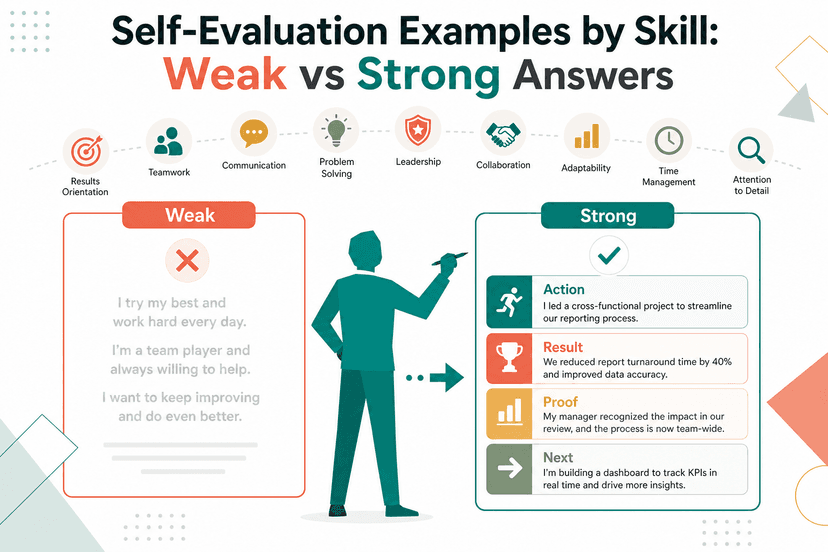
Avoid arguing with feedback on the spot, blaming colleagues for misses, and vague claims like "I worked really hard" with no results attached. If you disagree, calmly offer specific dated examples and ask how you can show it next time.
How far in advance should I prepare for a performance review?
A week is enough for about three hours of focused preparation. For next time, keep a running wins log all year, so preparing takes minutes instead of hours.