SBI feedback names the Situation (when and where), the Behavior (what the person did, as a camera would record it), and the Impact (what happened because of it). Below are 12 SBI feedback examples for real manager situations, 6 positive and 6 corrective, each written out word for word with the question to ask next.
Most SBI feedback examples online are tidy, along the lines of "In yesterday's meeting, you presented well, and the team felt informed." Nobody gets stuck on feedback like that. You get stuck when a former teammate trashes your decision in the team chat, or a solid performer misses a deadline with no warning.
The 12 examples below come from those moments. Each one is written the way you would say it out loud, and the corrective ones end with a question, because feedback that stops at the impact leaves the other person with nothing to do but defend themselves.
SBI comes from the Center for Creative Leadership, which now teaches an extended version called SBII. The second I stands for intent: after you share the impact, you ask what the person was trying to do. CCL's own guide to SBI and intent describes plain SBI as one-way and the intent question as what makes it two-way.
The 12 examples at a glance
Positive:
- Calming an angry client
- Flagging a risk early
- A clear update to senior leaders
- Helping a new hire without being asked
- Making a good call on delegated work
- Giving you honest feedback
Corrective:
- A missed deadline with no warning
- Interrupting in meetings
- Errors in client-facing work
- A former peer undermining a decision
- Repeatedly late to client calls
- Curt messages to another team
Positive SBI feedback examples
Positive feedback is where SBI gets skipped most, because "great job" feels like enough. It isn't specific enough to repeat. Naming the exact behavior tells the person what to do again, and it shows you noticed. For more on making praise land, see how to recognize contributions so they register.
Calming an angry client
A client called your report, furious about a delayed shipment.
"On Tuesday's call with Harlow Foods, when the client started shouting about the delay, you let him finish, repeated his main complaint back, and gave him a date you could keep. He ended the call thanking you, and he renewed the contract on Friday."
The behavior is three concrete actions, so your report knows exactly which moves worked.
Flagging a risk early
A designer warned you two weeks out that a vendor might miss a deadline.
"In our one-on-one two weeks ago, you told me the print vendor had gone quiet and might miss the launch. Because you raised it then, we lined up a backup printer, and the launch went out on time."
Praise for raising bad news early is worth giving on purpose. If people only hear from you when things go well, they learn to hide problems.
A clear update to senior leaders
Your report presented the quarterly numbers to the leadership team.
"In Thursday's leadership review, you opened with the one number that missed target and what we're doing about it, before the slides. The VP skipped her usual round of questions and approved the plan in ten minutes."
Helping a new hire without being asked
A senior team member took the new hire under their wing in week one.
"During Priya's first week, you walked her through our ticketing setup and sat with her on her first two customer calls, without anyone asking you to. She told me on Friday that she already feels useful, which is rare for week one."
The impact here comes from the new hire's own words. A secondhand impact is fine when you heard it directly.
Making a good call on delegated work
You handed off a project, and your report made a judgment call without checking with you first.
"On the onboarding redesign, when the survey tool broke on Monday, you switched to a short form and kept the timeline instead of waiting for me. That was the right call. We got 40 responses and stayed on schedule."
If you want people to own delegated work, acknowledge strong judgment calls made within agreed boundaries. Otherwise they will check with you on everything.
Giving you honest feedback
A report told you, carefully, that your last-minute requests were wrecking their week.
"In yesterday's one-on-one, you told me my Friday afternoon requests were eating into your weekends. That was hard to say to your manager. I've moved my request cutoff to Thursday noon because of it."
Thanking someone for criticism, and naming what you changed, is the fastest way to get more of it.
Corrective SBI feedback examples
Each corrective example has two extra parts after the impact: an intent question, so you hear their side before deciding anything, and an ask, so the conversation ends with something specific. Say the SBI part, then stop talking and wait for the answer. The broader skill of giving constructive feedback that changes behavior starts with that pause.
A missed deadline with no warning
"The vendor report was due Wednesday at 5. I found out Thursday morning, when the client emailed asking for it, that it wasn't finished. I had to apologize to them without knowing why or when they'd get it."
Intent question: "What happened on your end?"
Ask: "Next time something is going to slip, tell me the day you know, even if you're still hoping to make it."
Notice the impact stays on what happened to the client and to you. It doesn't guess at the reason.
Interrupting in meetings
"In this morning's sprint planning, you cut Marcus off twice while he was explaining his estimate. After the second time, he stopped contributing for the rest of the meeting, and we planned his work without his input."
Intent question: "How did that meeting feel from your side?"
Ask: "Let people finish their point before you respond, even when you can see where they're going."
Count the interruptions you saw. "Twice" is a fact. "You always interrupt" is a judgment, and it starts an argument about the word "always."
Errors in client-facing work
"The proposal you sent Ridgeway on Monday had last year's prices on page 4 and the wrong company name in the footer. Their buyer flagged both in her reply, and now we look careless on the deal we most need to win this quarter."
Intent question: "Walk me through how it went out. Where did the review step happen?"
Ask: "Before anything goes to a client, run it past someone else on the team, or send it to me first until we agree the process is solid."
The intent question here targets the process, which is where most repeated errors come from.
A former peer publicly challenges a decision
This one is harder because you used to be on the same side of the table.
"In the team channel yesterday, after I announced the new on-call rotation, you posted that it was 'another top-down call nobody asked for.' Two people reacted with a thumbs up, and I've had three questions since about whether the change is going ahead."
Intent question: "What's your real concern with the rotation?"
Ask: "If you disagree with a decision I make, bring it to me directly first. I'd rather hear it from you than read it in the channel."
Quote their words exactly. Paraphrasing makes it easy to argue about what they meant.
Repeatedly late to client calls
"You joined the last three Monday client calls between five and ten minutes late. On today's call, the client started without you and asked me afterward whether you're still the lead on their account."
Intent question: "Is something about Monday mornings making this hard?"
Ask: "Be on client calls a couple of minutes early. If Mondays have a real conflict, let's move the call."
A pattern of three is still SBI, as long as each instance is specific. Name the dates if you have them.
Curt messages to another team
"In the Slack thread with finance on Tuesday, you replied 'This is wrong, fix it' to Dana's budget sheet, with no detail on what was wrong. She escalated it to her manager, and it took two days and a meeting to sort out what was a five-minute fix."
Intent question: "What were you seeing in her sheet?"
Ask: "When you spot a problem in another team's work, say what's wrong and what you need. One extra sentence would have saved two days here."
This is the example most likely to get a defensive reply. If it does, describe the behavior again in the same calm words, and don't add new complaints. Here's more on staying calm and objective when someone pushes back.
How to deliver SBI feedback so it lands
Give it close to the moment. Feedback about Tuesday's meeting works on Wednesday. By the quarterly review, nobody remembers the details, and the person wonders why you waited. This is the case for real-time feedback over saving everything for a review.
Corrective in private, positive in public if they like it. Some people hate being praised in front of the team. Ask once and remember the answer.
One behavior per conversation. If you stack five issues, the person hears "you're failing" and remembers none of them. Pick the one with the biggest impact.
Check your behavior line for judgment words. Words like unprofessional, lazy, careless, or rude describe your conclusion. Replace them with what you saw.
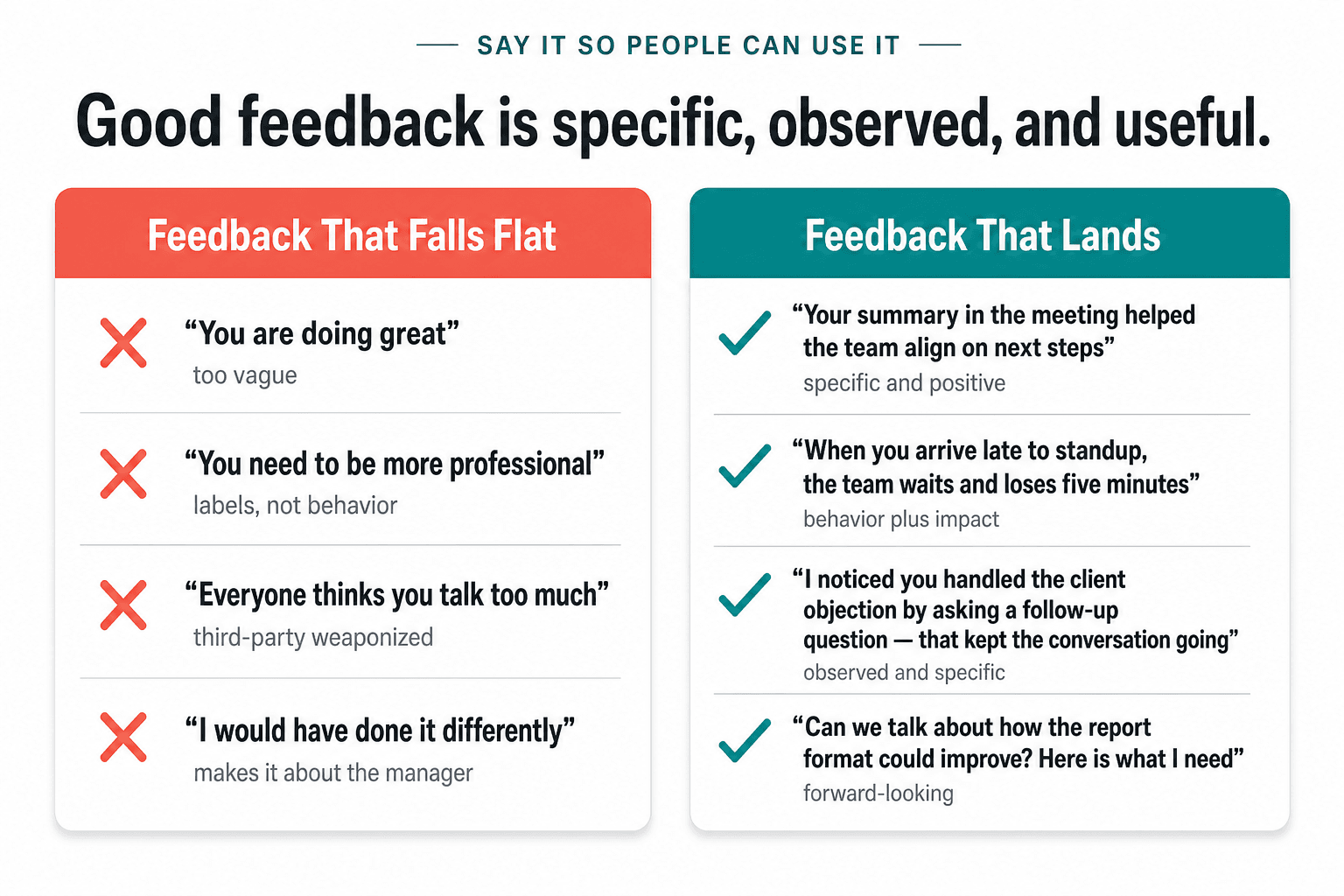
Common SBI mistakes, and the fix
- Weak: "Lately you've been sloppy." Problem: no situation, and "sloppy" is a label. SBI: "The proposal you sent Ridgeway on Monday had last year's prices on page 4."
- Weak: "You were unprofessional in the meeting." Problem: judgment word in place of behavior. SBI: "You cut Marcus off twice while he was explaining his estimate."
- Weak: "You made the whole team look bad." Problem: impact is exaggerated and vague. SBI: "The client asked me whether you're still the lead on their account."
- Weak: "You need to communicate better." Problem: no behavior, no impact, no ask. SBI: "I found out from the client that the report was late. Tell me the day you know something will slip."
Practice the hard ones before they happen
The corrective examples above are the conversations new managers put off longest. The How to Manage Team Performance and Feedback course covers feedback, underperformance, and reviews in short lessons. It's part of New Manager Essentials, where every video runs under two minutes, so you can watch one the morning of the conversation.

Related course - How to Manage Team Performance and Feedback
Short lessons on feedback, underperformance, and reviews you can watch the morning of the conversation.
Common Questions
Can you use the SBI feedback model for positive feedback?
Yes. SBI works for praise the same way it works for correction: name when and where, what the person did, and what it led to. Specific praise tells the person exactly what to repeat, which "great job" does not.
What is the difference between SBI and SBII feedback?
SBII adds a fourth step, intent. After you describe the situation, behavior, and impact, you ask what the person was trying to do. The Center for Creative Leadership, which developed SBI, recommends this step to turn one-way feedback into a two-way conversation.
How soon should you give SBI feedback?
As close to the moment as you can, ideally within a day or two. Details fade fast, and late feedback makes people wonder why you waited. Give corrective feedback in private.