

Most new manager mistakes are not about effort. They happen because the thing that got you promoted, doing the work yourself, is the exact thing you now have to stop doing. About 85% of new managers get no formal training before the job (Gartner, reported by Fast Company), so almost everyone learns these traps the hard way. Here are the six that catch first-time managers most often, and what to do about each one.
The 6 new manager mistakes, at a glance
- Doing the work yourself instead of leading it
- Trying to stay everyone's friend
- Ducking the conversation you know you need to have
- Going quiet: no rhythm, no feedback
- Rebuilding everything in week one
- Delegating, then hovering
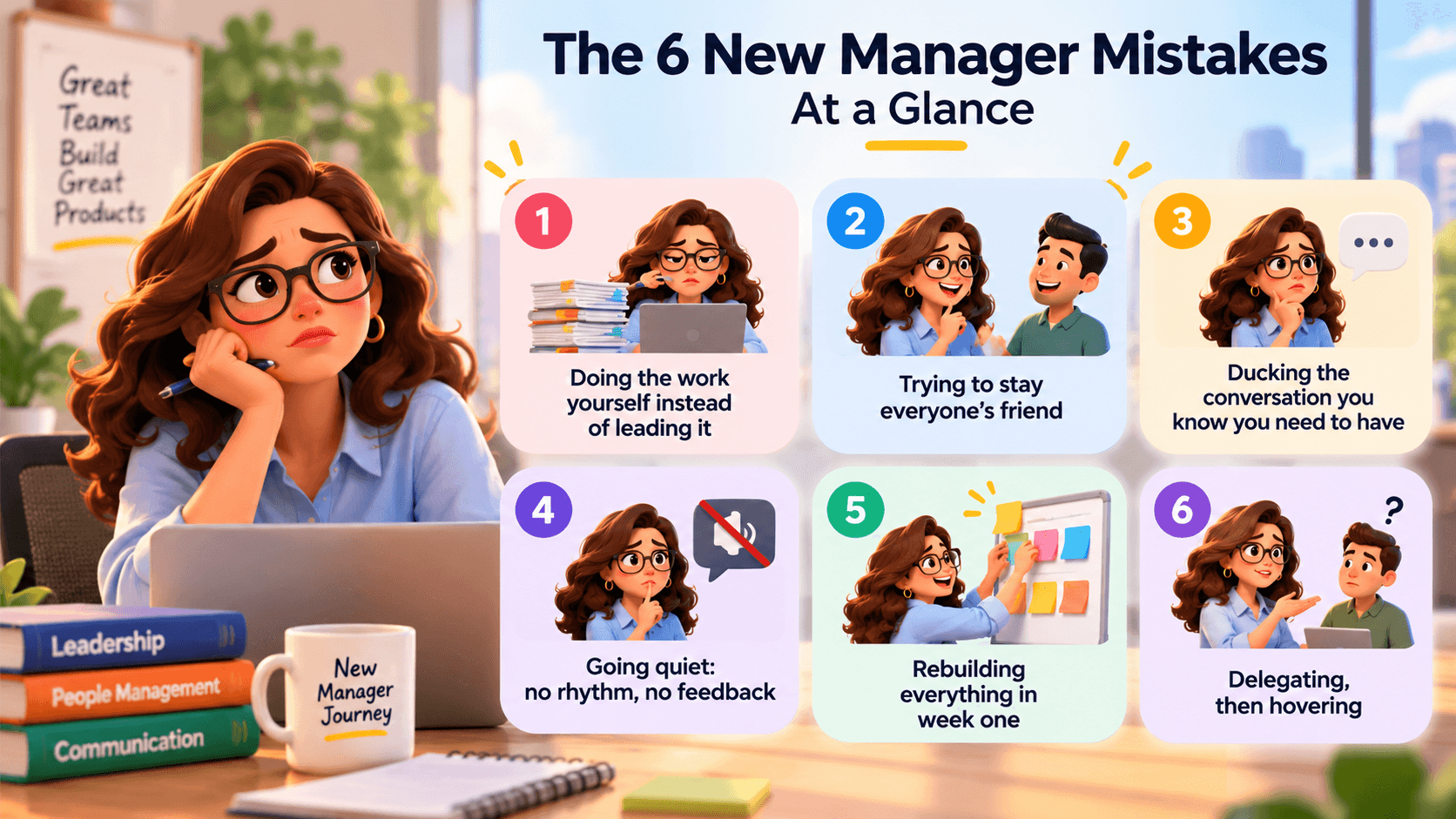
This list covers the individual-contributor-to-manager transition. It is not every mistake a manager can make. Managing up, for example, is a real skill with its own learning curve, and it is not on this list.
Doing the work yourself instead of leading it
You were promoted because you were good at the work. So when a task lands, your instinct is to grab it. It feels faster, and it feels like proof you still deserve the title.
The problem shows up a few weeks in. Your calendar is full, your team is waiting on you, and the actual manager work, unblocking people, setting direction, is not happening. You have become the bottleneck.
Do this tomorrow: write down every task on your plate this week. Circle the ones only you can do. Everything else gets handed to someone on the team by Friday, even if they do it at 80% of your speed. Speed is not the point anymore. If handing off work cleanly is where you struggle, the walkthrough on how to delegate without dropping the ball is worth two minutes.
Trying to stay everyone's friend
Last month these people were your peers. You got coffee, complained about the same things, covered for each other. Now you set their goals and review their work, and you badly want the friendship to survive the change.
So you soften every ask, avoid saying no, and hope nobody notices you are in charge. They notice. Being liked is not the same as being trusted, and a team that likes you but does not trust your judgment will not follow you when it counts.
Do this tomorrow: have one short, direct conversation with the people you were close to. Something like: "I value what we have. My job now is the whole team's results, so I'll make some calls I wouldn't have before. If anything I do feels off, tell me straight." Naming the shift out loud is the hardest part, and there is a short lesson on setting boundaries with people who were your peers last week if you want a script to borrow from.

Ducking the conversation you know you need to have
Someone is coasting. Someone missed a deadline again. You know you should say something, and you keep not saying it, because the conversation feels like it will blow up the relationship.
Waiting makes it worse. The behavior continues, the rest of the team sees it go unaddressed, and by the time you finally speak, you are annoyed and the feedback comes out sharper than you meant.
Do this tomorrow: address it within 48 hours of noticing, while it is small. Open with the specific behavior and its effect, not the person's character. "The report was two days late and the client noticed" lands. "You're unreliable" starts a fight. Preparation is most of the battle here, and the guide on getting ready for a tough conversation covers how to walk in calm.
Going quiet: no rhythm, no feedback
Try opening this one differently. Picture your best team member three months from now saying, "I had no idea how I was doing." That is what silence produces.
New managers get buried in their own workload and let the team's rhythm slide. One-on-ones get skipped when things are busy, which is exactly when people need them. Feedback waits for the annual review, so it arrives too late to change anything.
Do this tomorrow: book a recurring one-on-one with each report, 25 minutes, same slot every week, and protect it. Keep the agenda simple: what they are working on, what is in their way, what they need from you. And give feedback in the moment it happens, not six months later. Small and frequent beats big and rare.
Rebuilding everything in week one
You walk in with ideas. You can see what is broken, and you want to prove you were the right pick, so you start changing processes on day three.
The team reads this as "the new manager thinks we're doing it all wrong," before you have earned the standing to say so. You also do not yet know why things are the way they are. Some of what looks broken is a workaround for a problem you cannot see yet.
Do this tomorrow: use a simple 30-60-90 frame. In days 1 to 30, observe and ask questions. Do not rebuild the process yet. In days 31 to 60, test one or two small changes. In days 61 to 90, commit to what worked. The first 90 days lesson breaks down what to focus on in each stretch.
Delegating, then hovering
This one is sneaky because it looks like progress. You hand off a task, feel good about it, and then check in every few hours, ask for constant updates, and quietly redo parts you would have done differently. That is micromanaging, and it undoes the delegation you just did.
The message the team hears is that you do not trust them. The good people, the ones with options, leave first.
Do this tomorrow: when you hand off work, agree on the check-in points up front, then leave it alone in between. Define what "done" looks like and when it is due. Do not define the method. If the result meets the bar, the fact that they got there their own way is fine.
Fix one this week, not all six
You will not undo years of individual-contributor habits in a day. Pick the trap that stung reading this and work on that one for a week. When you are ready to go deeper, the full New Manager Essentials program breaks each of these into short lessons you can watch at the moment you actually hit the problem.

Related course - New Manager Essentials
The full program walks through every phase of this transition, from your first day to your first quarter goals.
Common Questions
What is the most common mistake new managers make?
The most common one is refusing to let go of the hands-on work. You were promoted for being good at the tasks, so you keep doing them, and the leadership work goes undone. The fix is to delegate on purpose: keep only what genuinely needs you, and hand off the rest even if the team is slower at first.
What should a new manager do in the first 90 days?
Resist the urge to rebuild everything right away. A 30-60-90 approach works well: days 1 to 30 are for observing and asking questions rather than changing the process, days 31 to 60 are for testing small changes, and days 61 to 90 are for committing to what worked. You earn the standing to make big changes by understanding the team first.
How do I manage people who used to be my peers?
Name the change directly instead of pretending it did not happen. Have a short, honest conversation acknowledging the friendship and explaining that your job is now the whole team's results, which means some decisions will feel different. Trust matters more than being liked, and clarity up front prevents most of the awkwardness later.
Why do so many new managers struggle?
Most were never taught how. Around 85% of new managers receive no formal training before stepping into the role, a pattern the Chartered Management Institute calls the "accidental manager." That gap is why these mistakes are so common, and it is also why they are fixable once you know what to look for.