Say what you've seen, why it matters, and what needs to change, then ask what's getting in the way. For example: "Your last three reports were late. That delayed the client update. What's been going on?" Below are word-for-word scripts for each stage, from the opening line to the follow-up.
Most advice on what to say to an underperforming employee tells you to "be specific" and "be supportive," and often to open with praise. Then it stops, right before the part you need: the actual words. Praise first is the bit I'd skip. A compliment followed by "but" teaches people to brace whenever you're nice to them.
The cost of getting this wrong is real. In Gallup's research on performance reviews, only 14% of employees strongly agreed that the reviews they get inspire them to improve.

Gallup, Give Performance Reviews That Actually Inspire Employees (Wigert and Mann, 2017) · share of employees who strongly agree
This post gives you the words for each stage of one informal conversation, before anything formal like a written warning. It's the conversation many new managers put off, and avoiding it is one of the common first-time manager mistakes for good reason: the problem grows while you wait.

The six stages of the conversation, plus the follow-up that decides what happens next
Stage 1: Prepare before you say anything
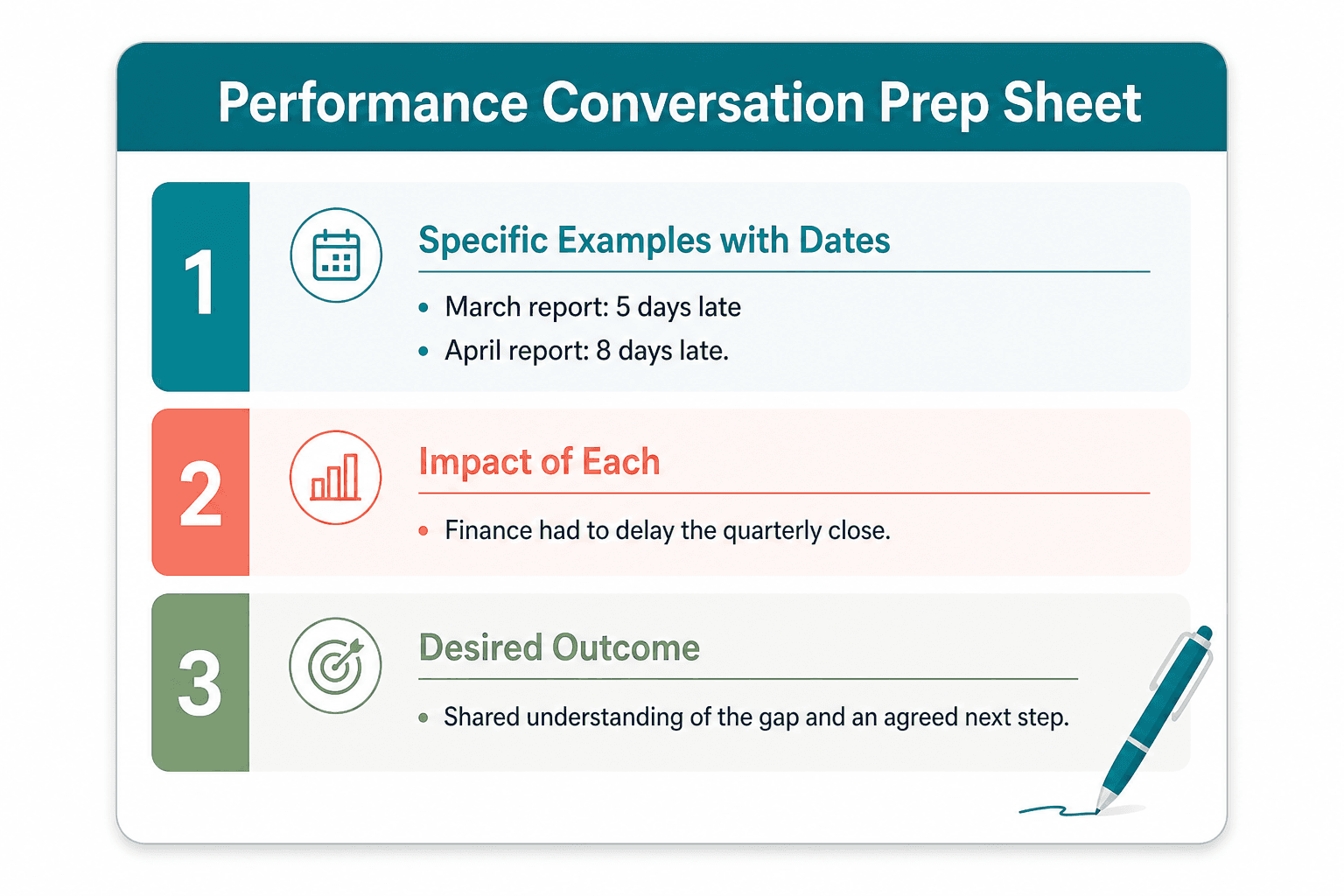
Most conversations about poor performance go wrong before they start, because the manager walks in with a feeling ("she's not pulling her weight") instead of facts. Before the meeting, write down three things:
Two or three specific examples, with dates. "The March and April reports were five and eight days late."
The impact of each one. "Finance had to delay the quarterly close."
The one outcome you want by the end of the meeting. Usually it's a shared understanding of the gap and an agreed next step, not a promise to "do better."
Then book the time. If you hold regular one-on-ones, raise it there, so it doesn't feel like an ambush. These one-on-one meeting questions for managers include a set for when someone's work starts slipping. And don't wait for the annual review to bring it up. A problem you raise within a week is a small fix, which is the whole case for real-time feedback.
Stage 2: Open the conversation
Say what the meeting is about in your first sentence. Small talk first makes the person wait for the bad news, and it makes the turn feel like a trap. The opening of difficult discussions works best when it's short and plain.
"Thanks for making time. I want to talk about the monthly reports, because they've been coming in late and I want to understand what's going on and figure out a fix together."
If the person is a strong performer whose work has dropped recently, say so. It changes how they hear everything after it:
"Your work is usually solid, which is why I noticed the last few reports. I want to talk about what's changed."
If they've had this conversation with you before, don't pretend it's new:
"We talked about deadlines in March. They've slipped again, so I want to go through it properly today."
Stage 3: Name the gap
Describe what happened, when, and what it led to. Keep it to behavior you saw or results you can show, and leave out guesses about why. This is the Situation-Behavior-Impact pattern, and these SBI feedback examples show it across a dozen situations.
"The March report came in five days late, and April's came in eight days late. Both times, finance had to push back the quarterly close, and I had to explain the delay to the CFO."
Then state the standard, so the gap is clear:
"The reports need to be in by the third working day of each month."
Stop there and let them respond. Don't stack five more examples. One clear pattern lands, while a long list sounds like a case being built against them.
If they push back or get upset: stay with the facts, in the same calm words. "I hear that this feels unfair. The dates are what they are, and I want to understand what's behind them." If they're upset, offer a short pause, and keep the meeting going rather than ending it. Here's how to handle emotional reactions professionally when a conversation gets heated.
Stage 4: Ask and listen
This is the stage most managers rush, and it's the one that decides whether anything changes. The same late report can come from five different causes, and each needs a different fix. Ask, then wait through the silence:
"What's been getting in the way?"
"How do you see it?"
"Is anything outside work making this harder right now? You don't have to share details."
When they answer, repeat it back before you respond: "So the finance data arrives late, and you're waiting on it before you can start. Is that right?" Getting the cause right is the heart of diagnosing performance gaps.
What you might hear, and what to say next
| What's behind it | What you might hear | What to say next |
|---|---|---|
| Unclear expectations | "I didn't know it was due on the third." | "Then that's on me to make clear. Let's write the standard down today." |
| A skill gap | "I'm not sure how to pull the finance data." | "Let's fix that first. Who could walk you through it this week?" |
| Too much work | "The vendor project has taken all my time." | "Let's look at your list together and decide what moves or waits." |
| Motivation or fit | "This work doesn't interest me." | "Thanks for being straight. The reports are part of the role, so let's make them easier, and also talk about what you'd like to grow into." |
| Something outside work | "Things at home are hard right now." | "I'm sorry to hear it. You don't need to share details. Let's look at what support is available and what we can adjust." |
If the cause is a skill gap, treat the next few weeks as performance coaching, with short practice and quick feedback, rather than a test they have to pass alone. If the cause is personal, point them to your employee assistance program or HR, and don't try to solve it yourself.
Stage 5: Agree the plan
The plan needs three parts: the standard, what each of you will do, and when you'll check. Say it out loud and get their agreement on each part.
"So here's what we're agreeing. The report is due by the third working day of each month. You'll flag it to me by the first working day if the finance data hasn't arrived. I'll talk to finance about getting it to you earlier. Let's check in on the 15th, after the next one is done. Does that work for you?"
Vague goals like "be more on top of things" give the person nothing to aim at and give you nothing to check. Being concrete about the standard is the core of setting clear performance standards, and it's the foundation of setting expectations for the whole team.
If deadlines are the problem, it can help to share a guide written for their side of the desk. This one on meeting deadlines covers planning and flagging risks early.
Stage 6: Close and recap
End by checking how they're feeling about it, then send the plan in writing the same day.
"I know this isn't an easy conversation. I want this to work, and I think it can. Is there anything you want to add before we wrap up?"
The written recap protects both of you. It means nobody remembers the agreement differently in three weeks. Keep it short and neutral:
Subject: Recap of today's conversation about monthly reportsHi [Name],Thanks for talking today. Here's what we agreed:- Standard: the monthly report is due by the 3rd working day.- You'll flag it to me by the 1st working day if finance data is late.- I'll ask finance to send the data earlier.- We'll check in on [date].If I've missed anything, reply and let me know.[Your name]

The follow-up: what to say two weeks later
The follow-up decides whether the first conversation worked. Put it on the calendar before you leave the room, and keep it, even if things look fine.
If it's improving:
"The report came in on the 2nd. That's exactly what we talked about, and it made the close much smoother. Thank you. Let's keep checking in monthly for now."
If it isn't:
"The report was late again this month, on the 7th. That's the second time since we agreed to the plan. I want to understand what happened, and I also need to be clear that if it continues, we'll need a more formal plan."
Tracking the agreement, and saying something either way, is what tracking progress and driving accountability looks like in practice.
What not to say, and what to say instead
| Don't say | Why it backfires | Say instead |
|---|---|---|
| "You're doing great, but..." | The praise disappears, and future praise starts to sound like a setup | Name the topic first. Give praise in its own conversation |
| "You've been really unreliable lately." | A label with no facts, so they'll argue about the label | "The March and April reports were five and eight days late." |
| "Everyone's noticed." | Vague, makes them hunt for the source, and spreads the problem | Describe only what you saw yourself |
| "I need you to step up." | Nothing to act on, nothing to check | "The report is due by the third working day." |
| "Don't worry, it's not a big deal." | If it isn't, why are you meeting? It also undercuts a later formal step | "This matters, and I think it's fixable." |
| "Is everything OK at home?" | Assumes a personal cause and can feel intrusive | "Is anything outside work making this harder? You don't have to share details." |
When it becomes formal
This post covers informal conversation. If the follow-up shows no real change, or the problem is serious from the start, the next step is usually a formal performance improvement plan with HR involved. Bring HR in before you mention one. Policies, notice requirements, and employment law differ by company and location, and this post is general guidance, not legal or HR advice.
The informal conversation still matters a lot if it gets there. Your notes and recap emails show the person was told clearly, given a fair chance, and offered support. Here's how designing and managing a performance improvement plan works when you do need one.
Practice the conversation before you have it
This is one conversation in a much bigger skill. The performance management course covers it end to end, from diagnosing gaps and giving constructive feedback to running reviews and improvement plans, in videos under two minutes each. It's one of 13 short courses in New Manager Essentials.

Related course - How to Manage Team Performance and Feedback
Short lessons from diagnosing gaps and giving constructive feedback to running reviews and improvement plans.
Common Questions
How do you start a conversation with an underperforming employee?
Name the topic in your first sentence, then describe one or two specific examples with dates and their impact. For example: "I want to talk about the monthly reports. The last two were late, and it delayed the quarterly close." Then ask what's been getting in the way, and listen before suggesting any fix.
What should you not say to an underperforming employee?
Avoid praise used to soften criticism, labels like "unreliable" or "lazy," vague phrases like "everyone's noticed," and requests with nothing to measure, such as "step up." Stick to what you saw, its impact, and the standard you need.
When should an underperforming employee be put on a performance improvement plan?
Usually after an informal conversation and a follow-up haven't produced a real change, or when the problem is serious from the start. Involve HR before mentioning a plan, because rules and policies vary by company and location.