Work Skills

  • Individual Contributor Excellence
  • New Manager Essentials

Business & Economics

  • Finance
  • Marketing
  • Accounting
  • Microeconomics
  • Macroeconomics

Clinical & Nursing

  • Nursing
  • Medical-Surgical Nursing
  • Anatomy and Physiology
  • Pathophysiology

Pharmacology

  • Pharmacology
  • Pharmacokinetics and Pharmacodynamics

Psychology

  • Introduction to Psychology
  • Social Psychology

Engineering

  • Mechanical Engineering
  • Electrical Engineering
  • Civil Engineering

Statistics

  • Statistics

Science and Maths

  • Biology
  • Cell Biology
  • Microbiology
  • Molecular Biology
  • Chemistry
  • Organic Chemistry
  • Analytical Chemistry
  • Physical Chemistry
  • Physics
  • Math Fundamentals
  • Calculus
jove Coach
JoVE Coach
  • Individual Contributor Excellence
  • New Manager Essentials
  • Finance
  • Marketing
  • Accounting
  • Microeconomics
  • Macroeconomics
  • Nursing
  • Medical-Surgical Nursing
  • Anatomy and Physiology
  • Pathophysiology
  • Pharmacology
  • Pharmacokinetics and Pharmacodynamics
  • Introduction to Psychology
  • Social Psychology
  • Mechanical Engineering
  • Electrical Engineering
  • Civil Engineering
  • Statistics
  • Biology
  • Cell Biology
  • Microbiology
  • Molecular Biology
  • Chemistry
  • Organic Chemistry
  • Analytical Chemistry
  • Physical Chemistry
  • Physics
  • Math Fundamentals
  • Calculus
Looking to upskill your team? Explore Coach for Business
PricingFor BusinessesAbout
  1. Home
  2. Blog

The Coach Blog

Learn practical workplace skills.

Your First 90 Days as a Manager: A Week-by-Week Playbook
Workplace Skills

Your First 90 Days as a Manager: A Week-by-Week Playbook

Your first 90 days as a manager break into three jobs: learn the team and the work on days 1-30, align expectations and bank one small win on days 31-60, then set direction and lead on days 61-90. Do them in that order.

J
JoVE Coach Team · 28 Sep 2026 · 8 min read
Read article

Latest articles

How to Respond to a Bad Performance Review: A 48-Hour Plan + Rebuttal Template
Workplace Skills

How to Respond to a Bad Performance Review: A 48-Hour Plan + Rebuttal Template

To respond to a bad performance review, don't reply on the spot. In the first 24 hours, reread it and sort each point into accurate or inaccurate. Then ask your manager for specific examples, agree a plan for the fair points, and write a short, factual rebuttal only for points that are wrong and matter.

857 views · 8 min read

Holiday Time-Off Requests: Fair Approval Rules and a Coverage Grid for Managers
Workplace Skills

Holiday Time-Off Requests: Fair Approval Rules and a Coverage Grid for Managers

Quick answer: Handle holiday time off requests with rules your team knows in advance: set minimum coverage first, publish a request deadline, approve in order received, rotate the most popular days each year, and say no early with an alternative. A simple coverage grid shows at a glance which days are safe to approve.

1.8K+ views · 7 min read

Performance Review Phrases for Managers: 60 Comments Sorted by Situation
Workplace Skills

Performance Review Phrases for Managers: 60 Comments Sorted by Situation

The best performance review phrases name a specific situation, what the person did, and the result. Instead of "great team player," write "When the launch slipped in March, you covered two colleagues' accounts, and both clients renewed." Below are 60 performance review comments for managers, sorted by 10 situations, each rewritten this way.

497 views · 20 min read

Brag Document Template: A Filled-In Example and 30-Minute Build Guide
Workplace Skills

Brag Document Template: A Filled-In Example and 30-Minute Build Guide

A brag document is a running list of your work accomplishments, with the impact and proof for each one, that you keep all year and share with your manager before reviews. To build one, create six sections (goals, projects, collaboration, feedback, learning, and impact), fill them from your email, calendar, and project tools, then update it every two weeks.

1.5K+ views · 11 min read

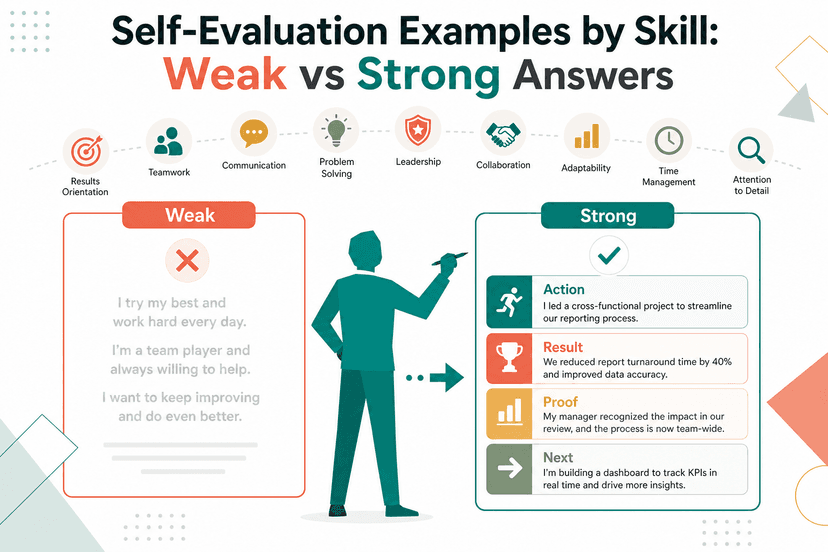
Self-Evaluation Examples by Skill: Weak vs Strong Answers (+ Fill-In Template)
Workplace Skills

Self-Evaluation Examples by Skill: Weak vs Strong Answers (+ Fill-In Template)

A strong self evaluation answer has four parts: what you did, the result, the proof, and what you'll do next. For example: "I rebuilt the onboarding checklist, cutting setup time from 10 days to 6, per the ops dashboard. Next, I'll extend it to enterprise clients." Below are weak vs strong self evaluation examples for 9 skills, and a fill-in template.

1.2K+ views · 11 min read

How to Prepare for a Performance Review: A 7-Day Checklist for Employees
Workplace Skills

How to Prepare for a Performance Review: A 7-Day Checklist for Employees

To prepare for a performance review, spend about 20 to 45 minutes a day for a week: gather your goals and past feedback, list your wins with proof, name one gap and your fix, collect peer feedback, set next goals, write talking points and questions, and rehearse. The full checklist is below, with a printable version.

934 views · 11 min read

Your Best Employee Wants to Quit. Here's the Conversation to Have Today
Workplace Skills

Your Best Employee Wants to Quit. Here's the Conversation to Have Today

Quick answer: When your best employee wants to quit, talk to them today, not after you've built a counteroffer. Thank them for telling you, ask what's driving it and what would make staying worth it, and promise only what you can deliver. Then confirm what's possible with your manager or HR within 48 hours.

539 views · 11 min read

What to Say to an Underperforming Employee (Word for Word)
Workplace Skills

What to Say to an Underperforming Employee (Word for Word)

Say what you've seen, why it matters, and what needs to change, then ask what's getting in the way. For example: "Your last three reports were late. That delayed the client update. What's been going on?" Below are word-for-word scripts for each stage, from the opening line to the follow-up.

876 views · 10 min read

Two Employees Not Getting Along? Diagnose Before You Mediate
Workplace Skills

Two Employees Not Getting Along? Diagnose Before You Mediate

When two employees are not getting along, diagnose before you mediate. Talk to each person separately, then sort the problem into one of five types: misconduct, unclear roles, workload, a style clash, or one incident that festered. Only style clashes and festered incidents call for a joint conversation. The other types need a different fix.

387 views · 9 min read

Team Lead vs Manager: What Actually Changes When You Get the Title
Workplace Skills

Team Lead vs Manager: What Actually Changes When You Get the Title

Quick answer: The core difference in team lead vs manager is authority over people. A team lead guides the daily work and usually still does hands-on work. A manager makes the people decisions: hiring, performance reviews, pay input, and discipline. Titles vary by company, so check what authority comes with yours, not the word.

1.4K+ views · 8 min read

How to Start a Difficult Conversation With an Employee: The First 60 Seconds
Workplace Skills

How to Start a Difficult Conversation With an Employee: The First 60 Seconds

Quick answer: To start a difficult conversation with an employee, name the topic in your first sentence, describe one specific thing you saw, say why it matters, then ask a question and stop talking. Skip small talk and compliments. Below are opening scripts for 8 common scenarios, from missed deadlines to a complaint about them.

1.6K+ views · 9 min read

The Month-Two Dip: Imposter Syndrome as a New Manager
Workplace Skills

The Month-Two Dip: Imposter Syndrome as a New Manager

Quick answer: Imposter syndrome as a new manager is the feeling that you were promoted by mistake and will soon be found out. It often peaks around month two, when the learning grace period ends and your results still lag. It is common, it is not a clinical diagnosis, and it eases as you build evidence.

980 views · 8 min read

Am I Micromanaging? 9 Signs It's You, Not Your Team
Workplace Skills

Am I Micromanaging? 9 Signs It's You, Not Your Team

Quick answer: The clearest signs you are micromanaging are that you still do your old job, you hand off tasks along with every step, you ask for updates more often than the work changes, and work stalls when you're away. Check yourself against the 9 signs below. Each one comes with a fix you can try this week.

2.1K+ views · 11 min read

SBI Feedback Examples: 12 Common Workplace Situations
Workplace Skills

SBI Feedback Examples: 12 Common Workplace Situations

SBI feedback names the Situation (when and where), the Behavior (what the person did, as a camera would record it), and the Impact (what happened because of it). Below are 12 SBI feedback examples for real manager situations, 6 positive and 6 corrective, each written out word for word with the question to ask next.

1.7K+ views · 11 min read

One-on-One Meeting Questions for Managers, Sorted by the Situation You're In
Workplace Skills

One-on-One Meeting Questions for Managers, Sorted by the Situation You're In

The best one-on-one meeting questions fit the situation you are in. A first meeting needs questions about how the person works. A quiet report needs questions that require a story to answer. Slipping work needs questions about what changed. Below are questions for 8 common situations, a note on what to do with each answer, and a 30-minute template.

1.4K+ views · 11 min read

Managing People Older Than You Without Overcorrecting
Workplace Skills

Managing People Older Than You Without Overcorrecting

Managing people older than you goes wrong in two directions: deferring too much or asserting too hard. Hold everyone to the same standards, ask for their expertise on how the work gets done, and keep the decisions about what gets done and by when. Don't make age the topic, and don't pretend it doesn't exist.

2.2K+ views · 11 min read

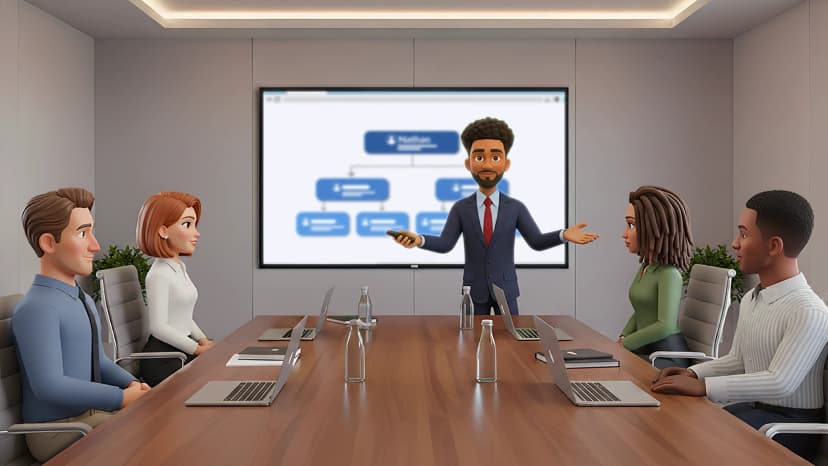
Your First Team Meeting as a New Manager: What to Say and What to Skip
Workplace Skills

Your First Team Meeting as a New Manager: What to Say and What to Skip

Keep your first team meeting as a new manager to 30 minutes. Spend under 10 minutes talking about yourself and the change, about 15 minutes asking three questions and listening, and the rest on next steps. Skip the vision speech, any talk about the previous manager, and promises you can't keep.

1.7K+ views · 11 min read

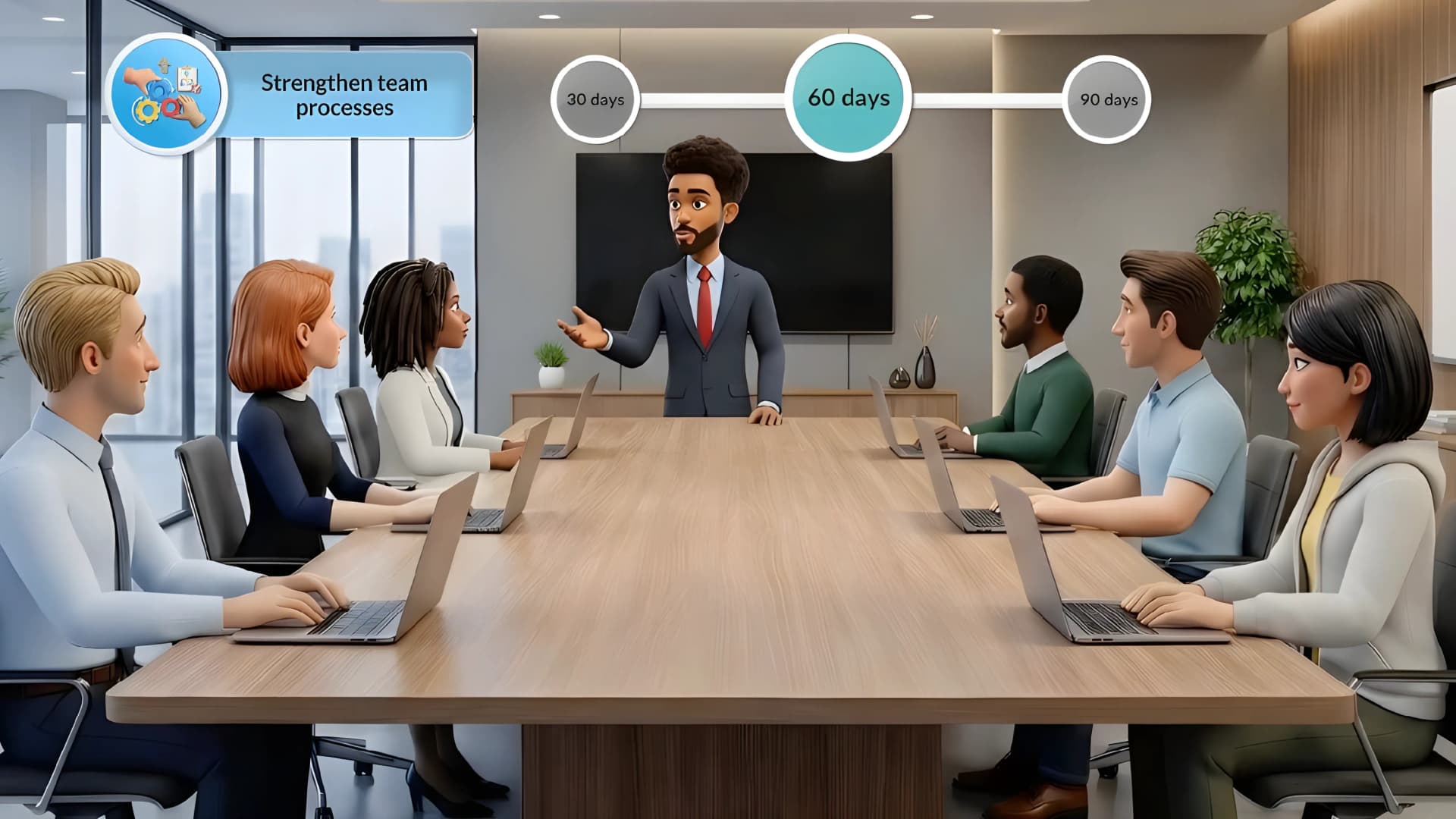
Your First 90 Days as a Manager: A Week-by-Week Playbook
Workplace Skills

Your First 90 Days as a Manager: A Week-by-Week Playbook

Your first 90 days as a manager break into three jobs: learn the team and the work on days 1-30, align expectations and bank one small win on days 31-60, then set direction and lead on days 61-90. Do them in that order.

2.4K+ views · 8 min read

Best New Manager Courses Online: Honest Comparison for 2026
Workplace Skills

Best New Manager Courses Online: Honest Comparison for 2026

Most people who get promoted into their first management role receive no formal training. Research from the Chartered Management Institute and YouGov found that 82% of people entering management positions are “accidental managers” with no formal management and leadership training.

1.8K+ views · 7 min read

New Manager Mistakes: 6 Traps First-Time Managers Fall Into
Workplace Skills

New Manager Mistakes: 6 Traps First-Time Managers Fall Into

Most new manager mistakes are not about effort. They happen because the thing that got you promoted, doing the work yourself, is the exact thing you now have to stop doing.

1.2K+ views · 7 min read

Managing Peers After a Promotion: How to Set Real Boundaries
Workplace Skills

Managing Peers After a Promotion: How to Set Real Boundaries

Managing peers after a promotion starts with naming the shift out loud instead of pretending nothing changed. Set boundaries on the specific situations most likely to blur (schedule favors, gossip about leadership, old inside jokes at someone else's expense), have that conversation in your first two weeks, and treat consistency, not likability, as what actually earns the relationship back.

2.1K+ views · 9 min read

A learning experience by JoVE

A faster way to learn with engaging video lessons under two minutes and certificates as you go, trusted by 5 million learners worldwide.

Work SkillsPopular
  • Individual Contributor Excellence
  • New Manager Essentials
Business & Economics
Clinical & Nursing
Pharmacology
Psychology
Engineering
Statistics
Science and Maths

About JoVE Coach

  • Blog
  • About
  • For Businesses
  • Pricing
Privacy PolicySitemapTerms of Use

© 2026 MyJoVE Corporation

A learning experience by JoVE

A faster way to learn with engaging video lessons under two minutes and certificates as you go, trusted by 5 million learners worldwide.

Work SkillsPopular

  • Individual Contributor Excellence
  • New Manager Essentials

Pharmacology

  • Pharmacology
  • Pharmacokinetics and Pharmacodynamics

Engineering

  • Mechanical Engineering
  • Electrical Engineering
  • Civil Engineering

About JoVE Coach

  • Blog
  • About
  • For Businesses
  • Pricing

Clinical & Nursing

  • Nursing
  • Medical-Surgical Nursing
  • Anatomy and Physiology
  • Pathophysiology

Statistics

  • Statistics

Psychology

  • Introduction to Psychology
  • Social Psychology

Science and Maths

  • Biology
  • Cell Biology
  • Microbiology
  • Molecular Biology
  • Chemistry
  • Organic Chemistry
  • Analytical Chemistry
  • Physical Chemistry
  • Physics
  • Math Fundamentals
  • Calculus

Business & Economics

  • Finance
  • Marketing
  • Accounting
  • Microeconomics
  • Macroeconomics
Privacy PolicyTerms of UseSitemap

© 2026 MyJoVE Corporation