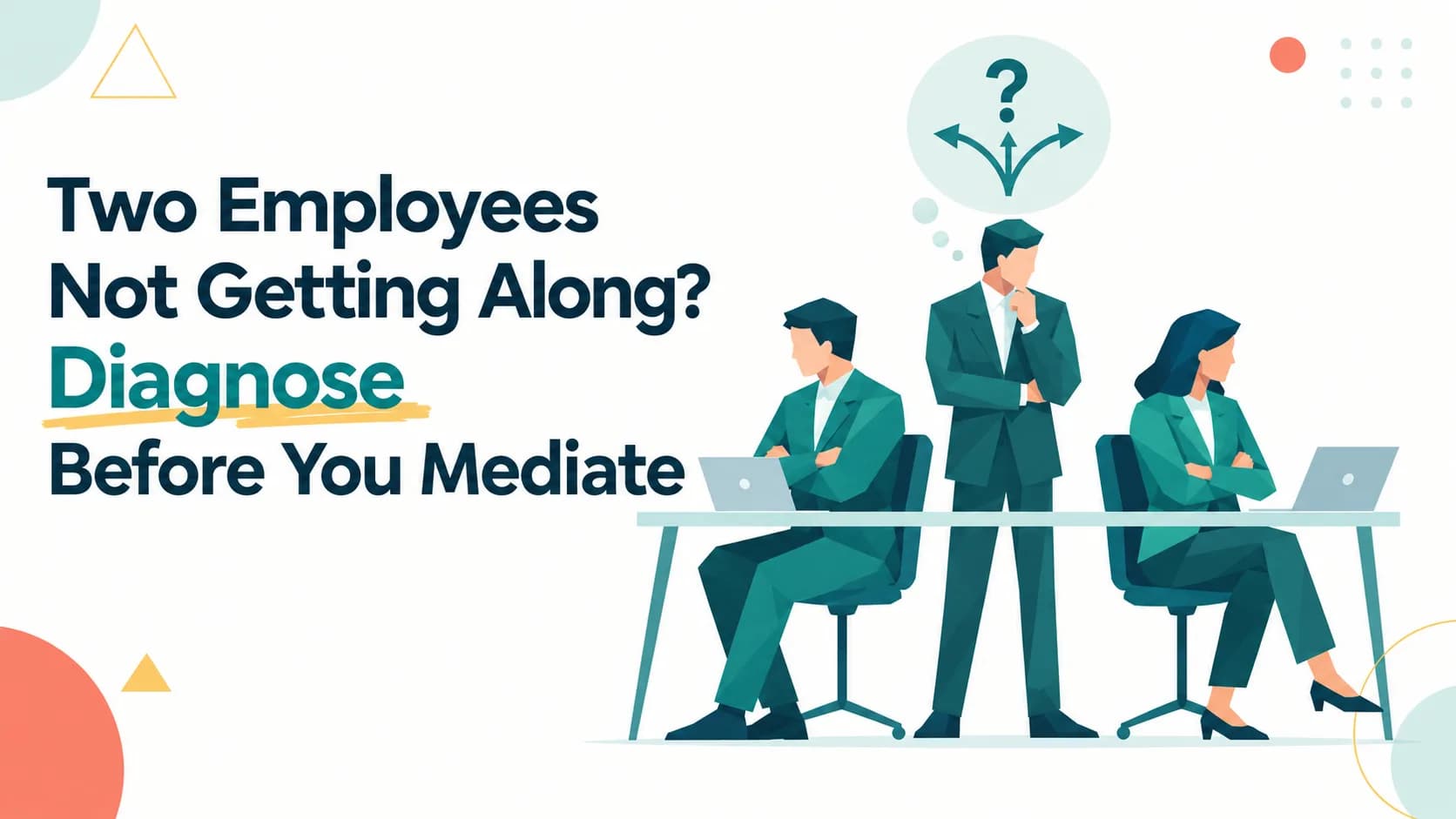
When two employees are not getting along, diagnose before you mediate. Talk to each person separately, then sort the problem into one of five types: misconduct, unclear roles, workload, a style clash, or one incident that festered. Only style clashes and festered incidents call for a joint conversation. The other types need a different fix.
When two employees are not getting along, most managers reach for the same fix: get them in a room and have them talk it out. Sometimes that works. More often it turns a problem about roles or workload into a conversation about feelings, and both people leave feeling judged while the cause stays exactly where it was.
I'd argue your first job is diagnosis. "They just don't get along" is a description of what you see, and it can come from at least five different causes. Each one needs a different fix, and mediation is the right fix for only two of them.
What usually sits behind they don't get along
Conflict at work between two coworkers is close to universal. In CPP Inc.'s Global Human Capital Report on workplace conflict, a 2008 survey of 5,000 full-time employees in nine countries across Europe and the Americas, 85% said they deal with conflict at work to some degree. When asked about causes, people named personality first. Look at what came after it.

CPP Global Human Capital Report, Workplace Conflict, July 2008 · 5,000 full-time employees in nine countries across Europe and the Americas
Personality clashes do happen. But when people name personality, they're often describing how a structural problem feels from the inside. Two people sharing one vague goal, or both stretched past capacity, will start to find each other difficult. That's why finding the real cause behind team problems comes before any fix.
How to handle two employees not getting along: the diagnostic guide
Work through these questions in order, after you've talked to each person on their own. Stop at the first yes.

Diagnostic decision guide · 4 questions, 5 conflict types
The order matters. Misconduct comes first because it changes who handles the problem. Roles and workload come next because they're the most common causes and the easiest to miss, since both people will describe them as a personality problem.
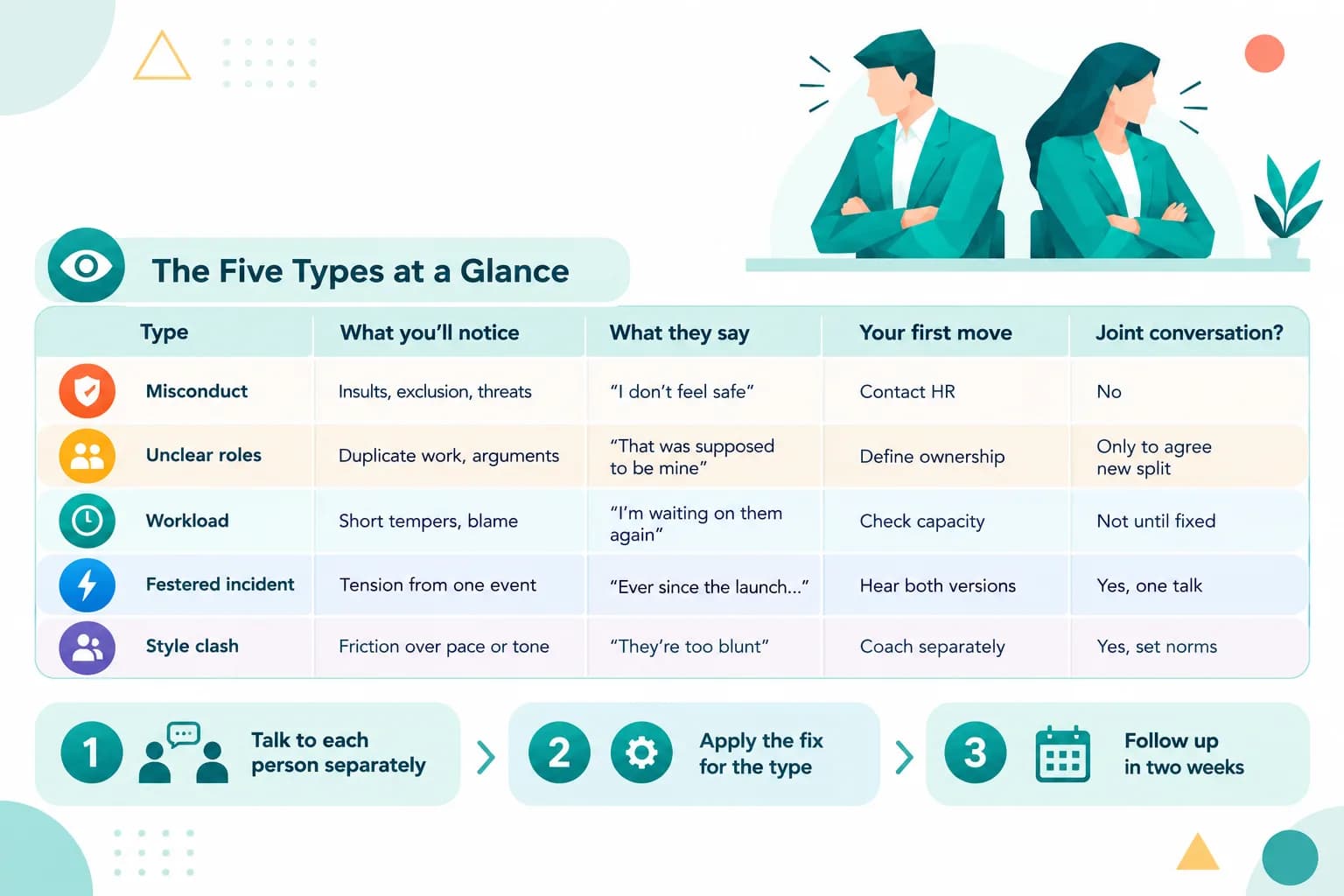
The five types at a glance
- Type: Misconduct. What you'll notice: Insults, exclusion tied to identity, threats, or fear of the other person. What each person tends to say: "I don't feel safe around them". Your first move: Contact HR before anything else. Joint conversation?: No. HR leads.
- Type: Unclear roles. What you'll notice: Duplicate work, dropped handoffs, arguments over who decides. What each person tends to say: "That was supposed to be mine". Your first move: Define ownership for the disputed work. Joint conversation?: Only to agree the new split.
- Type: Workload. What you'll notice: Short tempers near deadlines, blame for delays. What each person tends to say: "I'm waiting on them again". Your first move: Look at capacity and priorities. Joint conversation?: Not until the load is fixed.
- Type: Festered incident. What you'll notice: Tension that started on a specific day. What each person tends to say: "Ever since the launch meeting...". Your first move: Hear both versions of that day. Joint conversation?: Yes, one focused talk.
- Type: Style clash. What you'll notice: Friction over pace, detail, or tone, with no single trigger. What each person tends to say: "They're too blunt" or "too slow". Your first move: Coach each person separately. Joint conversation?: Yes, to agree working norms.
These types overlap sometimes. A workload problem can create a festered incident, for example. When that happens, fix the structural cause first, or the joint conversation will be undone by next week's deadline.
Step 1: Talk to each person separately
Meet each person on their own, ideally the same day, so neither hears about it secondhand first. Ask both the same questions:
"How is working with [name] going from your side?"
"When did it start to feel difficult? Was there a moment?"
"What do you need from them that you're not getting?"
"Who do you think owns [the disputed work]?"
"What would a good working relationship look like a month from now?"
You're listening for structure words: "supposed to," "waiting on," "my project," "nobody told me." Those point to roles or workload. Words about character, such as "rude" or "lazy," tell you how they feel and rarely tell you why.
Don't repeat what one person said to the other, and don't promise an outcome or hint at who you think is right, which takes real practice at staying calm and objective when one of them is upset. If you already hold regular one-on-one, these questions fit there naturally. This list of one-on-one meeting questions for managers has more for situations like this.
Step 2: Apply the fix for the type
Misconduct: hand it to HR
If either person describes harassment, discrimination, threats, or feeling unsafe, stop diagnosing and contact HR the same day. Write down what you were told and when, in their words. Don't investigate on your own, and don't bring the two people together, because a mediation can pressure someone who was harmed to "work it out" with the person who harmed them. This post is general guidance, not legal or HR advice.
Unclear roles: fix ownership, not feelings
When two people keep tripping over the same work, the fix is a clear answer to "who owns this?" Write it into the team's roles and responsibilities: who decides, who does the work, who needs to be told. Share it with both of them, and with anyone else who touches the work.
This is often the fastest fix in the whole guide, and the most satisfying. People who seemed to dislike each other often get along fine once they stop competing for the same job. Getting role clarity right across the whole team prevents the next version of the same fight.
Workload: rebalance before you talk about behavior
If one person is waiting on the other, and the other is drowning, a conversation about tone won't help. Look at what each person is carrying, drop or move something, and tell both what changed. Then watch whether the friction eases, which it often does. Steady workload management prevents the next round.
Festered incident or style clash: hold one joint conversation
These two types are where mediation earns its place. For a style clash, hold separate coaching conversations with each person first, so neither walks into the joint meeting feeling ambushed. Before the meeting, decide what the conversation is about and what a good outcome looks like. Open it like this:
"I asked you both here because the handoffs on the launch work keep breaking down, and it's affecting the team. I've talked to each of you. I'm not here to decide who's right. I'd like each of you to say what you need from the other, and then we'll agree on how you'll work together from here."
Three ground rules keep it on track:
Each person talks without interruption. Then the other summarizes what they heard before responding.
Describe what happened, not who someone is. "You changed the deadline without telling me" can be discussed. "You're disrespectful" can only be denied. These SBI feedback examples show how to phrase it.
End with one or two written agreements. For example: "Deadline changes go in the project channel, tagged to both of you."
Your role is to keep it fair and specific, not to deliver a verdict. For more on running this kind of meeting, see how to turn conflict into constructive dialogue.
Step 3: Follow up in two weeks
Put a check-in on the calendar before the joint conversation ends. Meet each person separately again and ask one question: "Is the agreement working?" If it is, say so to both. If it isn't, find out which part broke, and whether you misdiagnosed the type.
A conflict that comes back is often one nobody checked on: people agree in the room, then drift back when no one asks. Here's how to reach an agreement and close the loop so it holds.
Mistakes that make it worse
- Common move: Siding with the stronger performer. Why it backfires: The other person stops trusting you, and so does everyone watching. Do this instead: Judge the behavior and the facts, not the person's value to the team.
- Common move: "You two need to figure it out". Why it backfires: Leaves a structural problem with the two people least able to fix it. Do this instead: Diagnose first, then own the fix that's yours to make.
- Common move: Asking teammates what they think. Why it backfires: Spreads the conflict and turns it into gossip. Do this instead: Talk only to the two people involved, plus HR if needed.
- Common move: Waiting for it to blow over. Why it backfires: Small conflicts harden into a festered incident, then into a team problem. Do this instead: Start the separate conversations within a week of noticing.
- Common move: Moving one person without explaining why. Why it backfires: Reads as punishment, and the other person reads it as winning. Do this instead: If you separate them, tell both why, and frame it around the work.
Waiting it out is the one new managers fall into most, because the conversation feels risky. Avoiding a conversation you know you need to have is one of the common first-time manager mistakes, and it gets harder the longer it waits.
Practice the conversations before you need them
Diagnosis tells you what kind of conversation you need. Running it well is a separate skill. The course on difficult conversations covers preparing, staying calm, turning conflict into dialogue, and closing with an agreement, the everyday conflict resolution a manager needs, in videos under two minutes each. Watch the one you need the morning of the meeting. It's one of 13 short courses in New Manager Essentials, if the rest of the job is new too.

Related course - How to Handle Difficult Conversations
Short lessons on preparing, staying calm, turning conflict into dialogue, and closing with an agreement.
Common Questions
Should a manager get involved when two employees aren't getting along?
Yes, once it affects the work, the team, or either person's wellbeing. Start by talking to each person separately to find the cause. Everyday workplace disagreements that don't touch the work can be left alone, but keep an eye on them.
When should you involve HR in a conflict between employees?
Right away if either person describes harassment, discrimination, threats, or feeling unsafe. Also involve HR if the conflict continues after you've fixed the cause and held a joint conversation, or if it starts heading toward discipline.
Can you make two employees get along?
No. You can't make two people like each other, but you can require professional behavior and clear ways of working together. Fixing roles, workload, and agreed norms usually does more for the relationship than asking them to be friends. If you want a shared standard to point both people to, this guide to professionalism at work describes it from the employee's side.