
Most people who get promoted into their first management role receive no formal training. Research from the Chartered Management Institute and YouGov found that 82% of people entering management positions are “accidental managers” with no formal management and leadership training.
You need skills you can use this week, not a three-month theory course. This comparison looks at the main online options through that lens: cost, time commitment, format, and whether the content actually helps a newly promoted manager handle real situations tomorrow.
Quick answer
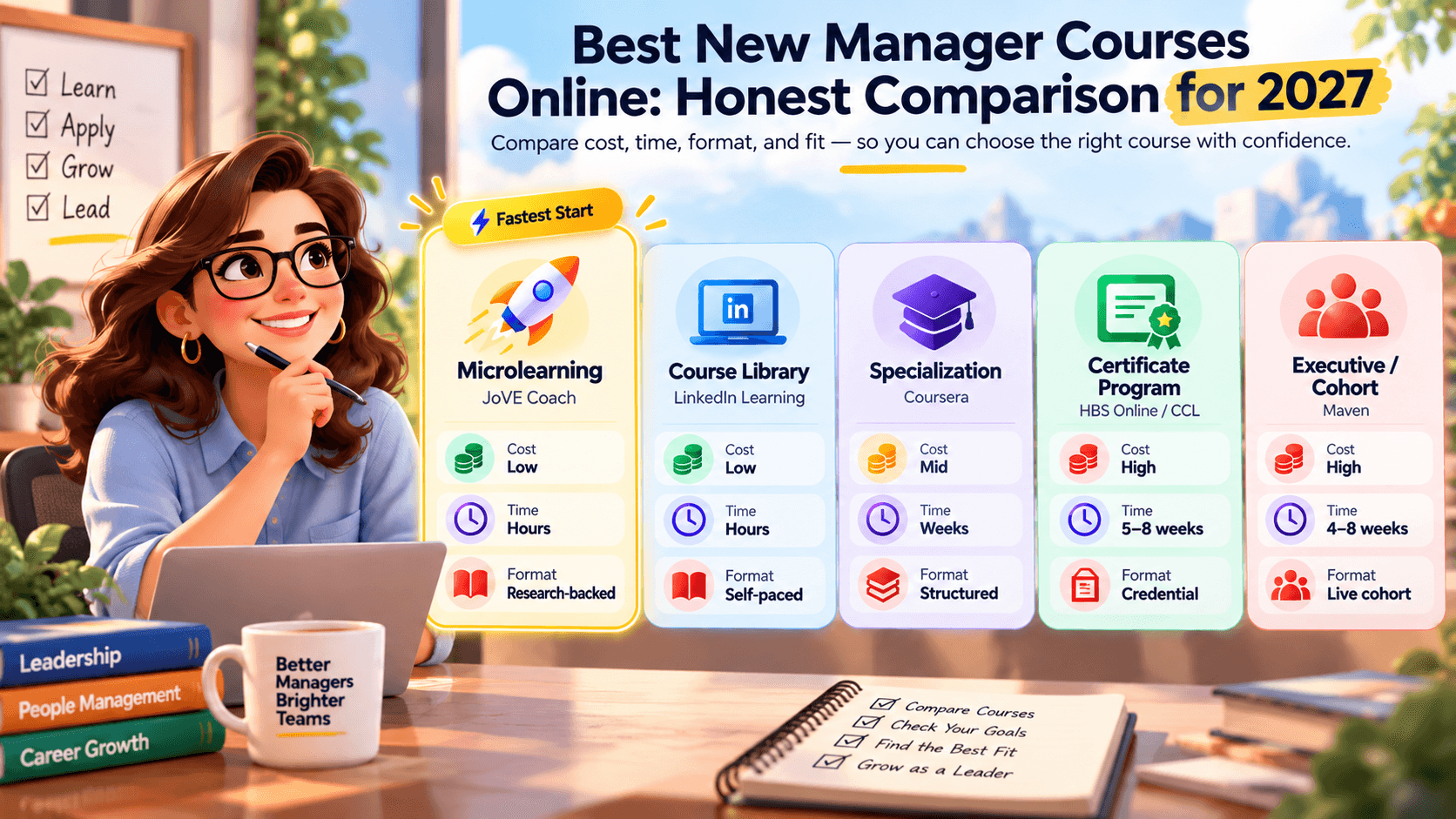
For most newly promoted managers who need practical, immediately usable skills without a heavy time or money commitment, short just-in-time micro-learning (like JoVE Coach New Manager Essentials) or low-cost self-paced libraries (LinkedIn Learning, selected Udemy courses) usually fit best. University-backed programs such as HBS Online offer stronger credentials at higher cost and longer duration. Cohort programs add peer accountability but require scheduled time.
How we compared the options
We weighed five practical criteria that matter to someone who was just promoted:
- Time to first use a skill — Can you apply something this week?
- Format fit for a busy new manager — Self-paced vs. cohort, short modules vs. long sessions.
- Cost — One-time vs. subscription, individual vs. organizational pricing.
- Depth vs. breadth — Foundations only, or ongoing just-in-time support.
- Evidence of practical focus — Scripts, scenarios, and tools for common first-year traps rather than pure theory.
No ranking claims “the best” overall. The right choice depends on your constraints.
JoVE Coach New Manager Essentials
Best for: Newly promoted managers who need short, specific lessons they can watch in the moment of need (before a difficult conversation, when deciding what to delegate, or during the first 90 days).
Format is online, self-paced micro-learning: 13 micro-courses and 93 concept videos, each under two minutes. Topics cover the full transition from individual contributor to manager, including setting boundaries with former peers, building credibility, delegating with clarity, handling difficult conversations, and managing performance.
Strengths: Extremely low time friction. You can open a two-minute video on how to set boundaries with former peers right before the conversation. Content is organized around the actual problems new managers face rather than abstract leadership models. Just-in-time design matches the reality that most new managers learn under pressure.
Limitations: No live cohort or instructor feedback. No formal university credential. Best used as ongoing support rather than a one-time “complete the program” experience.
Cost and time: Access model is typically organizational or individual subscription-style (check current pricing on the site). Individual videos are short enough to fit between meetings.
Start with the transition course if you are in your first 90 days: Your First 90 Days as a Manager. For the full program overview, see New Manager Essentials.
LinkedIn Learning — New Manager learning paths
Best for: Budget-conscious managers who want a broad library they can dip into as needed.
LinkedIn Learning offers several dedicated paths (for example, “Develop Your Skills as a New Manager” and specific courses on the first 90 days). Modules are short video lessons covering delegation, feedback, one-on-ones, trust, and managing former peers.
Strengths: Low monthly cost, huge library, mobile-friendly, certificates of completion that appear on LinkedIn. Easy to start immediately.
Limitations: Quality varies by instructor. Content is general rather than deeply scenario-based. Easy to consume passively without practicing the hard conversations.
Cost and time: Approximately $30 per month (or included with some LinkedIn Premium plans). Paths typically total 8–15 hours.
Coursera specializations (New Manager Readiness and similar)
Best for: Managers who want a more structured multi-course path with university or industry branding and peer-reviewed assignments.
Options include the New Manager Readiness Specialization and related programs covering communication, performance, and team leadership. Some are taught by university faculty or industry practitioners.
Strengths: Clear progression, shareable certificates, flexibility to audit for free or pay for the credential. Assignments force application to your real situation.
Limitations: Still primarily video-plus-quiz. Time commitment is higher than pure micro-learning. Not every specialization is tightly focused on the first-year manager experience.
Cost and time: Subscription (often ~$49/month) or individual specialization pricing. Several weeks at a few hours per week.
HBS Online — Management Essentials
Best for: Managers (or organizations) willing to invest more time and money for a Harvard Business School credential and process-focused frameworks.
The course runs roughly 20–25 hours over several weeks and covers managerial processes, decision-making, implementation, and adapting to distributed and AI-enabled work. Current pricing is in the range of $1,850–$1,949.
Strengths: Strong brand, rigorous case-based approach, clear certificate. Good for managers who want frameworks they can apply to systems and incentives, not just people skills.
Limitations: Higher cost and time commitment. Less focused on the immediate “I was promoted last Friday” survival skills (boundaries with former peers, first difficult conversation, day-one credibility). Better as a mid-year or year-two investment than pure first-90-days support.
CCL Boost (Center for Creative Leadership)
Best for: Managers who want a short, research-backed, self-paced program specifically designed for the first-time transition.
CCL Boost is an asynchronous online course of about six hours focused on the mindset and skill shifts required when moving from individual contributor to manager. Price is approximately $250.
Strengths: Purpose-built for new managers, grounded in CCL research, practical tools and reflection activities, modest cost and time.
Limitations: Finite course rather than ongoing library. Less granular just-in-time coverage of specific moments (for example, the exact words for a performance conversation).
Cohort and higher-touch options (Maven, selected executive programs)
Best for: Managers who learn best with peers, deadlines, and live discussion and whose organizations will fund the higher price.
Examples include Maven’s MGMT Fundamentals (roughly $950 for a multi-week cohort) and various executive education boot camps. These add accountability and networking.
Strengths: Peer learning, structured application, instructor access.
Limitations: Fixed schedules conflict with the unpredictable load of a new management role. Higher cost. Not ideal if you need something usable this afternoon.
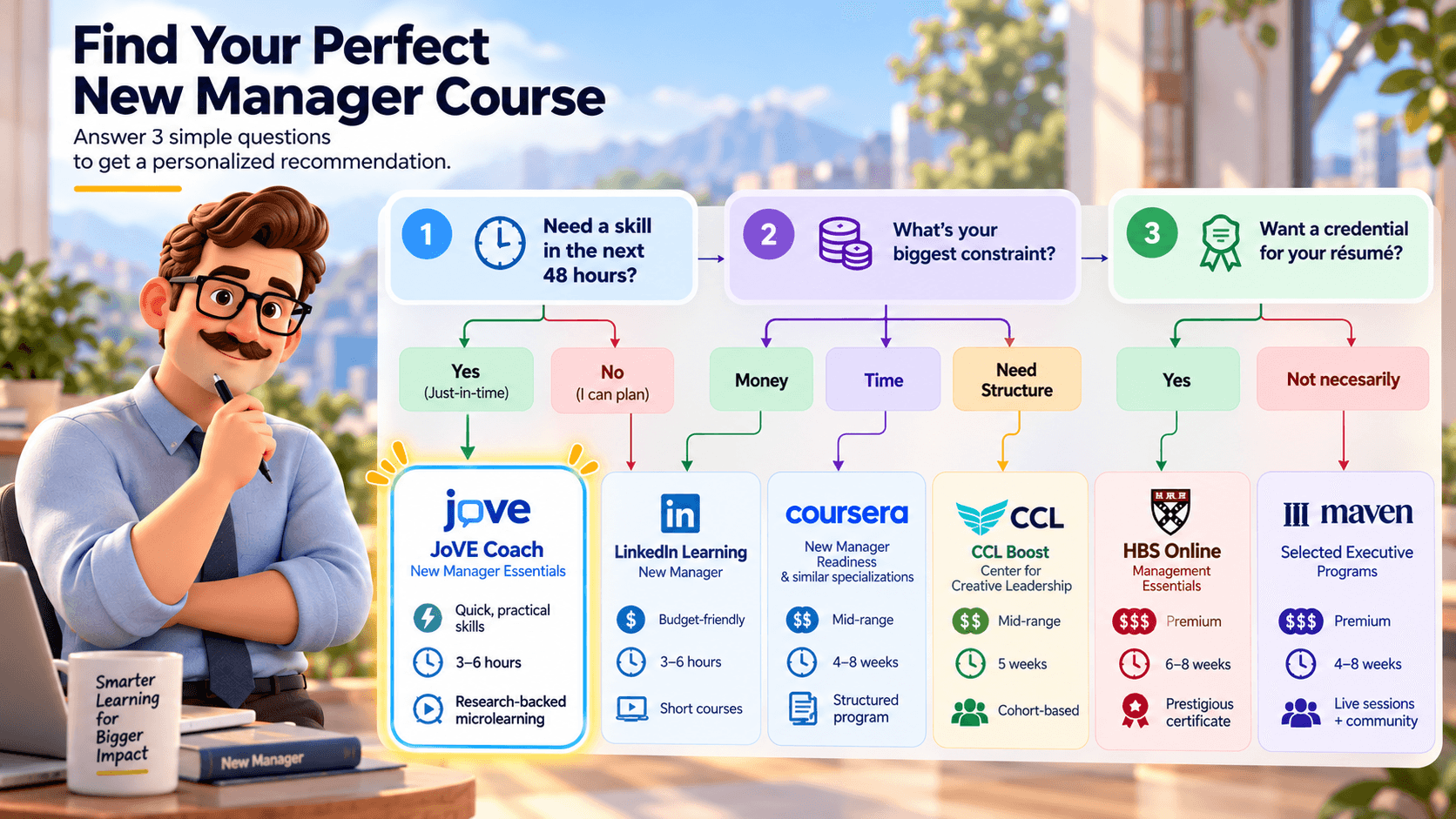
How to choose in five minutes
Ask yourself three questions:
- Do I need a skill for a conversation or decision happening in the next 48 hours? Prefer short, searchable micro-learning.
- Is my biggest constraint money, time, or lack of structure? Match the option to the constraint.
- Do I want a credential for my résumé or tools I will actually open under pressure? Credentials and just-in-time tools are different jobs.
Many new managers end up combining a low-friction library (LinkedIn Learning or JoVE Coach) for daily use with one deeper program later.
Why most courses miss the real first-year job
The biggest gap for new managers is not more content. It is content that shows up at the exact moment of need and is short enough to use under load. A two-hour video on “emotional intelligence” helps less than a two-minute lesson on staying calm in a tense conversation that you can watch in the parking lot before the meeting.
If you are in the middle of the transition, start with the concrete problems you are already facing: credibility with former peers, clear delegation, the first difficult conversation, and the first 90 days. The common mistakes first-time managers make and how to delegate work effectively lessons are practical places to begin.

Related course - New Manager Essentials
The full program walks through every phase of this transition, from your first day to your first quarter goals.
Common Questions
What is the best online course for a brand-new manager with almost no free time?
Short micro-learning designed for the moment of need. Two-minute lessons on specific situations (boundaries, delegation, difficult conversations) outperform multi-hour courses when your calendar is already full.
Are free or very cheap new manager courses worth it?
Yes for orientation and broad exposure. LinkedIn Learning and selected Udemy courses give useful language and frameworks quickly. They are weaker when you need practiced scripts for high-stakes conversations or ongoing just-in-time support.
How long should a first new-manager program take?
Enough to give you usable tools in the first 30 days, not a comprehensive leadership education. Many managers do better with continuous short support than one intensive program they never finish.
Is a university or HBS credential necessary for a first management role?
No. Credentials help later for career signaling. In the first year the priority is competence in the daily work of managing people.
Should my company pay for new manager training?
Yes. Organizations that promote people without training create the accidental-manager problem documented in the CMI research. Budget for practical, role-specific support rather than generic leadership theory.