
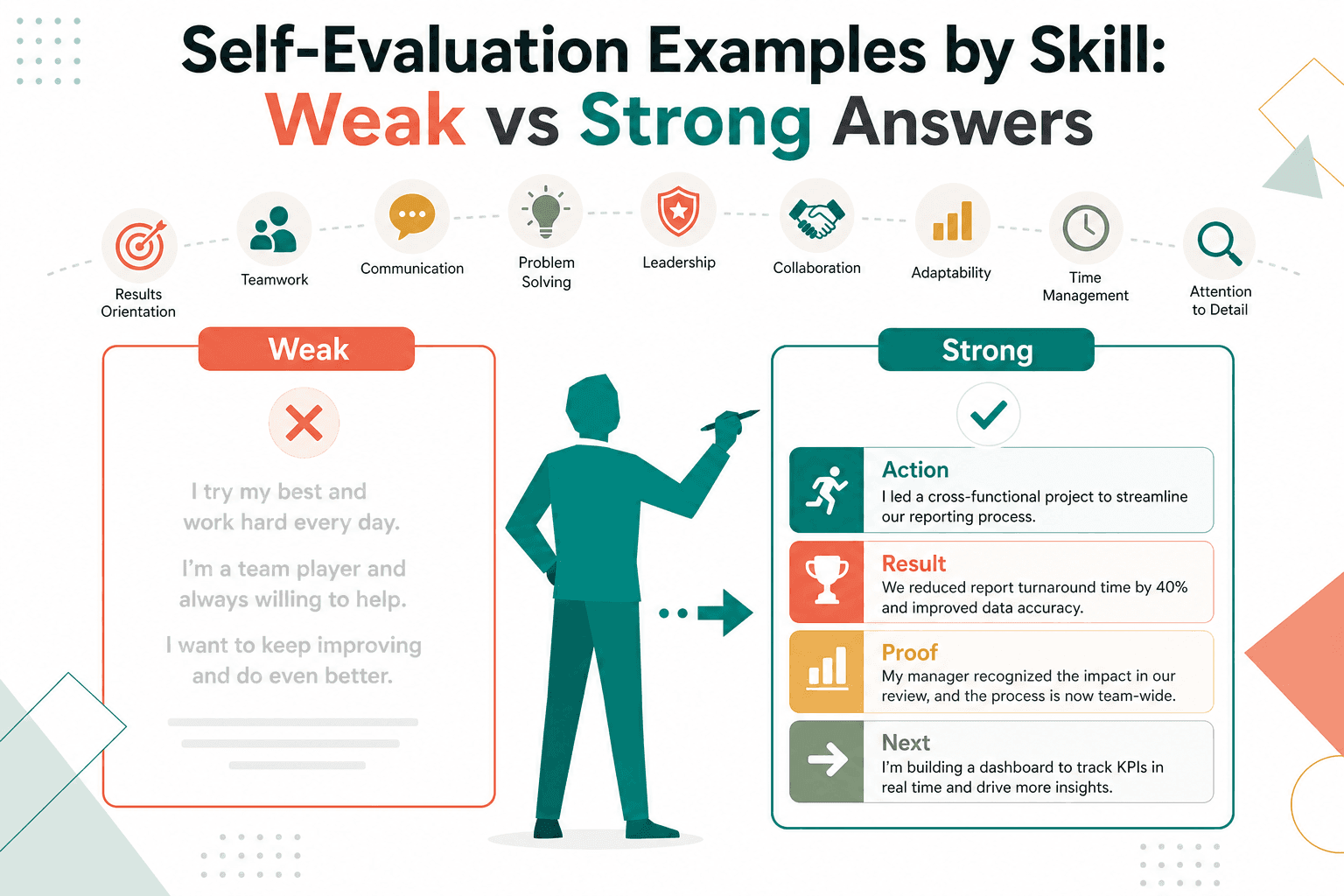
A strong self evaluation answer has four parts: what you did, the result, the proof, and what you'll do next. For example: "I rebuilt the onboarding checklist, cutting setup time from 10 days to 6, per the ops dashboard. Next, I'll extend it to enterprise clients." Below are weak vs strong self evaluation examples for 9 skills, and a fill-in template.
Search for self evaluation examples and you'll find lists of 70, 120, even 700 phrases to copy. The trouble is that your manager may read a dozen self-assessments this month, and "consistently exceeds expectations" sounds the same in every one of them. A copied phrase tells your manager you filled in the form. A specific example tells them what you did.
So this post does the opposite of a giant list. For each skill, you'll see one weak answer and one strong answer for the same work, and a short note on what changed. Once you see the pattern, you can write your own in minutes.
It matters more than it seems. Your self evaluation is often the first thing your manager reads before writing your review, and good lines get reused. Write the sentence you'd want quoted.
How to write a self evaluation: the 4-part formula
Every strong answer below follows the same four steps. Here's how one weak line becomes a strong one:
One weak line, rebuilt with the four parts. Use this pattern for every skill below
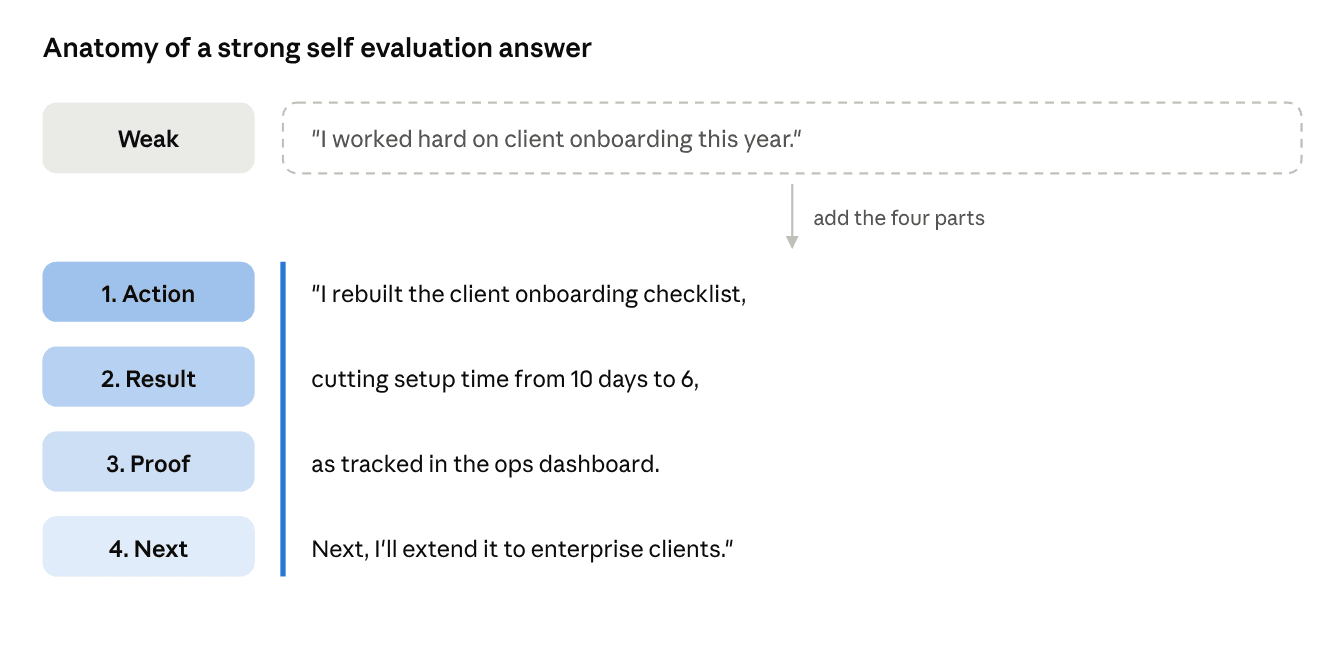
- Action. Start with what you did, in the first person, with a strong verb: built, led, fixed, trained, cut. Skip "helped with" unless you truly only helped.
- Result. Say what changed because of it. A number is best. If you don't have one, use a before-and-after ("from weekly fire drills to none") or a scale ("across three teams").
- Proof. Name where the result can be checked: a dashboard, a client email, a launch date, a colleague's feedback. One short phrase is enough.
- Next. End with what you'll do with it. This turns a look back into a plan, which is what your manager wants to discuss.
If this pattern looks familiar, it's close to the Situation-Behavior-Impact model managers use to give feedback, as in these SBI feedback examples. You're giving yourself the same specific, fair feedback.
Self evaluation examples by skill: weak vs strong answers
Each skill below has two pairs of examples. The weak version is the kind of line people copy from a list. The strong version describes the same work with the four parts. Swap in your own details, and keep the shape.
Communication self-assessment examples
| Weak | Strong |
|---|---|
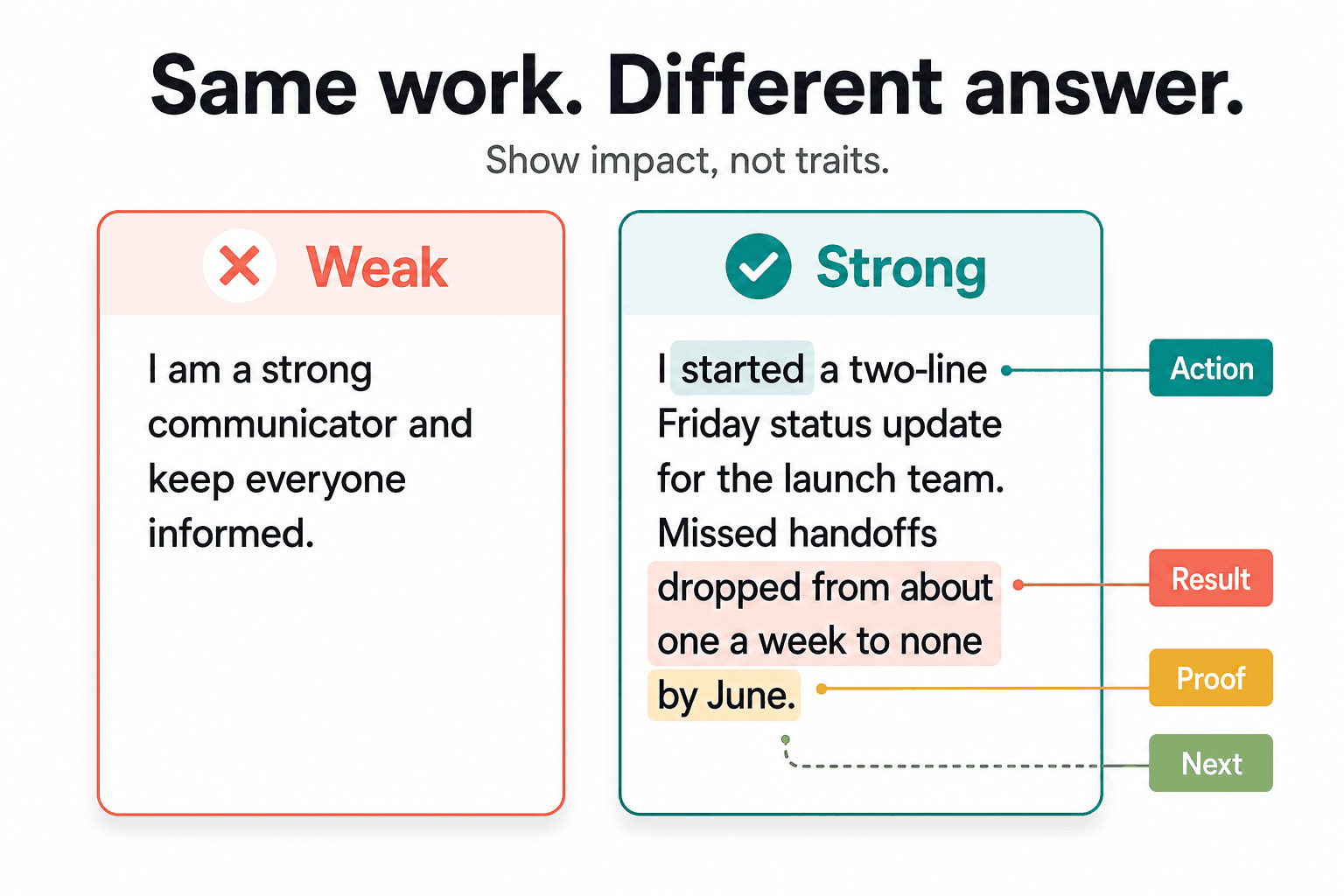
| "I am a strong communicator and keep everyone informed." | "I started a two-line Friday status update for the launch team. Missed handoffs dropped from about one a week to none by June, and the project lead now uses the format for other projects." |
| "I communicate well with clients." | "I rewrote our client kickoff email to answer the five questions clients asked most. Follow-up questions in week one fell by roughly half, based on our support inbox." |
What changed: the strong answers name a habit you can see, not a trait you claim. "Strong communicator" is an opinion. "Started a Friday update" is a fact your manager can confirm. If communication is a skill you want to build further, the guide to communication at work covers the habits that get noticed.
Teamwork and collaboration self evaluation examples
| Weak | Strong |
|---|---|
| "I am a team player and always willing to help." | "When a colleague went on leave in July, I took over her two client accounts for six weeks. Both renewed on time, and I handed them back with written notes on every open item." |
| "I work well with other departments." | "I set up a monthly 30-minute sync with finance to agree on reporting deadlines. Late data requests from our team went from four in Q1 to zero in Q3." |
What changed: "team player" is on almost every self-evaluation. A specific moment when you carried weight for someone else is not. Cross-team work like the finance sync is strong evidence of team coordination, which many managers value as much as solo output.
Accountability and reliability self-review examples
| Weak | Strong |
|---|---|
| "I am reliable and always meet my deadlines." | "I delivered 11 of 12 monthly reports on or before the due date. The one late report was flagged to my manager two days early with a new date, which we met." |
| "I take responsibility for my work." | "When I sent a client the wrong version of a contract in April, I told my manager within the hour, sent the corrected version with an apology, and added a final-check step that I've used on every contract since." |
What changed: a count beats a claim. "23 of 24" is more believable than "always", and it shows you're honest about the one miss. Owning a mistake and the fix you made reads as maturity, not weakness. Hitting dates consistently is the core of meeting deadlines, and naming your record proves it.
Time management self performance review examples
| Weak | Strong |
|---|---|
| "I manage my time well and prioritize effectively." | "With three projects overlapping in Q3, I agreed on priorities with my manager each Monday and blocked two mornings a week for the report work. All three shipped within a week of plan." |
| "I am very organized." | "I moved my task list from email flags into our project tracker in February. I haven't missed a recurring deadline since, and teammates can now see where my work stands." |
What changed: the strong answers show the system behind the result, which tells your manager it will keep working. Simple routines like weekly priority checks and time blocking are the heart of good time management skills.
Problem-solving self-assessment examples
| Weak | Strong |
|---|---|
| "I am a good problem solver." | "When invoice errors spiked in May, I traced 80% of them to one manual copy-paste step and proposed a simple lookup sheet. Errors fell from about 30 a month to 5 within two months, per the finance error log." |
| "I think outside the box." | "Our survey response rate had stalled at 12%. I tested a shorter three-question version with one client group, got 31%, and we've now rolled it out to all clients." |
Why it works: each strong answer walks through the problem, the cause you found, and the measured fix. That sequence shows how you think, which matters more than the label "problem solver." Finding the cause before fixing it is the core of analytical thinking skills.
Quality of work self evaluation examples
| Weak | Strong |
|---|---|
| "I produce high-quality work." | "Of the 40 client decks I built this year, two came back with corrections, both minor. I now run every deck through a five-point checklist before sending." |
| "I pay attention to detail." | "I caught a pricing error in the Q2 proposal before it went out, which would have undercharged the client by about $8,000. I added a second review step for all proposals over $20,000." |
Why it works: quality is hard to prove with adjectives and easy to prove with error rates and catches. It helps to describe quality the way your manager will. Managers are taught to rate work against clear standards, as in setting clear performance standards, so mirror those standards in your answer.
Initiative self-appraisal examples
| Weak | Strong |
|---|---|
| "I take initiative and go above and beyond." | "No one owned our outdated onboarding docs, so I offered to update them. I rewrote 12 pages over two months, and the last three new hires said they were the most useful thing in their first week." |
| "I am proactive." | "I noticed clients kept asking the same three billing questions, so I drafted an FAQ for the help center. Billing tickets dropped by about a quarter the following quarter." |
Why it works: initiative means doing something nobody asked for. The strong answers make that clear ("no one owned", "I noticed"), then show the payoff. Spotting a gap and closing it unasked is exactly what taking initiative looks like to a manager.
Areas for improvement: self evaluation examples for weaknesses
This is the section most people dread. Pick one real area, and show you're already working on it.
| Weak | Strong |
|---|---|
| "I sometimes work too hard." | "I tend to say yes to every request, which put two of my own deadlines at risk in Q3. I now check new requests against my priorities with my manager before agreeing, and I've hit every deadline since September." |
| "I could improve my presentation skills." | "Presenting to senior leaders is still uncomfortable for me. I've joined our internal presenting practice group, and I'd like to present the Q1 results myself to build confidence." |
The difference: "I work too hard" is a fake weakness, and managers know it. A real area, with a first step already taken, shows self-awareness and gives your manager something to support. If you got tough feedback this year, mention how you used it. Handling negative feedback calmly is itself a strength worth showing.
Goals: self assessment examples for next year
| Weak | Strong |
|---|---|
| "I want to keep growing and take on more responsibility." | "By the end of Q2, I'd like to lead the client renewal project end to end. To get there, I'd like to sit in on two senior client calls and take a short negotiation course." |
| "I would like to be promoted." | "I'd like to be considered for a senior analyst role within a year. Can we agree on two or three things you'd need to see from me to make that case?" |
The difference: a strong goal has a date, a clear outcome, and the support you need. Saying you want a promotion is fine, as long as you ask what it would take. Here's more on how to get promoted once you've asked. If the role you want is leading a team, it's worth knowing how a team lead role differs from a manager role first.
Fill-in self evaluation template (copy and paste)
Start with the one-sentence formula for each win, then drop the sentences into the full template.
One-sentence formula:
In [time period], I [action] which [result, ideally a number], as shown by [proof]. Next, I'll [what you'll do with it].
Full self-assessment template:
SELF EVALUATION: [Your name], [review period]
1. Top accomplishments (pick 3)
- In [period], I [action], which [result], as shown by [proof].
- In [period], I [action], which [result], as shown by [proof].
- In [period], I [action], which [result], as shown by [proof].
2. Skills I demonstrated (pick 2 or 3)
- [Skill]: [one specific example with a result]
- [Skill]: [one specific example with a result]
3. One area I'm working on
- [What happened or what I've noticed]
- [What I've already changed]
- [What I'd like to do next, and any support I need]
4. Goals for the next period
- [Goal with a date] / Skill to build: [skill] / Support I'd ask for: [support]
- [Goal with a date] / Skill to build: [skill] / Support I'd ask for: [support]
5. Anything else my manager should know
- [Feedback from colleagues, recognition, or context]
Aim for about one page. If you're filling in a company form with set questions, use the same pieces: accomplishments go in the achievements box, the improvement area goes in the development box, and so on.
Self-review phrases to avoid, and what to write instead
| Avoid | Why it falls flat | Write instead |
|---|---|---|
| "Exceeded expectations in all areas." | Nobody exceeds everything, so it reads as unexamined | Pick your three strongest areas and prove each one |
| "I'm a perfectionist." | A disguised boast, and managers spot it | Name a real area and the first step you've taken |
| "Helped with the launch." | Hides what you did | "Wrote the launch FAQ and trained the support team on it." |
| "I always meet deadlines." | "Always" invites someone to find the exception | "Delivered 23 of 24 reports on time." |
| "We increased sales by 10%." | Your manager can't tell what was yours | "I built the lead list that produced a third of new deals." |
| "I didn't have enough support." | Sounds like blame, even when it's true | "I'd hit these targets faster with [specific support]." |
Keep growing after the review
A self evaluation shows you where you stand. The next step is building the skills you named in your goals. The course on professional growth covers career goal setting, finding your skill gaps, and planning your next step, in short videos you can fit around your work.

Related course - Personal Development
Short lessons on career goal setting, finding skill gaps, and planning your next step, in videos you can fit around your work.
Common Questions
How do you write a self evaluation?
For each point, write what you did, the result, the proof, and what you'll do next. For example: "I rebuilt the onboarding checklist, cutting setup time from 10 days to 6, per the ops dashboard. Next, I'll extend it to enterprise clients." Cover three accomplishments, two or three skills, one area for improvement, and your goals.
What should I write in my self assessment?
Include your top three accomplishments with results, two or three skills shown through specific examples, one real area you're working on with the steps you've taken, and two or three goals for the next period with the support you need. Keep it to about one page.
How long should a self evaluation be?
About one page, or a few short paragraphs per question if your company uses a form. Specific, short answers are easier for your manager to use than long ones, and they're more likely to be quoted in your review.
Should I rate myself high or low on a self evaluation?
Rate yourself honestly, and back every rating with evidence. Underrating yourself can anchor your manager low, while overrating without proof hurts your credibility. If you're between two ratings, choose the higher one only if you can point to specific results that support it.


