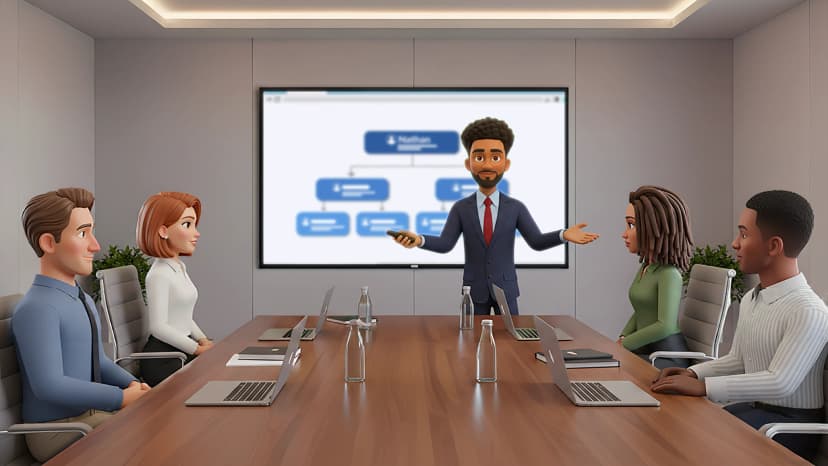
Keep your first team meeting as a new manager to 30 minutes. Spend under 10 minutes talking about yourself and the change, about 15 minutes asking three questions and listening, and the rest on next steps. Skip the vision speech, any talk about the previous manager, and promises you can't keep.
Most guides to this meeting assume you are walking into a room of strangers. They tell you to share your background, explain your leadership style, and run an icebreaker. If you were promoted from inside the team, that script falls flat.
Your team already knows your background. They have watched you sit through the same Monday stand-up you now run. What changed is your role, and the people in the room are watching for one thing: whether you will handle that change fairly.
Some of them hope you will fix what bothered them last month. One of them may have applied for your job.
Below you'll find a 30-minute agenda, the words to use in each block, and a list of what to leave out. Notes at the end cover what to change if you were hired from outside.
The 30-Minute Agenda for Your First Team Meeting as a New Manager
Thirty minutes is long enough to listen and short enough that you won't fill the silence with a speech. Book it within your first week, before rumors fill the gap.
- 0:00 to 2:00 - Name the change: Say out loud that the relationship has shifted
- 2:00 to 6:00 - Your first 30 days: Tell them what you will and won't do yet
- 6:00 to 9:00 - How you'll work together: Set up one-on-ones and how to reach you
- 9:00 to 24:00 - Three questions: Listen, take notes, and don't defend
- 24:00 to 27:00 - Play it back: Repeat what you heard and commit to one small fix
- 27:00 to 30:00 - Close: Confirm next steps and end on time
Send the invite with a one-line purpose: "Quick team meeting to talk about how we'll work together and to hear what you need." A clear purpose lowers the guessing before anyone walks in.
What to Say: The Talk Track, Block by Block
Read these scripts out loud once before the meeting, then put them in your own words. People can tell when you are reciting.
Minutes 0 to 2: Name the change
"Thanks for making time. You all know me, so I'll skip the background. What's different is my role, and I know that makes this a little strange for all of us. It's strange for me too. I'd rather say that out loud than act like nothing changed."
Saying "nothing's going to change" feels kind at the moment. It is also a promise you will break the first time you give someone feedback or make a call they dislike. Naming the awkwardness up front costs you ten seconds and buys you room later.
The harder work happens one person at a time, in private, never in front of the group. Our guide to managing peers after a promotion walks through the moments that test it, like the early schedule favor and the friend who disagrees with your first call. When a friendship starts to blur with your new role, practice drawing clear lines with friends who now report to you.
Minutes 2 to 6: Say what you will and won't do in your first 30 days
"For the next month, my job is to learn how this team works from the manager's seat. I'm not walking in with a list of changes. I'll meet each of you one-on-one, look at how work comes in and gets done, and come back to you with what I see before anything changes."
Expect someone to ask, "So what are you going to change?" Have this answer ready:
"Nothing big in the first month. If something is blocking your work right now, tell me today and I'll look at it this week. Bigger changes will come after I've talked to each of you, and you'll hear about them from me first."
That answer gives you two promises you can keep: look at a blocker this week, and tell them before you change anything. Keeping small promises is how new managers build credibility with people who knew them as a peer.
Minutes 6 to 9: Explain how you'll work together
"Starting next week, I'll set up a 30-minute one-on-one with each of you. Invites go out by Friday. Our weekly team meeting stays at its usual time for now. If something is urgent, message me directly. I'd rather hear about a problem while it's small."
Give a day, not a vague offer. "My door is always open" puts the work of reaching out on them. "Invites go out by Friday" puts it on you, and Friday becomes the first deadline they see you hit.
Also name one thing that stays the same, such as who owns a recurring report or how the on-call rotation works. It tells people their daily work is safe while you learn.

Minutes 9 to 24: Ask three questions, then stop talking
This block is the reason the meeting exists. Ask the group one question at a time:
"What's working on this team that you want me to protect?"
"What's one thing that slows you down every week?"
"What did you need from a manager in the past that you didn't get?"
How you listen matters more than which questions you pick.
- Wait out the silence. Count to ten in your head before you speak. Someone almost always fills it.
- Write answers where people can see them, on a whiteboard or a shared screen. Visible notes show you are recording, not judging.
- Don't explain or defend. If someone criticizes a process you helped build, say "Thanks. Tell me more about that," and write it down.
- Plan for a quiet room. If answers dry up, open a shared doc or anonymous form and say it stays open until Friday. Some people will only say the real thing in writing.
On a video call, ask everyone to type a short answer in the chat first, then invite two or three people to say more. It stops the two loudest voices from setting the agenda. For more on the early hesitation a team shows a new leader, see earning trust from a team that is still holding back.
Minutes 24 to 27: Play it back and commit to one small fix
"Here's what I heard: [two or three themes]. I can't fix all of that this month. The one I'll take on first is [small item], and I'll give you an update at next week's meeting."
Pick a fix you fully control and can finish in under two weeks. Good examples: cancel a status meeting nobody uses, chase down a tool access request that has been stuck for a month, or clarify who approves a recurring task. Skip anything that needs your manager's budget or another team's buy-in.
A fast, small win does more for trust in week one than a big promise that stalls.
Minutes 27 to 30: Close
"That's it for today. One-on-one invites go out by Friday, and I'll update you on [small item] next week. Thanks for being straight with me."
End on time, even if the conversation is going well. If people want to keep talking, that is what the one-on-ones are for.
What to Skip in Your First Team Meeting
What you leave out shapes the meeting as much as what you say. Cut these:
- A vision speech or change plan. You don't know enough yet, and a team often hears "my plan" as "your work was wrong."
- Any comment on the previous manager, good or bad. Praise sounds like you are measuring yourself against them. Criticism gets repeated.
- Any mention of the colleague who also applied. Have that conversation privately, before the team meeting if timing allows, or first in your round of one-on-ones. You can open with: "I know you went for this role too. I want you to grow here, and I'd like to hear what you were hoping this role would give you."
- Jokes about being the boss. They get quoted back to you the first time you make an unpopular call.
- Promises about pay, promotions, headcount, or remote work that your manager hasn't confirmed in writing. If asked, say: "I don't know yet. I'll find out and tell you by [date]."
- Individual performance issues. These are private conversations, every time.
- A long icebreaker. Your team already knows each other. Fifteen minutes of real questions will tell you more than a game.

If You Were Hired From Outside
The agenda still works. Change two things.
First, replace the opening script. Spend two minutes on what you did before and why you took this job, then move straight to the first-30-days block. Keep it short, because the team cares more about how you will treat them than about your resume.
Second, do your homework before the meeting. Ask your own manager, and the previous manager if they are available, about any recent conflict, recent wins, and anyone who wanted the role. Walking in blind to a sore spot is the most common way an outside hire loses the room on day one.
After the Meeting: Your Next Two Weeks
The meeting earns you a little goodwill. What you do next decides whether it lasts.
Gallup estimates that managers account for at least 70% of the variance in employee engagement scores across business units (Gallup). Engagement follows what you do week to week, and the first two weeks set the pattern.
Within 24 hours, send a short recap:
"Thanks for today. Here's what I heard: [themes]. First thing I'm taking on: [small item], update next week. One-on-one invites are in your calendar. The shared doc stays open until Friday if you think of anything else."
Then keep the promises in order:
- Hold every one-on-one in the first round. Rescheduling the first one tells people where they rank.
- Report on your small fix at the next team meeting, even if it is only half done.
- Decide the format of your regular team meeting after the one-on-ones, once you know what people need from it. Running weekly meetings that drive results is the next skill to build.
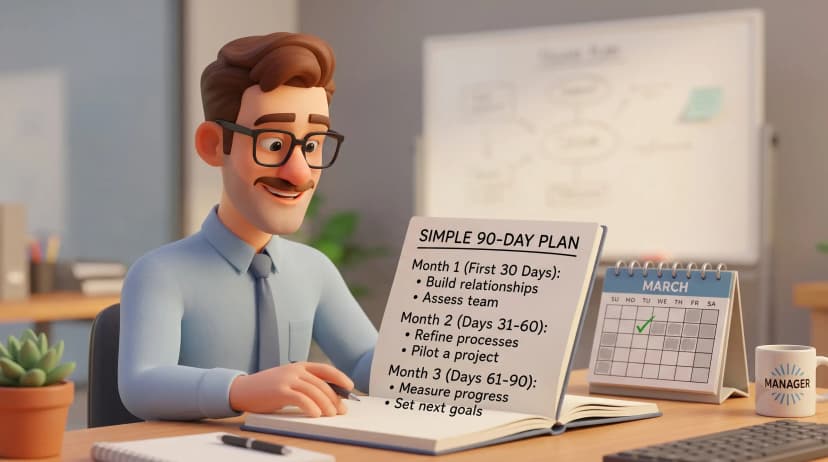
This meeting is one step in your first 90 days as a manager, and the week-by-week plan picks up where this post ends, with what to ask in those first one-on-ones. The meeting sets up the one-on-ones, and the one-on-ones set up every change you make later.
Practice the Next Conversation Before You Need It
This meeting is the first of many new conversations in your first month: the friend who now reports to you, your first piece of feedback, the first decision someone pushes back on. The Transitioning From Individual Contributor to Manager microcourse covers that shift in six short videos, each under two minutes, so you can watch the one you need the night before you need it.
It is one of 13 courses in New Manager Essentials, JoVE Coach's self-paced program for first-time managers.

Related course - New Manager Essentials
Short videos and practice for first-time manager conversations, from your first team meeting to feedback that lands.
Common Questions
Should I hold one-on-ones before or after my first team meeting?
If you were promoted from within, hold the team meeting first so everyone hears the same message at the same time. Then run one-on-ones within the next week or two. The one exception is a colleague who also applied for your role. Talk to them privately before the team meeting if you can, so they don't hear your plans for the first time in a group.
Can I run my first team meeting on a video call?
Yes. Use the same 30-minute agenda and ask people to turn cameras on if your team normally does. Have everyone type a short answer in the chat before anyone speaks, and keep notes in a shared doc on screen so people can see what you are recording.
What should I say if someone asks a question I can't answer?
Say you don't know yet and give a date for your answer: "I don't know yet. I'll find out and tell you by Thursday." Then meet that date. This matters most for questions about pay, promotions, headcount, and policy, where a guess can turn into a promise you can't keep.