Loading video…


 8 Concepts
 13K views

Video Summary: What are Capacitors
Ever wonder how your smartphone camera flash delivers that brilliant burst of light in milliseconds? The energy stored in capacitors makes this possible, as these electronic components can rapidly discharge accumulated electrical energy on demand. What are capacitors? They're fundamental circuit elements consisting of two conducting plates separated by an insulating material called a dielectric, capable of storing electrical energy in an electric field. From car audio systems in Ford and Toyota vehicles to medical defibrillators in US hospitals, capacitors are essential for energy storage and signal processing applications. Watch the full video on JoVE Coach to master this concept with expert-led visuals and step-by-step explanations.
What are capacitors? At their core, capacitors are passive electronic components designed to store electrical energy temporarily in an electric field. The basic structure consists of two conducting plates (typically aluminum, tantalum, or ceramic) separated by a dielectric material such as air, paper, plastic, or specialized ceramics. This simple yet elegant design enables capacitors to accumulate and release electrical charge rapidly, making them indispensable in modern electronics from smartphones to industrial power systems.
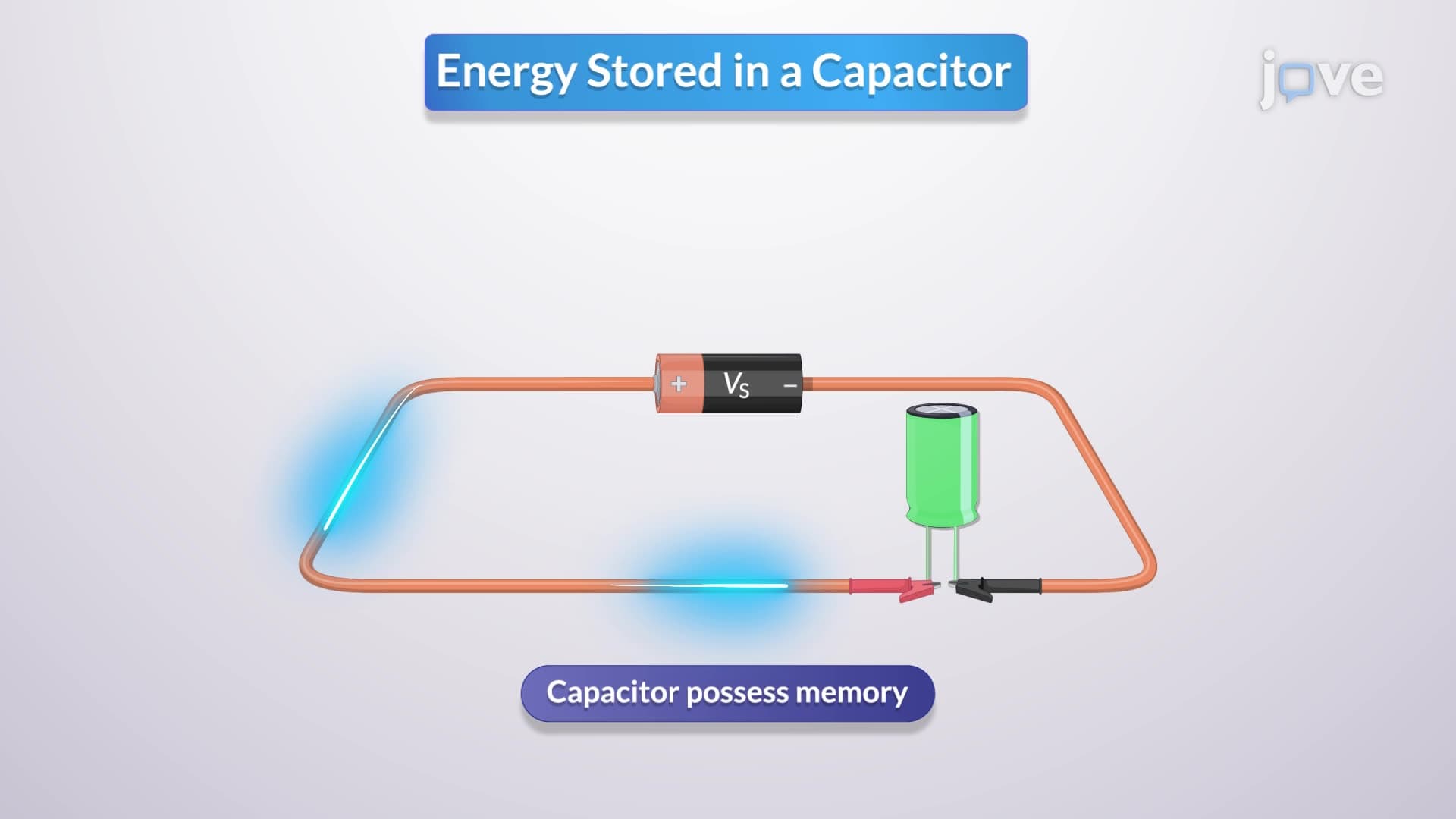
The energy stored in capacitors depends on the electric field created between the plates when voltage is applied. As positive charge accumulates on one plate and negative charge on the other, an electric field develops across the dielectric. The strength of this field, combined with the capacitor's geometry, determines how much energy can be stored. This principle appears frequently on AP Physics exams and college-level electrical engineering courses, where students must calculate energy storage using the formula: Energy = (1/2) × C × V², where C represents capacitance and V represents voltage.
The types of energy stored in capacitors primarily involve electrostatic potential energy, though the specific storage mechanism varies with capacitor design. In parallel-plate capacitors commonly studied in high school physics, energy storage occurs through charge separation across the dielectric gap. Electrolytic capacitors, widely used in power supplies for computers and televisions, achieve higher energy density through thin oxide layers that act as extremely effective dielectrics.
Understanding the energy stored in capacitors concept requires grasping how dielectric materials enhance storage capacity. Materials like barium titanate can increase capacitance by factors of thousands compared to air-filled capacitors. This principle explains why modern smartphones can pack tremendous energy storage into tiny components, advanced dielectrics enable compact designs essential for portable electronics.
The energy stored in capacitors overview reveals applications spanning from everyday consumer electronics to critical infrastructure. In automotive systems, capacitors in Ford and General Motors vehicles store energy for ignition systems and audio equipment. Medical devices like automated external defibrillators (AEDs) found in US schools and workplaces rely on capacitors to store and rapidly deliver life-saving electrical energy to patients experiencing cardiac arrest.
For students preparing for the MCAT or engineering entrance exams, understanding capacitor energy storage connects directly to broader electrical principles. The energy stored in capacitors study guide approach should emphasize both theoretical calculations and practical applications, as exam questions frequently test both conceptual understanding and mathematical problem-solving skills involving energy, charge, and voltage relationships in capacitive circuits.
Related Micro-courses