Loading subject page…


290,608 views


Video Summary: What Is Ionization Energy
Ever wonder why sodium explodes in water while neon gas remains completely unreactive? The answer lies in ionization energy, the energy required to remove electrons from atoms. This fundamental concept explains why elements like those used in Tesla's lithium-ion batteries behave so differently from the noble gases in neon signs across Las Vegas. Understanding what is ionization energy reveals the hidden forces that govern all chemical reactions around us. Watch the full video on JoVE Coach to master this concept with expert-led visuals and step-by-step explanations.
Ionization energy represents one of the most crucial periodic properties that determines how atoms interact chemically. Defined as the minimum energy required to remove the most loosely bound electron from a gaseous atom in its ground state, this property explains why certain elements readily form ions while others remain stubbornly neutral. The measurement is expressed in kilojoules per mole (kJ/mol), providing a quantitative way to compare the "grip" different atoms have on their electrons.
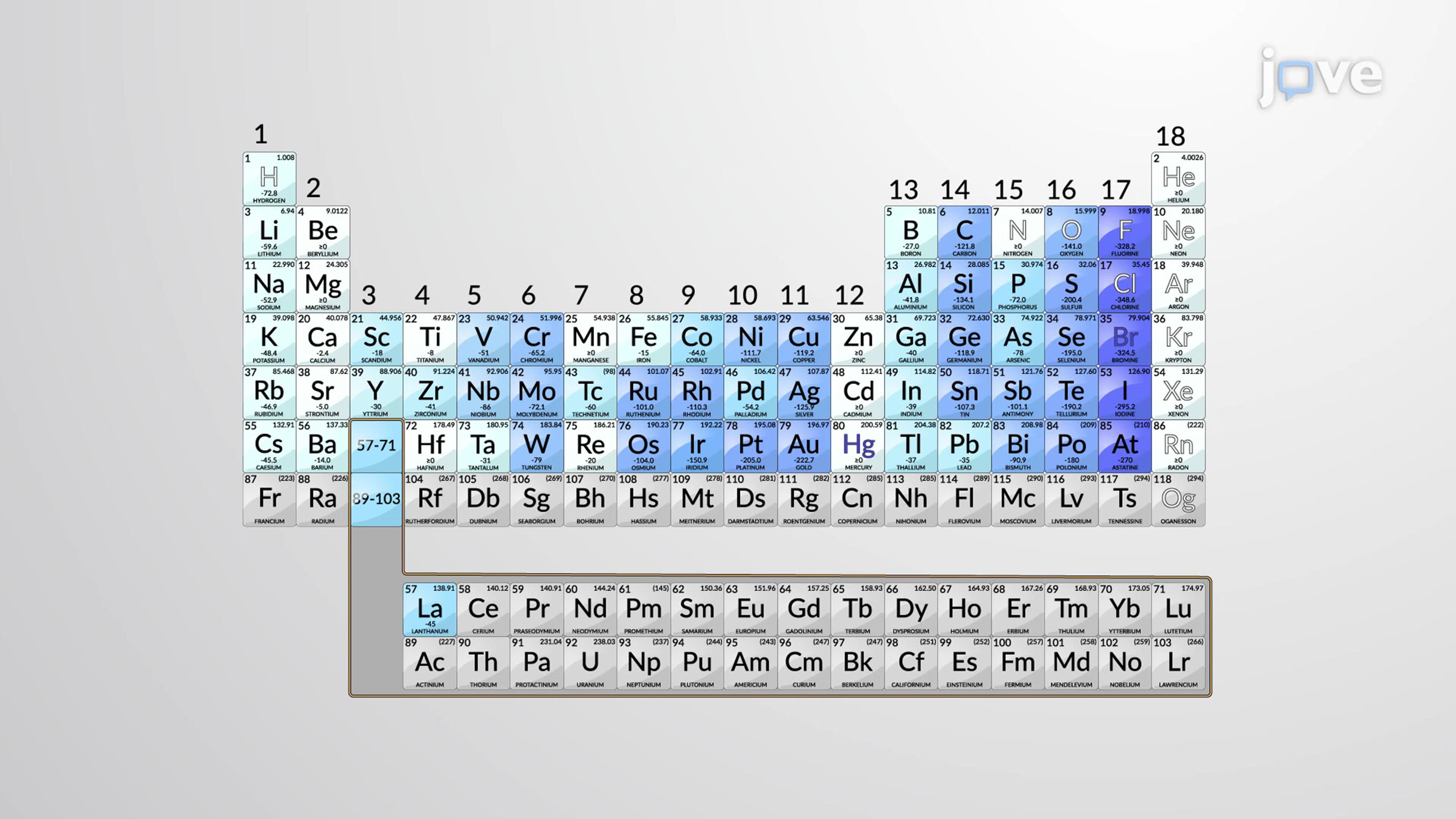
The ionization energy definition becomes clearer when examining periodic trends. Moving across a period from left to right, ionization energy generally increases. This occurs because the nuclear charge increases while electrons are added to the same energy level, creating a stronger electrostatic attraction. For example, chlorine (1251 kJ/mol) requires significantly more energy to ionize than sodium (496 kJ/mol), explaining why sodium readily loses electrons in reactions while chlorine tends to gain them.
Moving down a group, ionization energy decreases as atomic radius increases. The outermost electrons become farther from the nucleus and experience greater shielding from inner electron shells. This trend explains why francium, at the bottom of Group 1, has the lowest first ionization energy of all naturally occurring elements.
What is ionization energy in detail includes recognizing important exceptions to general trends. Boron shows lower ionization energy than beryllium despite being farther right on the periodic table. This occurs because beryllium's electron comes from a lower-energy 2s orbital, while boron's electron occupies a higher-energy 2p orbital. Similarly, oxygen has a lower first ionization energy than nitrogen due to electron-electron repulsion in oxygen's paired p-orbital electrons.
These exceptions appear consistently in subsequent periods, making them crucial for AP Chemistry and college-level coursework. Students preparing for the MCAT or advanced placement exams must recognize these patterns to accurately predict chemical behavior.
The concept extends beyond first ionization energy to second, third, and higher ionization energies. Each successive electron removal requires increasingly more energy, particularly when electrons must be removed from completed inner shells. For instance, magnesium's second ionization energy (1451 kJ/mol) is reasonable, but its third ionization energy (7733 kJ/mol) is dramatically higher because it involves removing an electron from the stable neon-like core configuration.
This principle explains why main-group elements typically form ions with charges that preserve noble gas configurations, a concept fundamental to understanding ionic compounds in both academic study and industrial applications like battery technology.
Related Micro-courses