Loading…
Loading video…

12,994 views
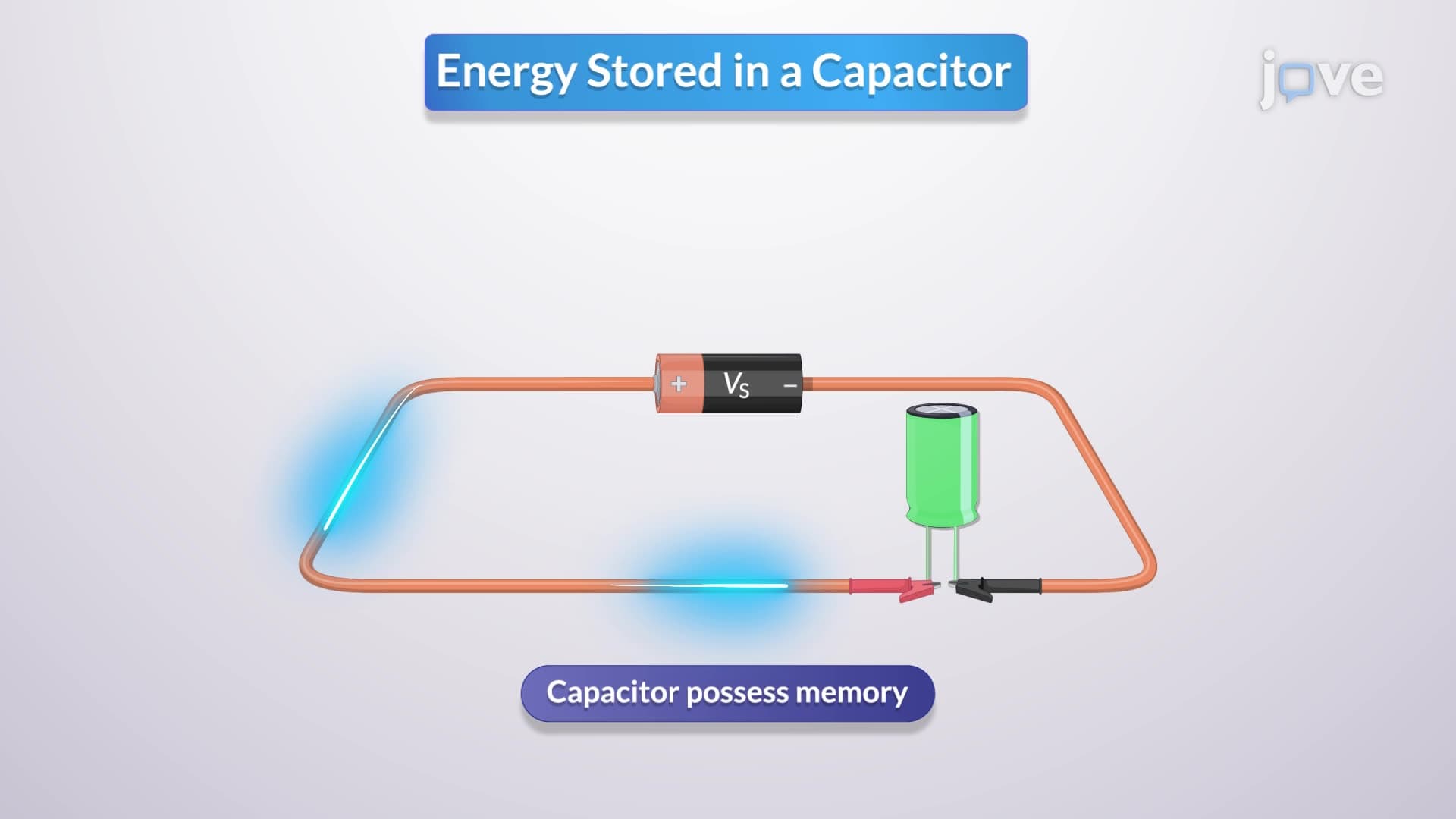
Ever wonder how your smartphone stores energy for that instant camera flash? The secret lies in equivalent capacitance – the combined effect when multiple capacitors work together in electronic circuits. From the capacitors in your iPhone's camera flash to the power systems in Tesla's electric vehicles, understanding what are series and parallel capacitors is crucial for mastering circuit analysis. These configurations follow specific mathematical relationships that determine total energy storage capacity. Watch the full video on JoVE Coach to master this concept with expert-led visuals and step-by-step explanations.
Equivalent capacitance represents the single capacitor value that could replace multiple capacitors in a circuit while maintaining identical electrical behavior. This concept forms the foundation for analyzing complex capacitor networks in everything from computer motherboards to automotive electronics.
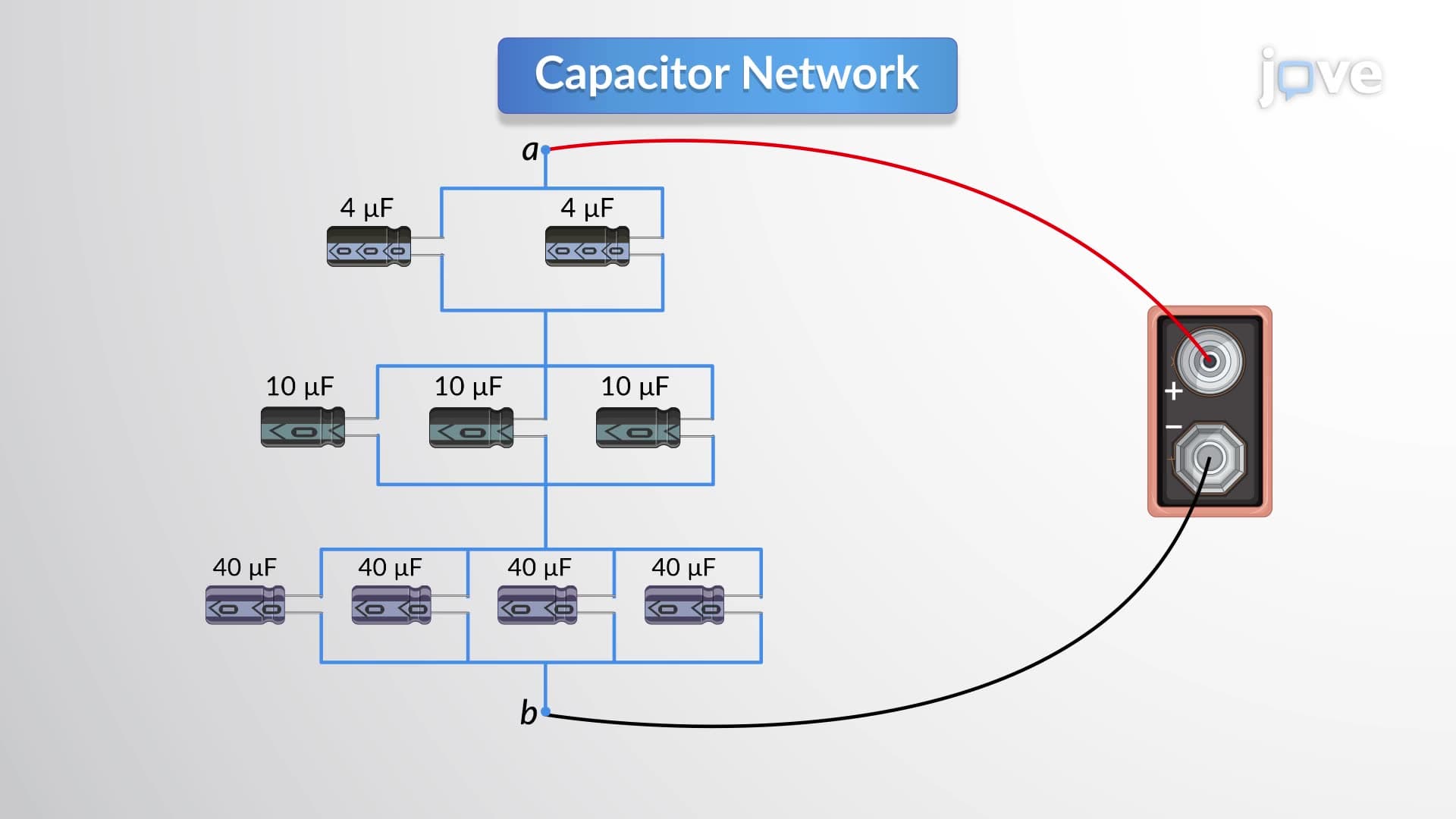
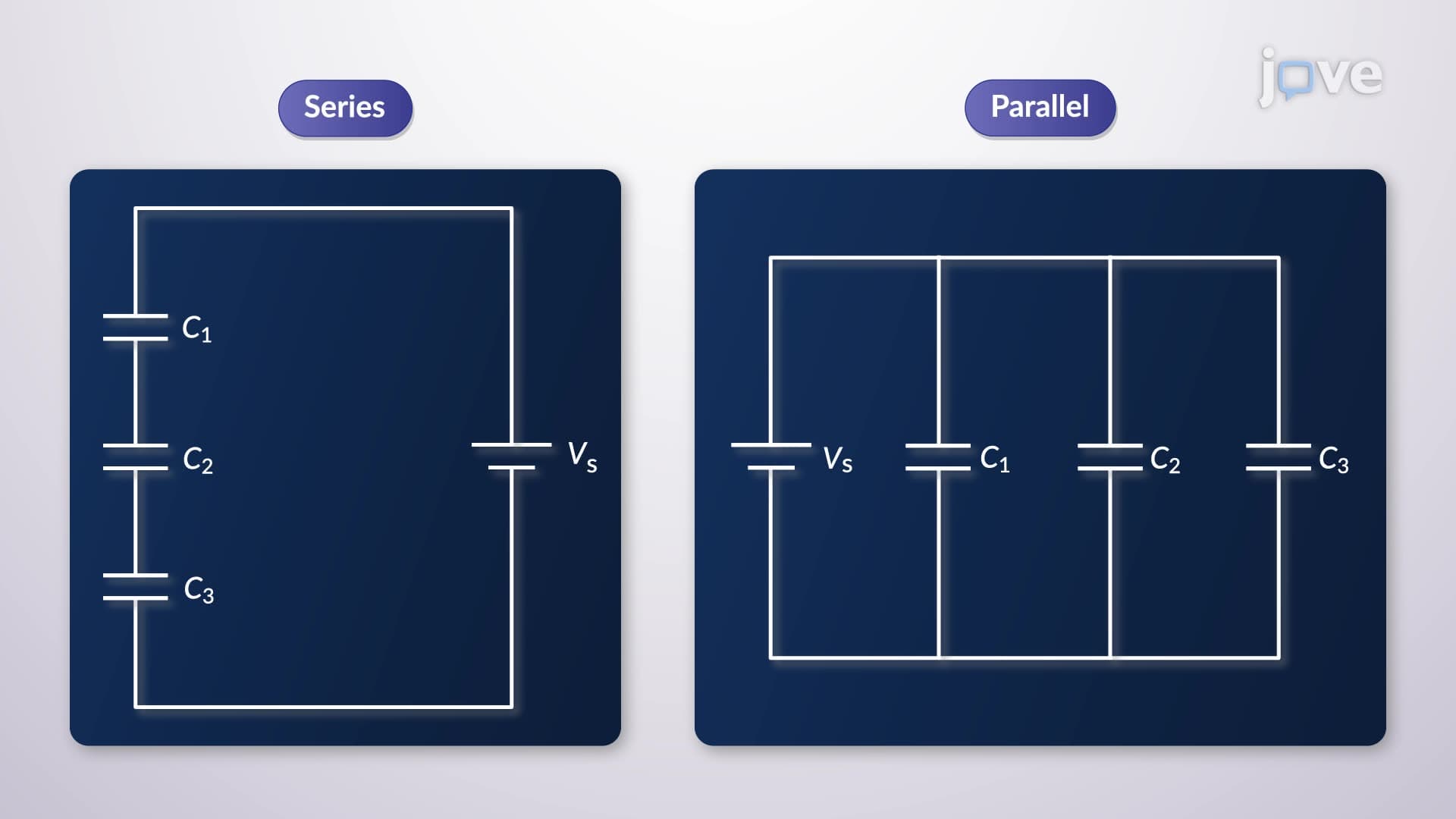
In series arrangements, capacitors connect end-to-end, creating a single path for charge flow. The equivalent capacitance definition for series circuits follows the reciprocal relationship: 1/C(total) = 1/C1 + 1/C2 + 1/C3. This counterintuitive result means series capacitance is always less than the smallest individual capacitor.
Consider a cardiac defibrillator used in US emergency rooms. Multiple capacitors in series ensure proper voltage distribution while limiting total capacitance to control energy delivery. The series configuration prevents dangerous voltage spikes that could harm patients during emergency treatment.
Key characteristics of series capacitors include equal charge storage across all components and voltage division proportional to inverse capacitance values. This makes series arrangements ideal for high-voltage applications where voltage regulation is critical.
What is equivalent capacitance in detail for parallel configurations? Unlike series arrangements, parallel capacitors connect side-by-side, sharing common voltage but dividing current. The equivalent capacitance simply equals the sum: C(total) = C1 + C2 + C3.
Power supply circuits in desktop computers exemplify parallel capacitor usage. Multiple capacitors in parallel increase total energy storage while maintaining consistent voltage levels across sensitive components like CPUs and graphics cards manufactured by companies like Intel and NVIDIA.
Understanding equivalent capacitance basics proves essential for AP Physics C, SAT Subject Tests, and college-level electrical engineering courses. MIT's introductory physics curriculum emphasizes these concepts because they appear frequently in circuit analysis problems.
Professional applications span from audio equipment design (where capacitor networks shape frequency response) to renewable energy systems. Solar panel inverters manufactured by companies like SolarEdge utilize sophisticated capacitor arrays to convert DC power efficiently.
The equivalent capacitance concept also governs energy storage in electric vehicle charging stations across the US, where proper capacitor configuration ensures safe, rapid charging for vehicles from Tesla, Ford, and General Motors.
Frequently Asked Questions
Series capacitors connect end-to-end with equal charge but divided voltage, while parallel capacitors connect side-by-side with equal voltage but divided charge. Series arrangements reduce total capacitance using reciprocal addition, whereas parallel configurations increase total capacitance through direct addition. These fundamental differences determine which configuration suits specific applications.
Equivalent capacitance represents the single capacitor value that produces identical circuit behavior to multiple capacitors combined. For series: 1/C(total) = 1/C1 + 1/C2 + ..., making total capacitance smaller than any individual component. For parallel: C(total) = C1 + C2 + ..., making total capacitance larger than any individual component.
These problems typically involve mixed series-parallel networks requiring step-by-step reduction to find total capacitance. Exams often include energy storage calculations, voltage distribution analysis, and time constant determination in RC circuits. Students must apply Kirchhoff's laws and understand charge conservation principles to solve complex capacitor networks successfully.
Absolutely – MCAT physics sections frequently feature biomedical devices using capacitor networks, including defibrillators, pacemakers, and diagnostic equipment. Understanding capacitor behavior helps analyze medical device functionality and safety mechanisms. These concepts also appear in passages about neural signal transmission and cellular membrane capacitance.
Engineers choose series configurations for high-voltage applications like power transmission systems and medical equipment, where voltage division prevents component damage. Parallel arrangements suit energy storage applications like camera flashes, power supplies, and electric vehicle systems where maximum capacitance and current capacity are priorities.
Not at all – equivalent capacitance uses only algebra and basic circuit analysis principles. The mathematical relationships involve simple addition and reciprocal calculations that high school students can master easily. Focus on understanding physical principles rather than complex mathematics, and practice with gradually increasing problem complexity.
Start with simple two-capacitor problems before tackling complex networks, always draw clear circuit diagrams, and practice systematic reduction techniques. Create step-by-step solution templates for series and parallel combinations, memorize the fundamental formulas, and solve plenty of mixed network problems from AP Physics or college textbooks.
Progress to RC circuit time constants, energy storage and dissipation calculations, and impedance analysis in AC circuits. Explore applications in filter design, oscillator circuits, and transmission line theory. These advanced concepts build directly on equivalent capacitance fundamentals and appear in electrical engineering coursework.
Related Micro-courses

Related Subjects
 Civil Engineering 30 micro-courses›Mechanical Engineering 28 micro-courses›