Loading…
Loading video…

382 views

Ever notice how suspension bridges like San Francisco's Golden Gate Bridge maintain their perfect curved shape? Parabolas are the mathematical curves behind this engineering marvel, formed when a plane cuts through a cone parallel to its slant. These special curves are defined as the set of all points equidistant from a fixed point (the focus) and a fixed line (the directrix), creating the symmetric U-shape we see in bridge cables and satellite dishes across America. Watch the full video on JoVE Coach to master this concept with expert-led visuals and step-by-step explanations.
Parabolas represent one of the four fundamental conic sections, distinguished by their unique formation when a cutting plane runs parallel to a cone's slant height. Unlike circles or ellipses, parabolas extend infinitely in one direction, creating their characteristic open curve. This geometric property makes them invaluable in engineering applications where objects need to travel in predictable curved paths.
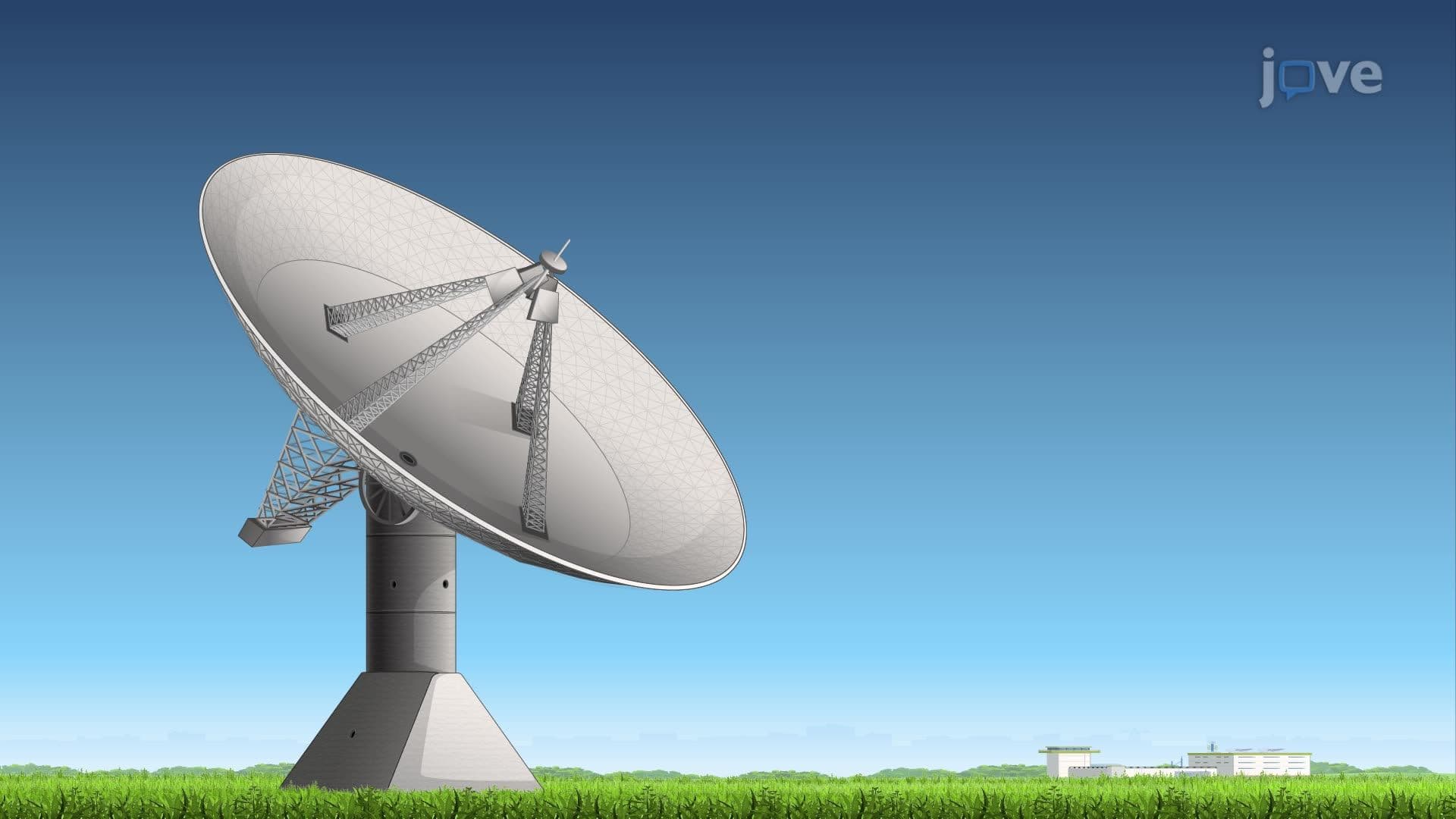
The mathematical definition of parabolas centers on an elegant principle: every point on the curve maintains equal distance to both a fixed point (focus) and a fixed line (directrix). This relationship creates the parabola's perfect symmetry and explains why satellite dishes and radio telescopes use parabolic shapes—signals from space naturally converge at the focus point.
For AP Calculus and SAT Math Level 2 exams, students must understand how to apply the distance formula: d = √[(x₂-x₁)² + (y₂-y₁)²] to both the focus and directrix, then set these distances equal. This process reveals why the standard form y² = 4px emerges naturally from geometric principles.
Vertical parabolas follow the form (x-h)² = 4p(y-k), where (h,k) represents the vertex coordinates and p determines the focus distance. When p > 0, the parabola opens upward; when p < 0, it opens downward. Horizontal parabolas use (y-k)² = 4p(x-h), opening right for positive p values and left for negative ones.
College algebra courses emphasize recognizing these forms quickly. The Statue of Liberty's torch flame follows a parabolic curve, as do the cables on the Brooklyn Bridge and the reflective surfaces in automotive headlights manufactured in Detroit.
Parabolic designs appear throughout US infrastructure. The Gateway Arch in St. Louis approximates an inverted parabola, while NASA's Deep Space Network antennas in California use precise parabolic dishes to communicate with spacecraft millions of miles away. Understanding parabolic mathematics helps explain why these structures work so effectively in their respective applications.
Frequently Asked Questions
Parabolas are U-shaped curves formed when a plane intersects a cone parallel to its slant height. They're defined as the set of all points equidistant from a fixed point (focus) and a fixed line (directrix). This creates their characteristic symmetric shape seen in bridges, satellite dishes, and headlight reflectors.
SAT Math frequently tests parabolic vertex form, standard form conversions, and finding focus/directrix coordinates. Questions often involve real contexts like projectile motion or architectural designs. Practice identifying the vertex (h,k) in y = a(x-h)² + k and understanding how 'a' affects the opening direction and width.
AP Calculus emphasizes parabolas in optimization problems, related rates, and as examples of quadratic functions. Students analyze concavity, find maximum/minimum points, and use parabolic models for physics applications. The focus-directrix definition rarely appears, but understanding parabolic derivatives and integrals is crucial.
College algebra covers parabolic transformations, graphing techniques, and solving quadratic systems. Students learn to convert between vertex form and standard form, identify key features from equations, and model real-world situations. Most midterm exams include at least one comprehensive parabola problem worth 15-20 points.
Parabolic shapes appear in suspension bridge cables like those on the Golden Gate Bridge, satellite TV dishes across suburban neighborhoods, and car headlight reflectors. McDonald's famous golden arches approximate parabolic curves, and basketball shots follow parabolic trajectories governed by gravity and initial velocity.
Parabolas build naturally on basic algebra skills most students already possess. If you're comfortable with plotting points and basic distance calculations, you can master parabolic concepts. The geometric definition might seem abstract initially, but connecting it to familiar objects like satellite dishes makes the concept more intuitive.
Focus on memorizing standard forms and practice converting between different representations quickly. Create a formula sheet with vertex form, standard form, and focus-directrix relationships. Work through released SAT and AP problems, timing yourself to build speed and confidence.
Explore other conic sections (ellipses, hyperbolas) to understand the complete family of curves. Advanced courses cover parabolic reflectors in physics, optimization applications in calculus, and parametric representations. Engineering students eventually study parabolic partial differential equations in upper-level mathematics courses.
Related Micro-courses
Related Subjects
 Physics 33 micro-courses›
 Statistics 17 micro-courses›