Loading subject page…

494 views

Video Summary: What are Asymptotes in Rational Functions
Ever wonder why your GPS shows "infinite time" when calculating a route with road closures? Asymptotes in rational functions explain this mathematical behavior where graphs approach but never reach certain boundary lines. These invisible barriers appear in rational functions-ratios of polynomials-creating vertical lines where denominators equal zero and horizontal lines describing end behavior. Consider modeling internet bandwidth during peak usage: as users approach network capacity, connection speeds approach zero asymptotically. Watch the full video on JoVE Coach to master this concept with expert-led visuals and step-by-step explanations.
Asymptotes in rational functions serve as invisible mathematical boundaries that define function behavior at extremes. Unlike polynomial functions that extend infinitely in predictable patterns, rational functions-formed by dividing one polynomial by another-exhibit unique behaviors near these asymptotic lines. These boundaries emerge naturally from the mathematical structure of ratios, creating fascinating patterns that appear throughout advanced mathematics and real-world modeling.
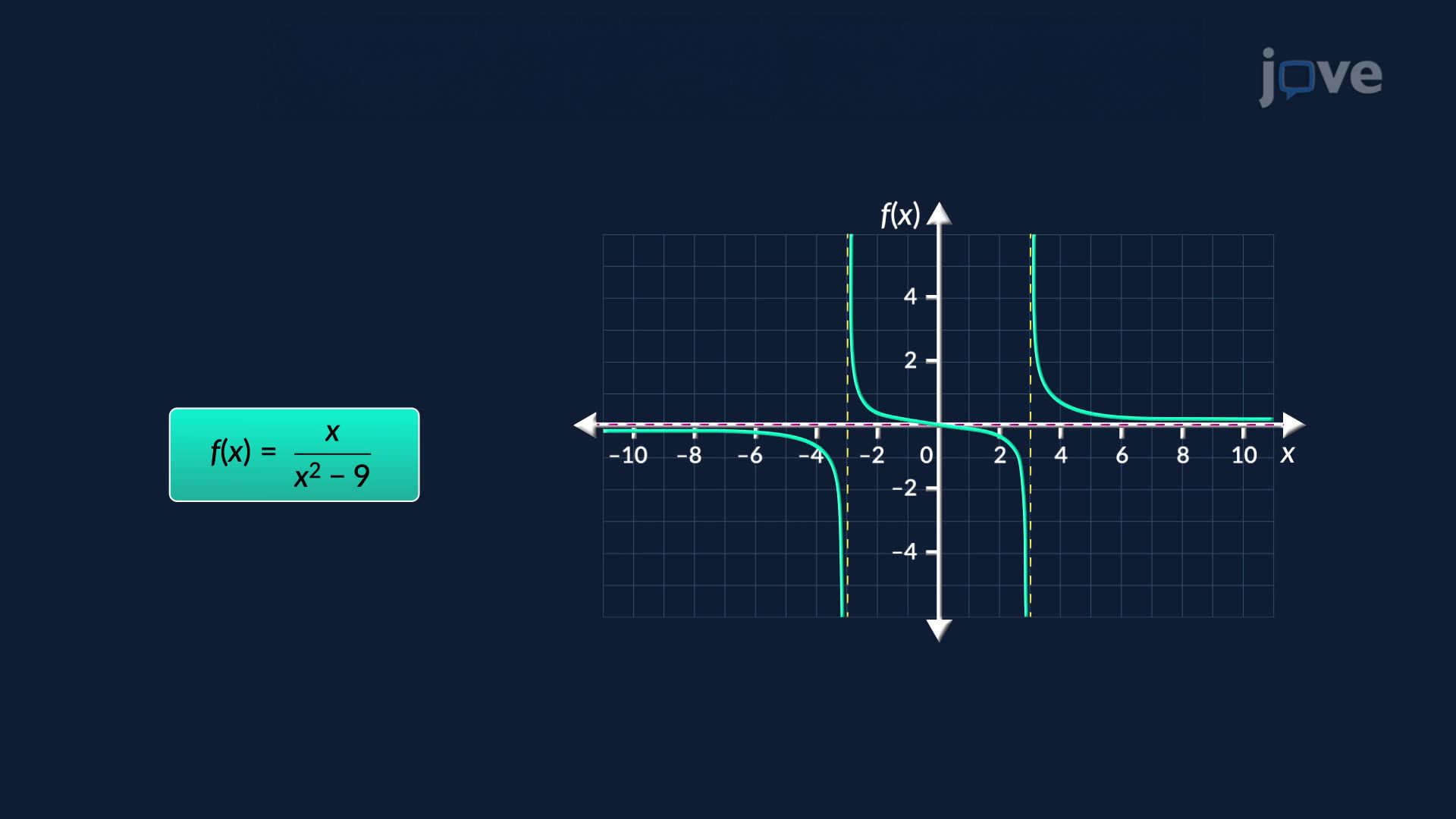
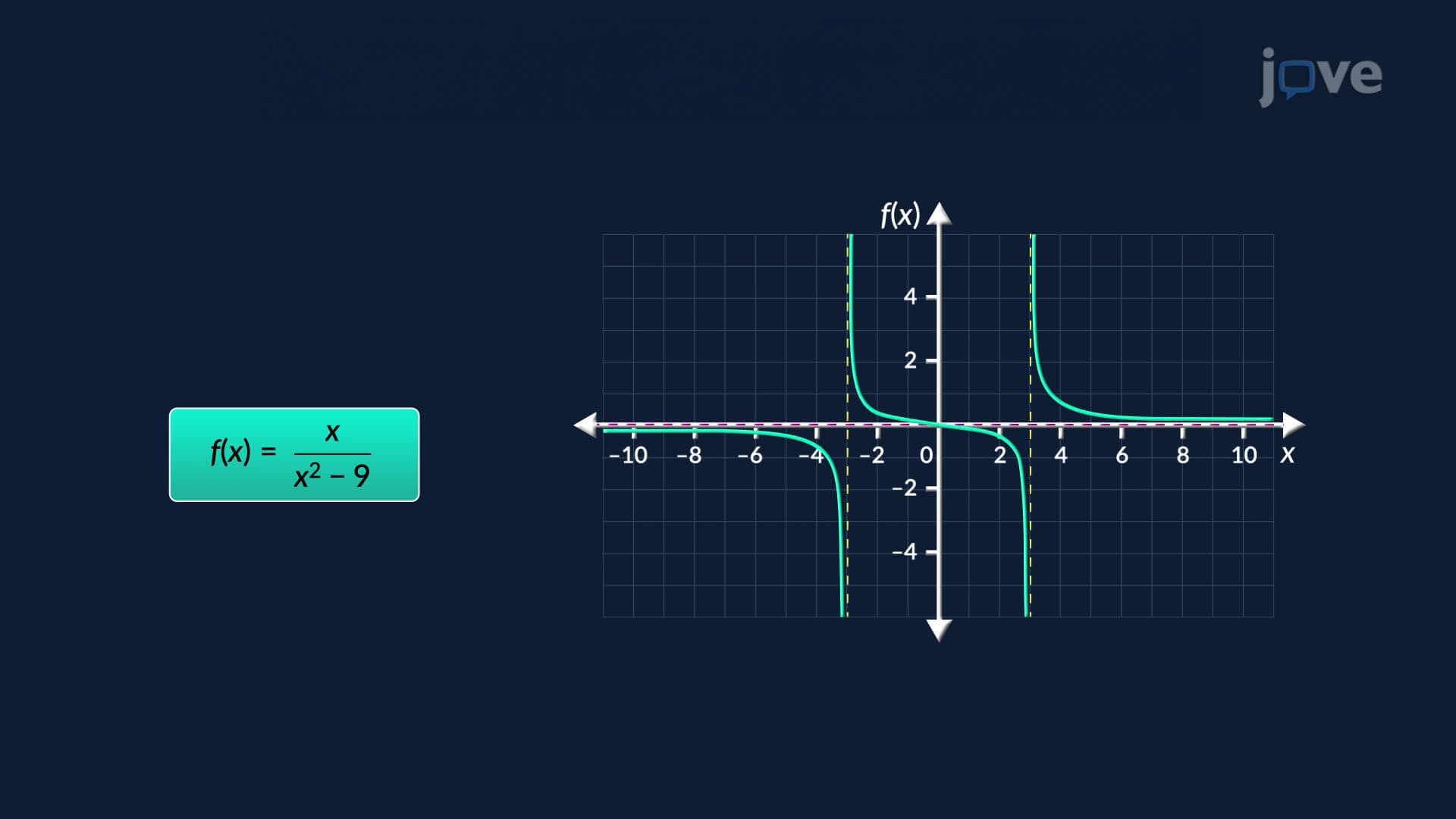
Vertical asymptotes occur where denominators equal zero, creating mathematical "walls" that functions cannot cross. To find these boundaries, set the denominator equal to zero and solve: if f(x) = (x+1)/(x-3), then x = 3 creates a vertical asymptote. Near these lines, function values approach positive or negative infinity, creating dramatic graphical behavior essential for AP Calculus and college algebra success.
Horizontal asymptotes describe end behavior as x approaches infinity. The degree relationship between numerator and denominator determines these patterns: when denominator degree exceeds numerator degree, y = 0 becomes the horizontal asymptote. Equal degrees create horizontal asymptotes at the ratio of leading coefficients, while higher numerator degrees eliminate horizontal asymptotes entirely.
Consider environmental engineering applications where pollutant concentration follows rational function models. As water volume increases in treatment facilities, contaminant levels approach zero asymptotically-never quite reaching perfect purity but getting arbitrarily close. This behavior appears in pharmacokinetics (drug concentration over time), economics (supply-demand equilibrium), and engineering (system efficiency limits).
Understanding asymptotes in rational functions proves crucial for SAT Math Level 2, AP Calculus AB/BC exams, and college precalculus courses. These concepts bridge algebraic manipulation with advanced calculus topics like limits and continuity, preparing students for higher mathematics while providing practical modeling tools for scientific applications.
Related Micro-courses