Loading subject page…

- Mechanical Engineering
- Transformations of Stress and Strain
- Yield Criteria for Ductile Materials under Plane Stress
Micro-course: Transformations of Stress and Strain
6,613 views
Learn key concepts and earn your certificate.



Yield Criteria for Ductile Materials under Plane Stress

00:00
01:25
Video Summary: Yield Criteria for Ductile Materials Explained
Why do airplane wings bend but not break during turbulence? The answer lies in yield criteria for ductile materials - engineering principles that predict when materials like aluminum and steel will deform permanently versus return to their original shape. Boeing engineers use these criteria to ensure aircraft components can handle extreme loads, from takeoff thrust to storm conditions. Understanding Yield Criteria For Ductile Materials Explained helps predict material behavior under complex stress conditions beyond simple tension tests. Watch the full video on JoVE Coach to master this concept with expert-led visuals and step-by-step explanations.
- Understand how Yield Criteria For Ductile Materials Explained helps engineers predict material failure under complex loading conditions
- Identify the difference between uniaxial stress (simple tension) and biaxial stress states in real structural applications
- Analyze the Maximum Shearing Stress Criterion (Tresca criterion) and its graphical representation using Tresca's hexagon
- Compare the Maximum Distortion Energy Criterion (Von Mises criterion) with shear stress approaches for material safety assessment
- Evaluate which yield criterion is most appropriate for different engineering applications and stress conditions
- Apply yield criteria concepts to determine safety factors in structural design problems
- Recognize how yield criteria bridge the gap between laboratory tensile tests and real-world multi-directional loading
- Explore the relationship between distortion energy and material yielding in ductile materials like steel and aluminum
Understanding Yield Criteria For Ductile Materials Explained
When engineers design structures from ductile materials like steel bridges or aluminum aircraft frames, they face a critical challenge: laboratory tensile tests only reveal material behavior under simple, one-directional loading. Real structures experience complex, multi-directional forces. Yield criteria provide the mathematical bridge between simple test results and complex real-world applications.
The Challenge of Multi-Axial Stress States
Consider the wing spar of a commercial aircraft during flight. Unlike a simple tensile test specimen pulled in one direction, this component experiences simultaneous stresses: bending from lift forces, torsion from aileron movement, and compression from fuel weight. This creates what engineers call a "biaxial" or "multi-axial" stress state - forces acting in multiple directions simultaneously.
The fundamental question becomes: how do we predict when this complex loading will cause permanent deformation (yielding) based on simple uniaxial test data? This is where yield criteria become essential tools for structural analysis.
Maximum Shearing Stress Criterion (Tresca Criterion)
The Tresca criterion, developed by French engineer Henri Tresca in 1864, proposes that ductile materials yield when the maximum shear stress reaches the same level that causes yielding in a simple tensile test. Mathematically, this creates a hexagonal boundary on stress plots - known as Tresca's hexagon.
This criterion proves particularly useful for analyzing components like pressure vessels and structural beams where shear failure modes dominate. For example, when designing oil pipeline connections, engineers use the Tresca criterion to ensure welds can handle both internal pressure and thermal expansion stresses without permanent deformation.
Maximum Distortion Energy Criterion (Von Mises Criterion)
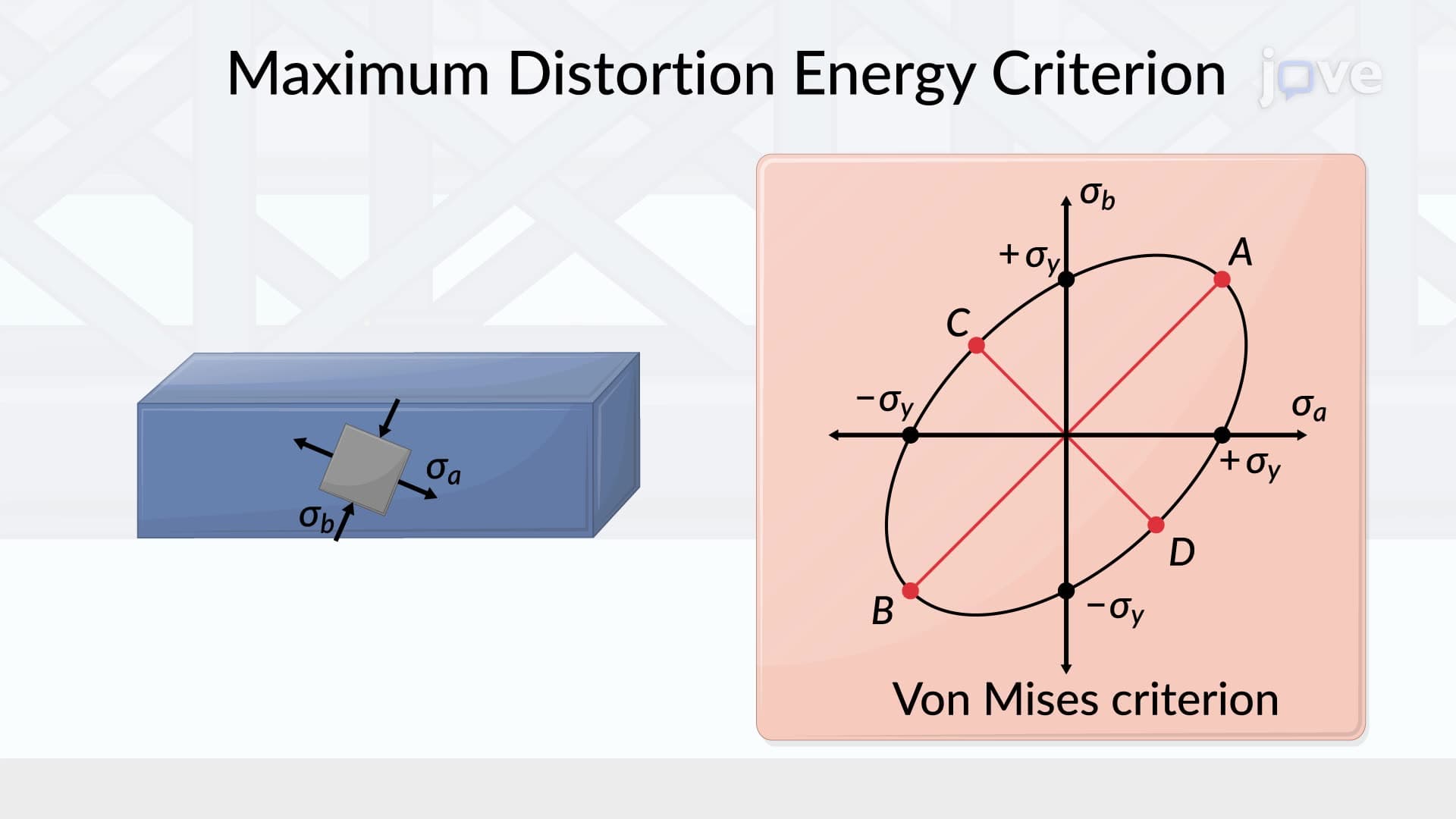
The Von Mises criterion, named after Austrian scientist Richard von Mises, takes a different approach. Instead of focusing on shear stress alone, it considers the total distortion energy stored in the material. This criterion states that yielding occurs when the distortion energy per unit volume equals that which causes yielding in a tensile test.
The Von Mises criterion often provides more accurate predictions for ductile metals under complex loading. NASA engineers rely heavily on this criterion when analyzing spacecraft components that experience rapid temperature changes, vibration, and multi-directional acceleration forces during launch and re-entry.
Students preparing for AP Physics C or college-level Materials Science exams should focus on understanding when to apply each criterion and how to interpret their graphical representations on principal stress plots.
Frequently Asked Questions
Yield criteria for ductile materials are mathematical tools that predict when materials will permanently deform under complex loading conditions. These criteria are crucial because real structures experience multi-directional forces, unlike simple laboratory tensile tests. Engineers use these principles to design safe bridges, aircraft, and buildings that won't fail under expected loads.
Yes, yield criteria concepts frequently appear on AP Physics C Mechanics exams and college Materials Science midterms. Students typically encounter problems involving stress analysis and safety factor calculations. The MCAT occasionally includes related questions in physics passages about material properties and structural analysis.
Focus on understanding the fundamental differences: Tresca uses maximum shear stress while Von Mises uses distortion energy. Practice identifying which criterion applies to different scenarios and interpreting stress plots. Many college physics and engineering courses test graphical interpretation of Tresca hexagons and Von Mises ellipses.
Ford Motor Company uses Von Mises criteria when designing car frames to ensure they can withstand crash impacts without catastrophic failure. Similarly, the Golden Gate Bridge's steel cables were analyzed using yield criteria to handle wind loads, traffic weight, and seismic activity simultaneously.
Not at all - the basic concepts build naturally from simple stress and strain topics covered in AP Physics. While the mathematics can be complex, understanding the fundamental principles (when materials yield under complex loading) is accessible to students with solid algebra and basic physics knowledge.
Start with mastering uniaxial stress concepts, then progress to understanding why multi-axial loading creates different challenges. Practice drawing and interpreting Tresca hexagons and Von Mises ellipses. Work through problems that ask you to determine safety factors using both criteria.
Consider exploring fatigue analysis (how repeated loading causes failure), fracture mechanics (crack propagation in materials), and advanced topics like creep behavior at high temperatures. These concepts build directly on yield criteria foundations and are essential for advanced engineering coursework.
The Von Mises criterion generally provides more accurate predictions for ductile metals under complex loading conditions. However, the Tresca criterion offers simpler calculations and more conservative (safer) estimates, making it popular for preliminary design work where safety margins are critical.
Related Micro-courses


