Loading…
Loading video…

9,583 views
Ever wonder why a basketball settles at the bottom of a bowl instead of rolling around endlessly? The potential energy criterion for equilibrium reveals that systems naturally seek positions where their potential energy's rate of change equals zero. In engineering structures like the Golden Gate Bridge, designers use this principle to ensure cables and supports maintain stable positions under various loads. This fundamental concept explains how mechanical systems from playground swings to skyscraper foundations find their equilibrium states. Watch the full video on JoVE Coach to master this concept with expert-led visuals and step-by-step explanations.
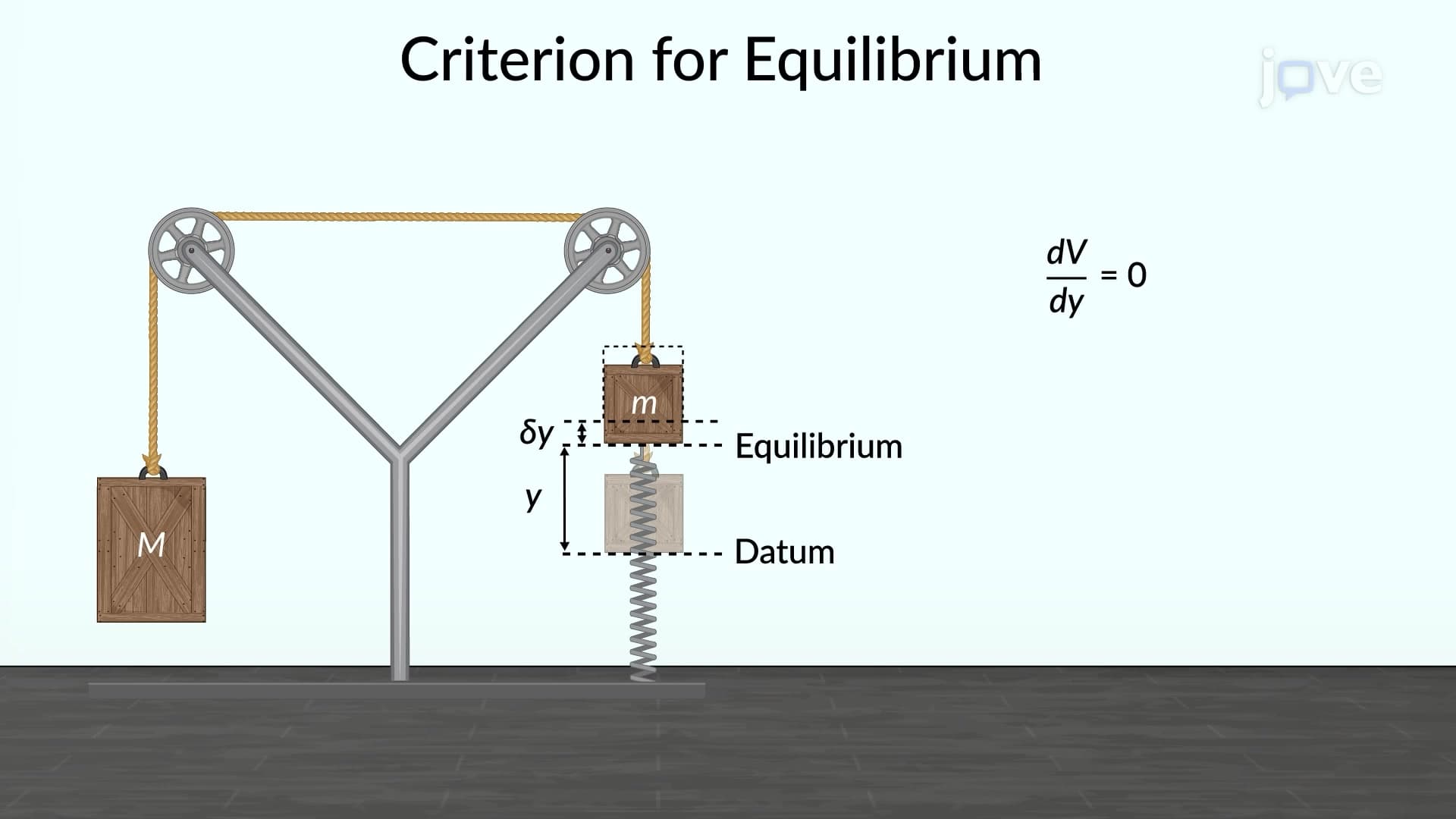
The potential energy criterion for equilibrium provides a powerful mathematical tool for determining when mechanical systems reach stable positions. Unlike force-based approaches that require vector analysis, this energy method uses scalar quantities, making calculations more straightforward for complex systems.
At its core, this criterion states that a system reaches equilibrium when the first derivative of its total potential energy equals zero: dU/dx = 0, where U represents total potential energy and x is the position coordinate. This mathematical condition emerges from the principle of virtual work, which states that no net work occurs during infinitesimal displacements at equilibrium.
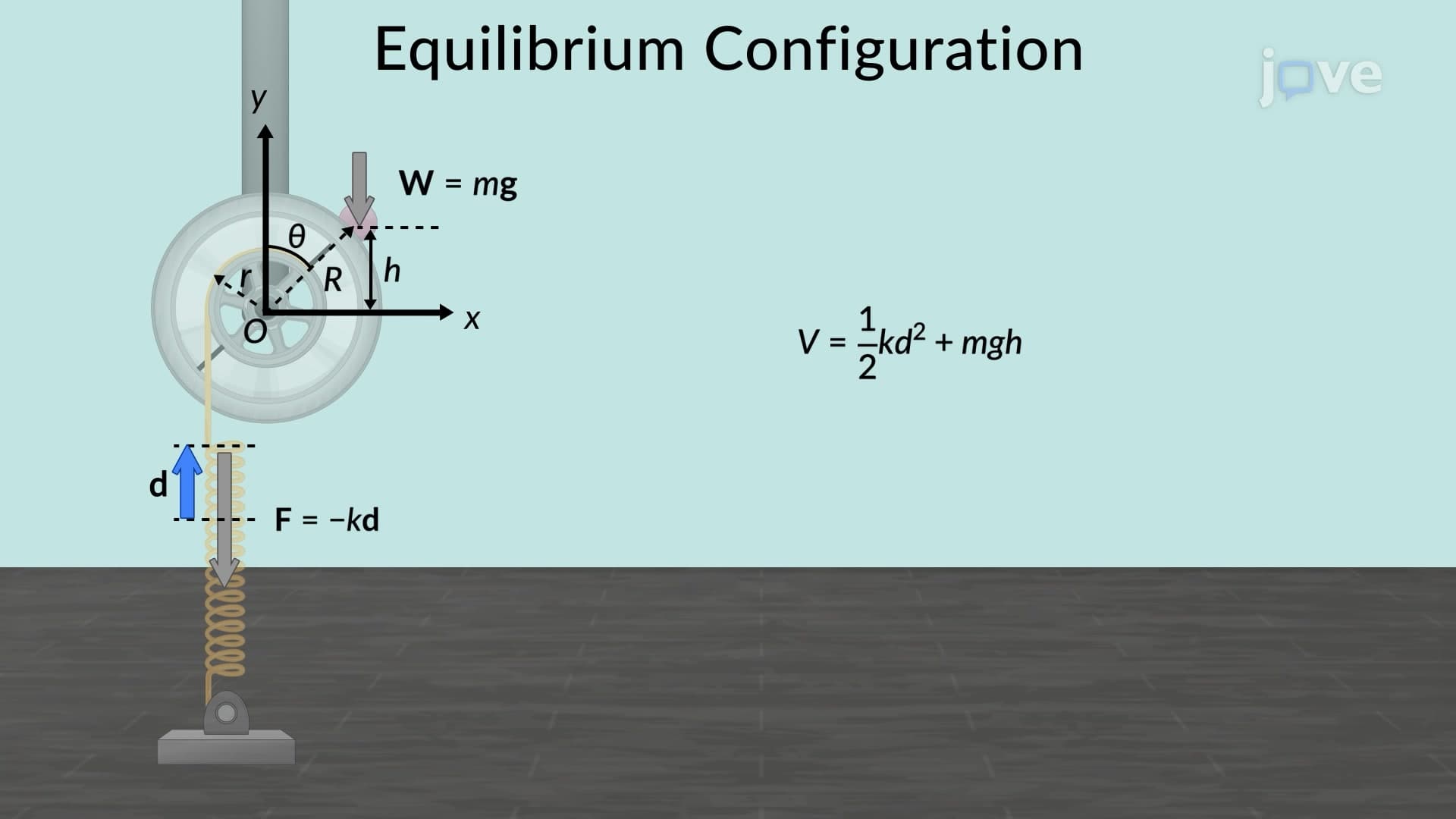
Consider a mass attached to a vertical spring—a common setup in AP Physics courses and college mechanics labs. The total potential energy combines gravitational potential energy (mgh) and elastic potential energy (½kx²). When you release the mass from rest, it oscillates until friction eventually brings it to equilibrium where the spring force balances the gravitational force.
Using the potential energy criterion, we differentiate the total energy function and set it equal to zero. This approach directly yields the equilibrium position without requiring separate force analysis—a technique particularly valuable on timed exams like the MCAT physics section.
Real engineering applications often involve systems with multiple degrees of freedom. For instance, analyzing the equilibrium of a suspension bridge requires considering multiple cable tensions and support points simultaneously. In such cases, the potential energy depends on several independent variables (x₁, x₂, x₃, etc.).
The equilibrium criterion extends naturally: ∂U/∂x₁ = 0, ∂U/∂x₂ = 0, and so forth for each coordinate. This multi-variable approach appears frequently in advanced physics courses and engineering statics problems, making it essential preparation for students pursuing STEM degrees.
This criterion proves invaluable in structural analysis, from determining optimal arch shapes in bridge design to calculating stable configurations of mechanical linkages in manufacturing equipment. Students encounter these principles in courses ranging from high school AP Physics C to undergraduate engineering mechanics.
On standardized exams, problems often present energy functions and ask students to find equilibrium points—a direct application of taking derivatives and setting them to zero. Mastering this approach provides both computational efficiency and conceptual understanding of why systems naturally settle into stable configurations.
Frequently Asked Questions
The potential energy criterion for equilibrium states that a system reaches equilibrium when the first derivative of its potential energy equals zero. This criterion is crucial because it provides a simple mathematical method to find stable positions in mechanical systems without complex force analysis, making it invaluable for engineering design and physics problem-solving.
AP Physics C exams frequently test this concept through problems involving springs, pendulums, and gravitational systems. Students typically receive a potential energy function and must find equilibrium points by taking derivatives, or they might need to analyze stability by examining second derivatives. These problems often combine calculus skills with physics understanding.
Absolutely—MCAT physics problems often involve energy methods and equilibrium analysis in biological and physical systems. This criterion helps you quickly solve problems involving molecular configurations, spring-based models of chemical bonds, and mechanical systems in medical devices, giving you a significant time advantage during the exam.
Engineers use this criterion extensively in structural design, from determining optimal cable tensions in suspension bridges like the Brooklyn Bridge to analyzing the stability of wind turbine foundations. Aerospace engineers apply it when designing satellite positioning systems, while civil engineers use it to ensure building foundations remain stable under various load conditions.
Not at all—you only need basic derivative knowledge typically covered in high school AP Calculus or college Calculus I. The concept primarily involves taking first derivatives of energy functions and setting them equal to zero. Most applications use straightforward polynomial or trigonometric functions that are easy to differentiate.
Start by practicing derivative techniques with common potential energy functions, then work through spring-mass and gravitational problems systematically. Focus on setting up the total potential energy equation correctly before differentiating—this step-by-step approach prevents calculation errors and builds confidence for more complex multi-variable problems.
Progress to stability analysis using second derivatives, Lagrangian mechanics, and Hamilton's principle. These advanced topics build directly on equilibrium concepts and appear in upper-level physics courses, graduate school entrance exams, and engineering graduate programs. Understanding energy methods deeply opens doors to quantum mechanics and advanced dynamics.
Use partial derivatives—take the partial derivative with respect to each independent variable and set each equal to zero simultaneously. This creates a system of equations to solve for equilibrium coordinates. Practice with simple two-variable problems first, like a mass on an inclined spring system, before tackling more complex engineering applications.
Related Micro-courses
Related Subjects
 Civil Engineering 30 micro-courses›Electrical Engineering 33 micro-courses›