Loading…
Loading video…

9,583 views
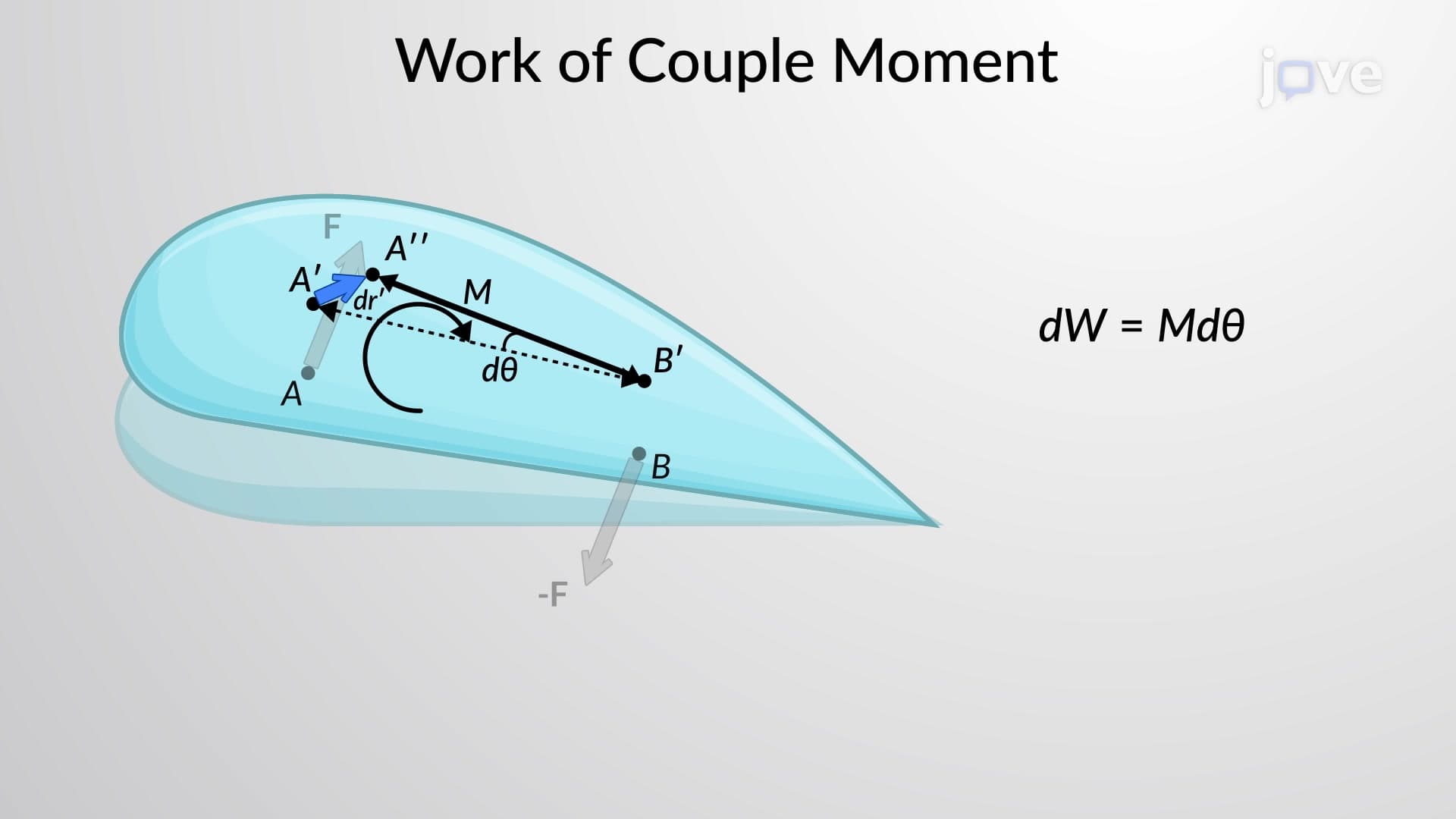
Ever wonder why a wrench turns a bolt even when forces seem to cancel out? Work couple moment describes the energy required to rotate objects when equal and opposite forces create rotational motion, like the forces your hands apply to a steering wheel during a turn. In mechanical engineering applications across US manufacturing, from Boeing's aircraft assembly to Ford's automotive production, understanding work couple moment is crucial for calculating the energy needed to rotate components. This fundamental physics concept explains how rotation generates work even when translational forces balance to zero. Watch the full video on JoVE Coach to master this concept with expert-led visuals and step-by-step explanations.
Work couple moment represents the energy required to produce rotational motion when a system of equal and opposite forces (called a couple) acts on a rigid body. Unlike single-force work calculations, couple work focuses exclusively on rotational effects since the translational components cancel each other out.
When two equal and opposite forces act on a rigid body separated by a perpendicular distance, they create what physicists call a couple. The moment of this couple equals the force magnitude multiplied by the perpendicular distance between the force lines of action. This couple moment causes pure rotation about the body's center of mass.
The work done by a couple moment follows the relationship: W = M × θ, where W represents work, M is the couple moment magnitude, and θ is the angular displacement in radians. This elegant formula emerges because translational work components from the two forces cancel perfectly, leaving only rotational work.
During rotation, each force in the couple moves through a linear displacement equivalent to the angular displacement multiplied by its distance from the rotation axis. Since one force moves in its direction while the other moves opposite to its direction, the net translational work is zero. However, both forces contribute positively to rotational work, creating the couple moment work.
Work couple moment calculations require careful attention to directional relationships. When the couple moment and angular displacement share the same rotational sense (both clockwise or both counterclockwise), the work done is positive, indicating energy input into the system. Conversely, when they have opposite senses, the work becomes negative, representing energy extraction.
This sign convention proves crucial in engineering applications, particularly in mechanical systems design. US aerospace companies like Lockheed Martin rely on these calculations when designing control surfaces, while automotive manufacturers use couple moment analysis for steering system optimization.
Students preparing for the AP Physics exam or engineering college coursework encounter work couple moment problems frequently. The concept appears in statics and dynamics courses at institutions like MIT, Stanford, and UC Berkeley. Practical applications include calculating energy requirements for rotating machinery, analyzing torque converters in automotive transmissions, and designing robotic joint actuators.
Understanding this concept prepares students for advanced topics in mechanical engineering, where couple moment work calculations become essential for motor sizing, gear train analysis, and vibration control system design.
Frequently Asked Questions
Work couple moment is the energy required to rotate an object using two equal and opposite forces separated by a distance. Unlike regular work involving single forces, couple work focuses only on rotational motion since the translational effects of the two forces cancel out, leaving pure rotational energy transfer.
AP Physics C: Mechanics exams often include couple moment problems in free-response sections, requiring students to identify force couples, calculate moments, and determine rotational work. These problems frequently appear alongside rigid body rotation topics and may be worth 10-15 points on the exam.
Engineering mechanics, statics, and dynamics courses at most US universities extensively cover work couple moment. Students at schools like Georgia Tech, Purdue, and Texas A&M encounter these concepts in sophomore-level courses, with applications extending into machine design and robotics coursework.
Car steering wheels demonstrate work couple moment perfectly - your hands apply equal and opposite forces that create rotation without net translation. Similarly, wrenches, screwdrivers, and bicycle handlebars all utilize couple moment principles to convert hand forces into rotational motion for practical tasks.
Most students find work couple moment manageable after mastering basic torque concepts. The mathematics involves only multiplication and basic trigonometry, making it accessible for students who've completed Algebra II and are comfortable with force analysis.
Focus on drawing clear free-body diagrams showing force pairs, practice identifying couples versus single forces, and memorize the work formula W = M × θ. Work through problems involving both positive and negative work scenarios to build confidence with sign conventions.
Work couple moment serves as foundation for studying gyroscopic effects, advanced rigid body dynamics, and mechanical vibrations. Students planning engineering careers will encounter these concepts again in robotics, aerospace dynamics, and mechanical system design courses.
Mechanical engineers calculate work couple moment when sizing electric motors for rotating equipment, designing automotive steering systems, and analyzing robotic arm movements. These calculations ensure adequate power supply and predict energy consumption in industrial machinery applications.
Related Micro-courses
Related Subjects
 Civil Engineering 30 micro-courses›Electrical Engineering 33 micro-courses›