Loading video…


 12 Concepts
 141.8K views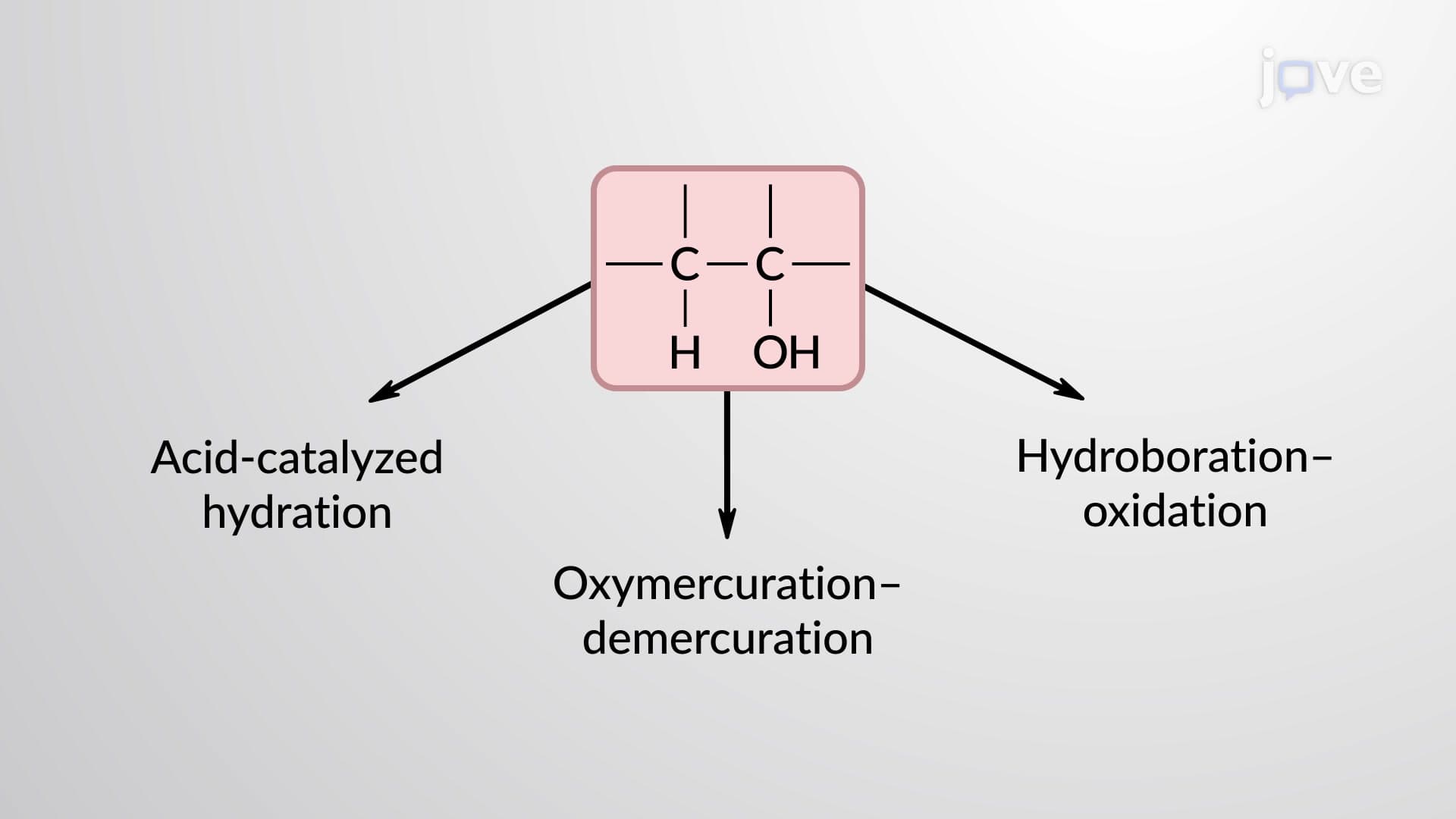

Video Summary: Preparation of Alcohols via Addition Reactions Explained
Ever wonder how the ethanol in hand sanitizers or the isopropyl alcohol in rubbing alcohol is actually made? The preparation of alcohols via addition reactions involves three powerful synthetic methods that chemists use to create these essential compounds from simple alkenes. From the acid-catalyzed hydration used in industrial ethanol production to the precise hydroboration-oxidation reactions employed by pharmaceutical companies like Pfizer in drug manufacturing, these reactions form the backbone of organic synthesis. Watch the full video on JoVE Coach to master this concept with expert-led visuals and step-by-step explanations.
The preparation of alcohols via addition reactions represents one of the most fundamental and versatile approaches in organic chemistry for synthesizing these important functional groups. These reactions transform readily available alkenes into alcohols through the addition of water (H₂O) across the carbon-carbon double bond, but each method employs distinct mechanisms that lead to different regiochemical and stereochemical outcomes.
Acid-catalyzed hydration follows a classic electrophilic addition mechanism where a strong acid (typically H₂SO₄ or H₃PO₄) protonates the alkene to generate a carbocation intermediate. This method strictly adheres to Markovnikov's rule, with the hydrogen adding to the less substituted carbon and the hydroxyl group attaching to the more substituted position. The reaction proceeds through a trigonal planar carbocation, making it susceptible to nucleophilic attack from either face, resulting in racemic mixtures when chiral centers form. This approach is extensively used in industrial ethanol production and frequently appears on AP Chemistry and MCAT examinations as a test of mechanistic understanding.
Oxymercuration-demercuration offers a more controlled alternative that avoids problematic carbocation rearrangements. The reaction begins with mercury(II) acetate attacking the alkene to form a three-membered mercurinium ion intermediate-a unique species that exhibits partial carbocation character through resonance. Water then attacks the more substituted carbon, maintaining Markovnikov regioselectivity while preventing rearrangements that plague acid-catalyzed hydration. The final demercuration step using sodium borohydride (NaBH₄) replaces mercury with hydrogen, yielding the desired alcohol. This method proves invaluable in pharmaceutical synthesis where structural integrity is paramount.
Hydroboration-oxidation stands apart by delivering anti-Markovnikov products through a concerted mechanism. Borane (BH₃) adds across the double bond via a four-membered transition state, with the boron atom attaching to the less substituted carbon due to steric constraints. This creates an alkylborane intermediate that can accommodate two additional alkene molecules, forming a trialkylborane. Subsequent oxidation with hydrogen peroxide under basic conditions replaces the boron with a hydroxyl group while maintaining the anti-Markovnikov regioselectivity. This reaction sequence is particularly valuable for synthesizing primary alcohols from terminal alkenes and frequently appears in organic chemistry coursework at universities like MIT and Stanford.
Related Micro-courses