Loading subject page…

- Organic Chemistry
- Covalent Bonding and Structure
- MO Theory and Covalent Bonding
Micro-course: Covalent Bonding and Structure
392,707 views
Learn key concepts and earn your certificate.


MO Theory and Covalent Bonding

00:00
02:40
Video Summary: Mo Theory and Covalent Bonding Explained
Ever wonder why diamond is incredibly hard while graphite is soft enough for pencils, despite both being pure carbon? Mo theory covalent bonding explains these differences by describing how electrons behave across entire molecules rather than between individual atoms. This approach revolutionizes our understanding of chemical bonding, from simple hydrogen gas to complex pharmaceuticals manufactured by US companies like Pfizer. Mo Theory And Covalent Bonding Explained reveals why some molecules are stable while others fall apart instantly. Watch the full video on JoVE Coach to master this concept with expert-led visuals and step-by-step explanations.
- Understand how Mo Theory And Covalent Bonding Explained provides a more complete picture of electron behavior than traditional Lewis structures
- Identify the differences between bonding and antibonding molecular orbitals and their energy relationships
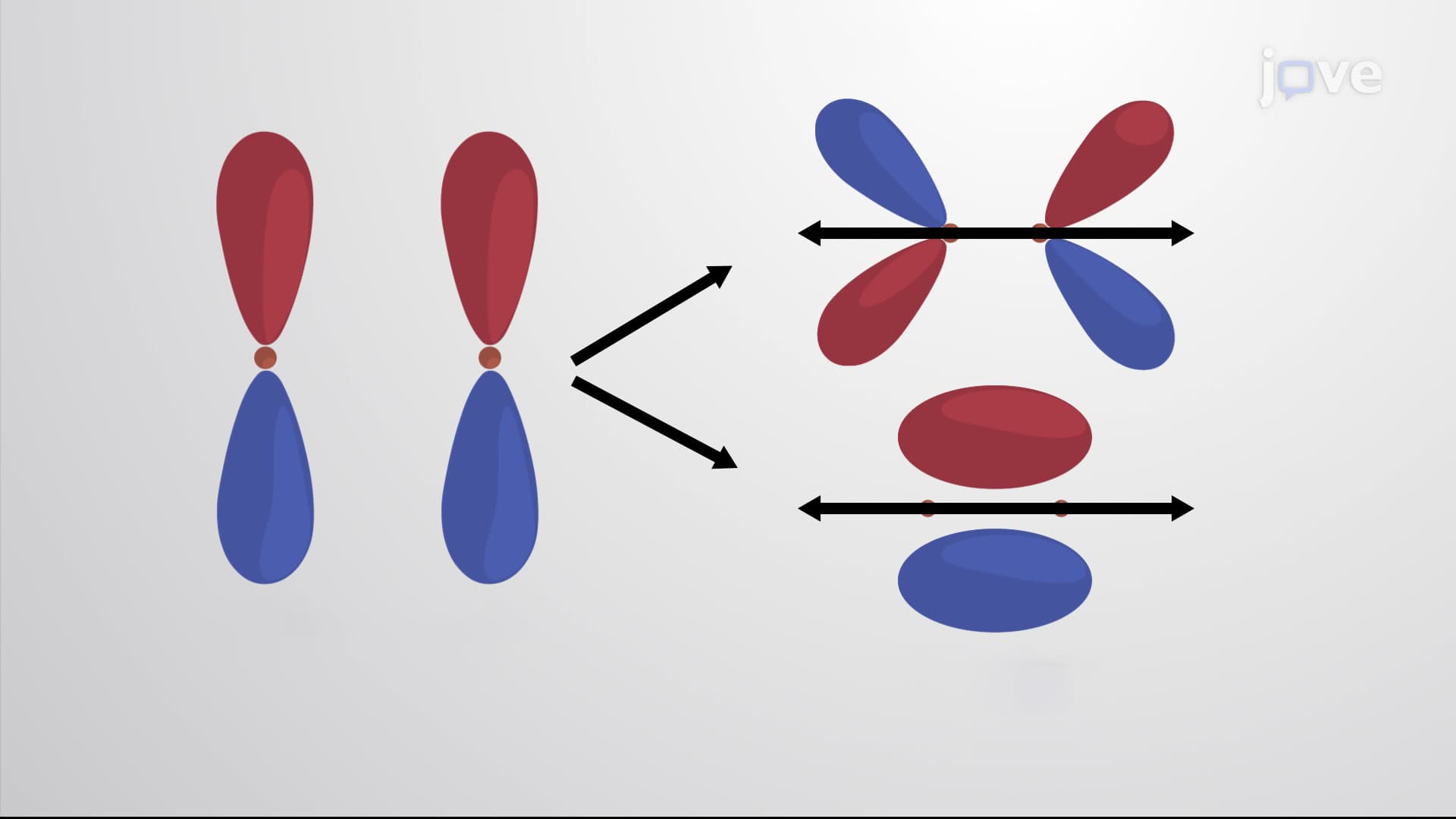
- Analyze how constructive and destructive interference of atomic orbitals creates molecular orbitals
- Compare sigma and pi molecular orbitals based on their formation and electron density patterns
- Evaluate molecular stability using bond order calculations from molecular orbital theory
- Apply molecular orbital concepts to predict whether molecules can exist in nature
- Recognize how molecular orbital theory explains delocalized electrons in complex molecules like benzene
- Explore real-world applications of MO theory in pharmaceutical design and materials science
Understanding Mo Theory And Covalent Bonding Fundamentals
Mo theory covalent bonding represents a quantum mechanical approach to understanding how atoms share electrons to form stable molecules. Unlike the localized electron-pair model, molecular orbital (MO) theory treats electrons as belonging to the entire molecule, occupying molecular orbitals that extend across multiple atoms. This perspective proves essential for understanding many real-world phenomena, from the conductivity of graphene being researched at MIT to the photosynthetic processes studied at Stanford University.
Molecular Orbital Formation and Energy Considerations
When atomic orbitals combine, they create molecular orbitals through wave interference patterns. Constructive interference occurs when atomic orbital waves are in-phase, creating bonding molecular orbitals with lower energy than the original atomic orbitals. This lower energy corresponds to increased stability-electrons in bonding orbitals actually stabilize the molecule. Conversely, destructive interference from out-of-phase atomic orbitals produces antibonding molecular orbitals with higher energy and a characteristic nodal plane between nuclei where electron density approaches zero.
Students preparing for AP Chemistry or college general chemistry courses must understand that antibonding orbitals, denoted with an asterisk (*), destabilize molecules when occupied. This concept frequently appears on MCAT exams, particularly in organic chemistry passages involving conjugated systems.
Sigma and Pi Molecular Orbitals: Different Overlap Patterns
The geometry of orbital overlap determines molecular orbital type. Head-on overlap along the internuclear axis-whether between s orbitals or p orbitals approaching end-to-end-creates sigma (σ) molecular orbitals. These orbitals concentrate electron density directly between nuclei, forming the strongest type of covalent bond.
Sideways overlap between parallel p orbitals generates pi (π) molecular orbitals, where electron density concentrates above and below the internuclear axis. Pi bonds are typically weaker than sigma bonds, explaining why double bonds (one sigma + one pi) are not twice as strong as single bonds. This distinction proves crucial for understanding organic reaction mechanisms taught in advanced placement and undergraduate courses.
Bond Order Calculations and Molecular Stability Predictions
Bond order provides a quantitative measure of bond strength and molecular stability. The formula-(bonding electrons - antibonding electrons) ÷ 2-allows chemists to predict whether molecules can exist. A bond order of zero indicates an unstable molecule that cannot form under normal conditions, while higher bond orders suggest stronger, more stable bonds.
For complex molecules like benzene, mo theory and covalent bonding explained through delocalized pi systems provides insights impossible with simple Lewis structures. The six pi electrons occupy three bonding molecular orbitals spread across the entire carbon ring, explaining benzene's unusual stability and why it resists addition reactions that would disrupt this delocalization.
Frequently Asked Questions
Mo theory and covalent bonding describes how electrons in molecules occupy molecular orbitals that extend across multiple atoms, rather than being localized between specific atom pairs. This quantum mechanical approach explains molecular stability, bond strength, and electron behavior more accurately than traditional bonding models.
AP Chemistry tests molecular orbital concepts through questions about bond order calculations, molecular stability predictions, and electron configuration in simple diatomic molecules. Students must identify bonding versus antibonding orbitals and explain how electron placement affects molecular properties.
The MCAT frequently tests MO theory in organic chemistry passages, especially regarding aromatic compounds, conjugated systems, and molecular stability. Understanding delocalized electrons in molecules like benzene and explaining why certain organic compounds are particularly stable requires solid MO theory knowledge.
Pharmaceutical companies like Johnson & Johnson use MO theory to design drug molecules with specific electronic properties. Understanding how electrons are distributed helps predict drug stability, reactivity with biological targets, and metabolic pathways in the human body.
While MO theory involves quantum mechanics, high school students can grasp the basic concepts through visual models and simple calculations. Focus on understanding bonding versus antibonding orbitals, bond order calculations, and why some molecules are more stable than others.
Practice drawing molecular orbital diagrams for simple molecules like H2, O2, and N2, then calculate bond orders. Use visual resources to understand orbital overlap patterns, and work through problems comparing MO predictions with experimental bond strengths and magnetic properties.
MO theory explains aromatic stability, conjugated system behavior, and why certain molecules undergo specific reaction types. Students studying advanced organic chemistry at universities like UC Berkeley use MO concepts to predict reaction outcomes and design synthetic pathways.
Advanced courses explore crystal field theory for transition metal complexes, band theory for semiconductors, and computational chemistry methods. Students interested in materials science or pharmaceutical research will encounter extended molecular orbital calculations in graduate-level quantum chemistry.
Related Micro-courses

12 Concepts

14 Concepts
12 Concepts