Loading subject page…


392,708 views

Video Summary: What Is Electronic Structure of Atoms
Ever wonder why sodium explodes in water while neon sits quietly in a light bulb? The electronic structure of atoms determines these dramatic differences in chemical behavior. Understanding what is electronic structure of atoms reveals how electrons arrange themselves around atomic nuclei, following quantum mechanical principles that govern everything from LED displays in smartphones to MRI machines in US hospitals. This fundamental concept explains atomic behavior through quantum numbers, orbital shapes, and electron probability distributions. Watch the full video on JoVE Coach to master this concept with expert-led visuals and step-by-step explanations.
The electronic structure of atoms represents one of chemistry's most fundamental concepts, describing how electrons exist and behave within atomic boundaries. Unlike classical physics, which treats electrons as discrete particles following predictable paths, quantum mechanics reveals electrons as wave-particle hybrids whose exact positions remain inherently uncertain.
This quantum mechanical model emerged from early 20th-century breakthroughs by scientists like Schrödinger and Heisenberg, revolutionizing our understanding of atomic behavior. Rather than orbiting the nucleus like planets around the sun, electrons occupy three-dimensional regions called orbitals, where their presence follows probability distributions.
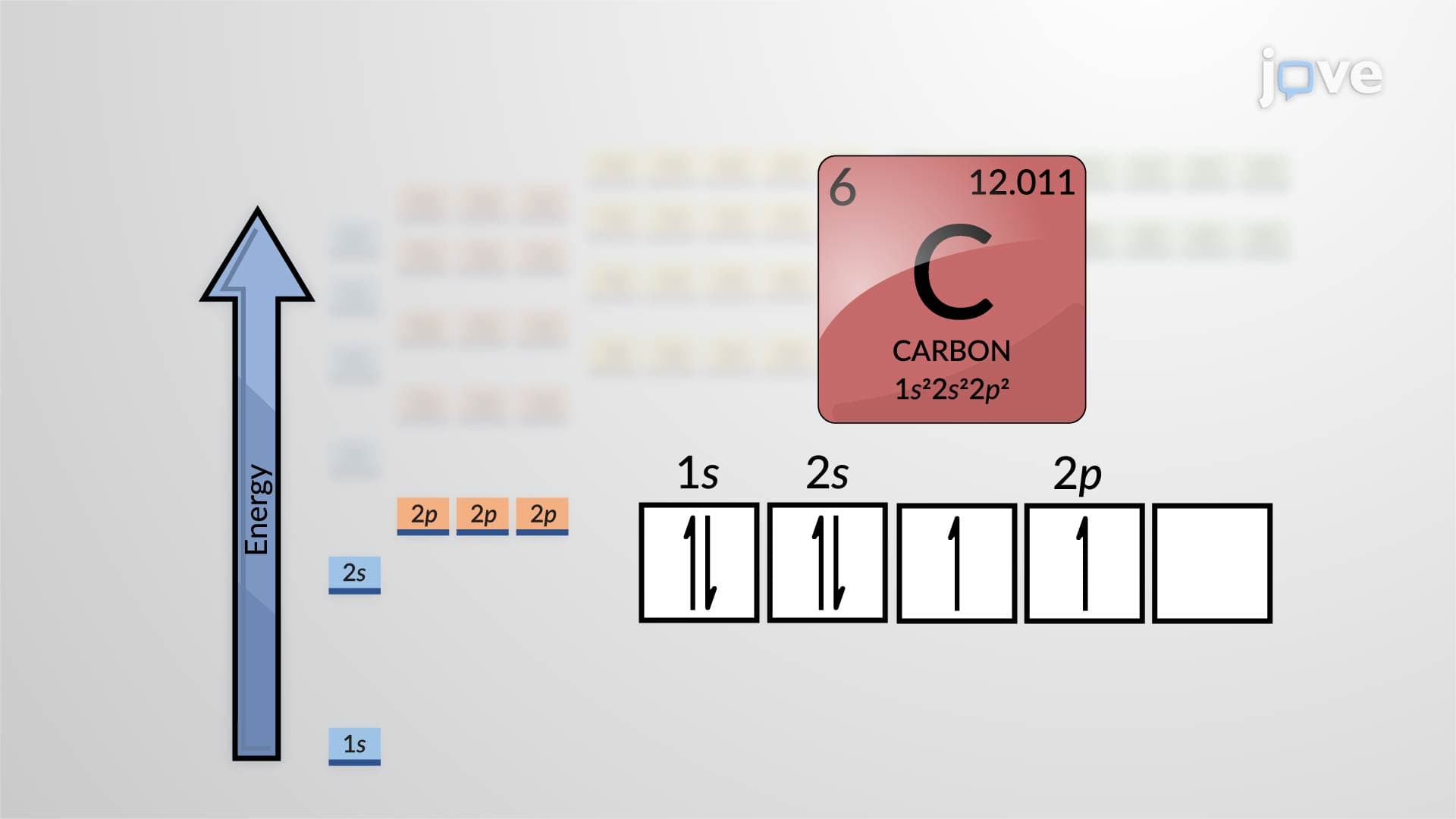
Each electron in an atom possesses a unique "address" defined by four quantum numbers. The principal quantum number (n) determines the electron's energy level and average distance from the nucleus, ranging from 1 to 7 for known elements. The angular momentum quantum number (l) defines orbital shape, creating the familiar s, p, d, and f designations that appear throughout college chemistry courses and AP Chemistry exams.
The magnetic quantum number (ml) specifies orbital orientation in space, while the spin quantum number (ms) accounts for electron's intrinsic magnetic property. This quantum address system ensures no two electrons share identical quantum states, following Pauli's exclusion principle-a fundamental rule that explains periodic table organization and chemical bonding patterns.
Electronic structure atoms studies reveal fascinating orbital geometries. Spherical s orbitals surround the nucleus uniformly, while p orbitals display distinctive dumbbell shapes aligned along x, y, and z axes. More complex d and f orbitals exhibit intricate geometries crucial for understanding transition metal chemistry and advanced materials science.
These orbital shapes represent electron probability densities-regions where electrons most likely exist. Unlike definite planetary orbits, quantum orbitals describe probability clouds, with electron density varying throughout three-dimensional space. This probabilistic nature underlies modern computational chemistry and pharmaceutical drug design techniques used by US biotechnology companies.
Understanding electronic structure proves essential for success in standardized exams including the MCAT, AP Chemistry, and college-level general chemistry courses. Students encounter these concepts when predicting molecular geometries, explaining periodic trends, and solving electron configuration problems.
Real-world applications span from semiconductor manufacturing in Silicon Valley to medical imaging technologies in US hospitals. Quantum mechanical principles governing electronic structure enable technologies like laser surgery, LED lighting, and quantum computing research conducted at institutions like MIT and Stanford University.
Related Micro-courses