Loading video…


 12 Concepts
 89.6K views

Video Summary: Naming Polysubstituted Aromatic Compounds Rules and Examples
Ever wondered why aspirin's chemical name includes "acetylsalicylic acid" while ibuprofen follows completely different naming rules? The nomenclature aromatic compounds multiple substituents follow systematic IUPAC guidelines that determine how we identify and name complex benzene derivatives found in everyday medications like these common pain relievers available at any US pharmacy. Understanding Naming Polysubstituted Aromatic Compounds: Rules and Examples transforms confusing chemical structures into logical, predictable names. Watch the full video on JoVE Coach to master this concept with expert-led visuals and step-by-step explanations.
The nomenclature of aromatic compounds with multiple substituents represents a cornerstone of organic chemistry that students encounter throughout high school AP Chemistry and college-level courses. This systematic approach ensures chemists worldwide can unambiguously identify complex aromatic molecules, from simple industrial solvents to sophisticated pharmaceutical compounds developed by major US drug manufacturers like Pfizer and Johnson & Johnson.
When naming aromatic compounds with exactly two substituents, chemists employ two complementary systems. The traditional approach uses positional prefixes: ortho (o-) for adjacent substituents, meta (m-) for substituents separated by one carbon, and para (p-) for substituents directly opposite each other. Alternatively, the numerical system assigns positions 1,2- (ortho), 1,3- (meta), and 1,4- (para). For example, para-dichlorobenzene, commonly used as a moth repellent sold in US hardware stores, can be named either p-dichlorobenzene or 1,4-dichlorobenzene.
When substituents differ, alphabetical ordering determines naming priority. Consider a compound with both a chlorine and methyl group in para positions: this becomes 4-chlorotoluene, not 4-methylchlorobenzene, because the methyl group creates the toluene parent name, which takes precedence over systematic alphabetical ordering.
Compounds containing three or more substituents exclusively use numerical positioning, abandoning ortho/meta/para terminology entirely. The nomenclature aromatic compounds multiple substituents strategy prioritizes assigning the lowest possible numbers to all substituents collectively. This often requires testing different starting positions to determine which numbering sequence yields the smallest numerical combination.
For instance, when naming 2,4,6-trinitrotoluene (TNT), the methyl group of toluene automatically receives position 1, and the three nitro groups occupy positions 2, 4, and 6-the lowest possible numbering sequence from that starting point.
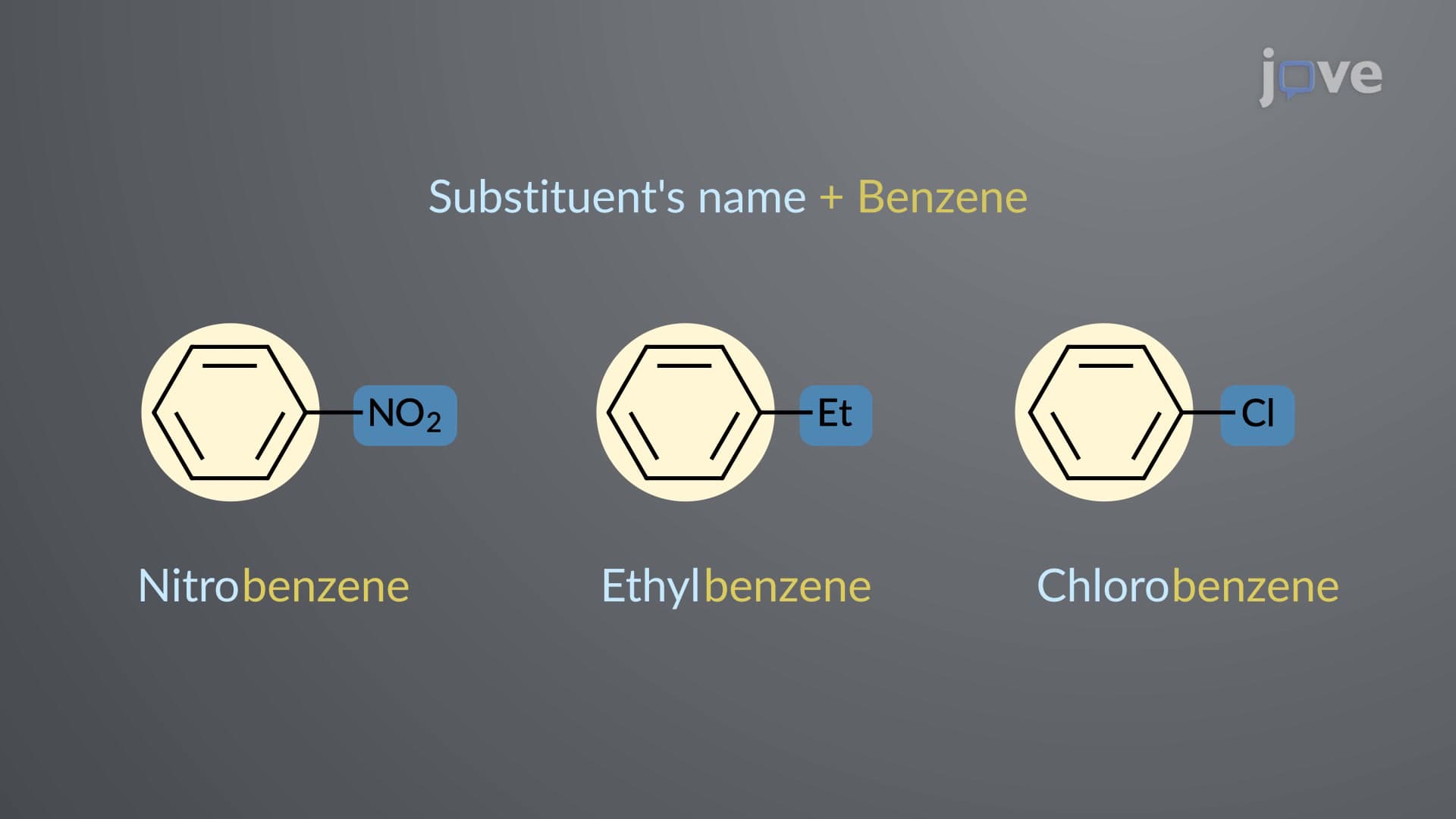
Certain substituents impart well-established common names that override systematic nomenclature rules. Compounds containing these recognizable parent structures-such as toluene (methylbenzene), aniline (aminobenzene), or phenol (hydroxybenzene)-are named as derivatives of these familiar molecules. This principle proves especially important for pre-med students preparing for the MCAT, where pharmaceutical nomenclature frequently appears in passage-based questions about drug mechanisms and metabolic pathways.
Understanding these naming conventions becomes crucial for success in advanced chemistry courses and standardized exams, where accurate structural interpretation often determines problem-solving success in both multiple-choice and free-response sections.
Related Micro-courses