Loading subject page…


75,402 views

Video Summary: Gausss Law Spherical Symmetry Explained
Ever wonder why lightning rods work so effectively to protect buildings? The answer lies in Gauss's law spherical symmetry, a fundamental principle that describes how electric fields behave around symmetrically charged objects. When charge is distributed uniformly on a sphere, the electric field outside behaves exactly like all the charge were concentrated at a single point at the center. This concept explains everything from the protective design of Faraday cages used in electrical safety testing to the behavior of charged particles in particle accelerators at national laboratories like Fermilab. Watch the full video on JoVE Coach to master this concept with expert-led visuals and step-by-step explanations.
Gauss's Law Spherical Symmetry Explained forms the cornerstone of electrostatic analysis for many practical applications. This principle states that when electric charge is distributed uniformly throughout a sphere or on a spherical surface, the resulting electric field exhibits perfect radial symmetry. The key insight is that spherical symmetry depends entirely on how charge is distributed, not on the physical shape of the conductor itself.
Consider a metal sphere used in Van de Graaff generators, common in physics demonstrations across US high schools. Even if this sphere has surface imperfections, as long as the charge distributes uniformly, the electric field outside maintains spherical symmetry. This principle appears frequently on AP Physics exams and college-level electromagnetism courses.
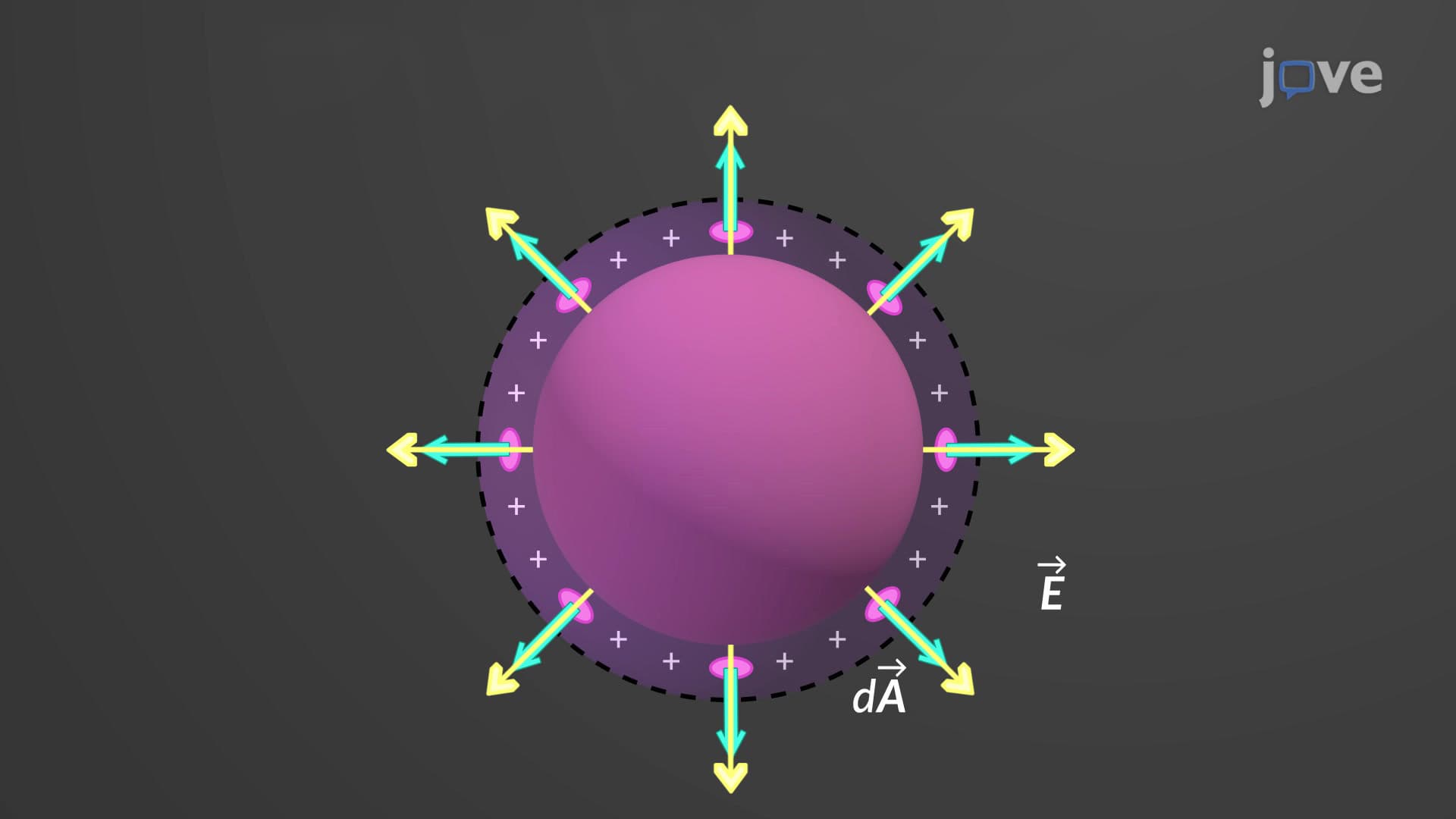
The mathematical beauty of spherical symmetry lies in its simplification of Gauss's law calculations. When dealing with spherically symmetric charge distributions, we can choose a spherical Gaussian surface centered at the charge distribution's center. Since the electric field magnitude remains constant over this surface and points radially outward everywhere, the dot product E·dA simplifies to E×A.
This simplification transforms complex vector calculus into straightforward algebra: E×4πr² = Q(enclosed)/ε₀. Students preparing for the MCAT or college physics courses will find this algebraic approach much more manageable than attempting surface integrals over irregular shapes.
Spherical symmetry principles govern numerous technologies Americans encounter daily. Lightning protection systems rely on the fact that charge accumulates on the outer surface of conductors, creating predictable electric field patterns. Tesla coils, popular in science museums like the Exploratorium in San Francisco, demonstrate how spherically symmetric charge distributions create spectacular electrical displays.
In the semiconductor industry, ion implantation processes use spherically symmetric electric fields to control charged particle trajectories with precision. Understanding these principles helps students pursuing engineering careers at companies like Intel or Texas Instruments grasp the fundamental physics behind microchip manufacturing.
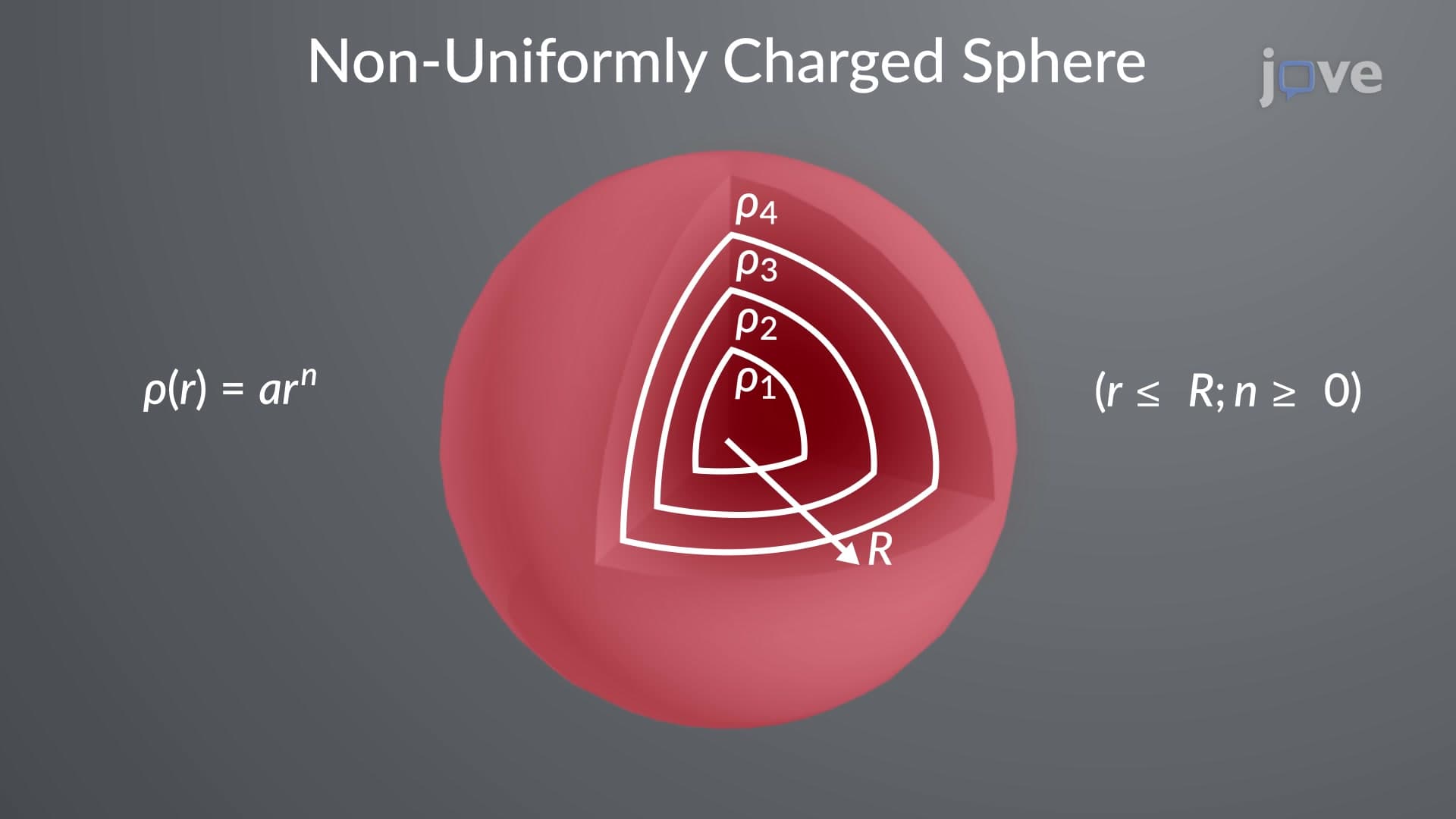
When approaching spherical symmetry problems on standardized tests, identify three key elements: charge distribution uniformity, appropriate Gaussian surface selection, and field direction consistency. Students should practice recognizing when spherical symmetry applies-uniform charge density throughout a volume qualifies, but non-uniform distributions (like higher charge density in one hemisphere) break symmetry.
For SAT Subject Test Physics or college midterm exams, remember that the electric field outside any spherically symmetric charge distribution matches that of a point charge carrying the same total charge. This equivalence principle often provides shortcuts for complex calculations, making it invaluable for time-pressured testing situations.
Related Micro-courses