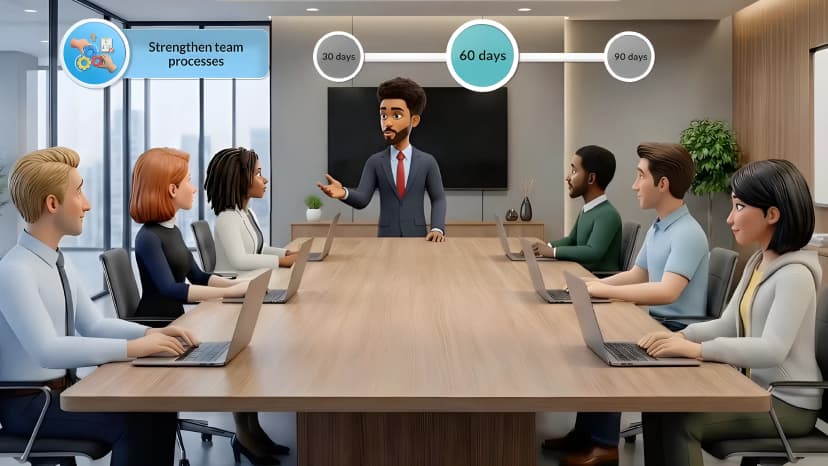

To introduce yourself as a new manager, send a short email the day your role is announced, then give a 60-second spoken intro at your first team meeting. Cover who you are, what you will do in your first month, how to reach you and when you will meet each person one-on-one. Promise only what you control.
You probably have a blank email open right now, and a first team meeting on the calendar. Maybe you were hired from outside and nobody knows your name yet. Maybe you were promoted on Friday and on Monday you will stand in front of people you ate lunch with last week. Either way, you are wondering how much to say, how friendly to sound, and what happens if someone asks a question you cannot answer.
Your team will read your introduction for three things: what changes for them, whether their work is safe, and whether you will listen before you act. Below are three emails, a short script, and answers to the questions you will get.
Why your first week carries more weight than you think
Gallup found that managers account for at least 70% of the variance in employee engagement across business units. In plain terms, how your team feels about work depends more on you than on almost anything else the company does.
You are also stepping into a role under pressure. In Gallup's State of the Global Workplace 2025 report, manager engagement worldwide fell from 30% to 27% in one year, while individual contributors stayed flat at 18%.

Gallup, State of the Global Workplace 2025 (Harter and Pendell, 2025). Employees worldwide, engaged at work by role. So your team is watching your first week closely, and you need a simple start you can repeat without improvising.
The order matters: who hears what, and when
Your introduction is four touches, in this order.

- Your manager announces it to you. Ask them to send the announcement first, so the team hears the decision from the person who made it.
- You send the introduction email the same day. Keep it under 200 words. It confirms the news in your voice and tells people what happens next.
- You give the spoken intro at your first team meeting. Same message, said out loud, with room for questions.
- You invite each person to a one-on-one within the first week. This is where the real introduction happens.
Step 4 matters most. Gallup reports that employees whose managers hold regular meetings with them are almost three times as likely to be engaged. Promise them in your email, then start keeping that promise in week one.
If you were promoted from within the team, step 1 is not optional.
What to say, and what to leave out
Run every sentence through one test: can you keep this promise by the end of next week? If yes, say it. If not, cut it.
Promises you can keep:
- "I will meet each of you one-on-one in the next two weeks."
- "For the first month, I am listening more than changing."
- "Here is the best way to reach me."
Promises you cannot keep yet:
- "Nothing is going to change." Something will, and the team will remember you said this.
- "My door is always open." It will not be, and people know it.
- Your vision for the team. You do not have enough context yet.
Leave out your full career history, any comment on the previous manager, and any opinion on how the team has been run. Two sentences about your background is enough. To make the email sound like you, add one true, small detail: where you are based, what you are reading, the team you supported before. Your team will judge you by how you behave in the first month, which is why building credibility as a new manager comes from what you do week after week.
New manager introduction email to team: 3 templates
Replace the brackets, cut anything that is not true for you, and keep the length.
Template 1: You are joining from outside
Subject: Hello from [Your Name], your new manager
Hi everyone,
As [Manager's Name] shared, I am joining as manager of [team] starting [date]. I spent the last [X] years [one line on relevant work], most recently at [company].
For my first month, my job is to learn how this team works, what is going well and what gets in your way. I will not be making big changes while I do that.
Over the next two weeks I will set up a 30-minute one-on-one with each of you. Please bring anything you think I should know. Before then, the fastest way to reach me is [channel].
Looking forward to meeting you on [day].
[Your Name]
Template 2: You were promoted from within the team
Subject: Next steps as I take over [team]
Hi all,
As [Manager's Name] announced, I am stepping into the manager role for [team] from [date]. Most of you have worked alongside me, so this is a change for all of us, me included.
A few things will be different. I will be in more planning and leadership meetings, and some of my old work will move to others. Over the next two weeks I will meet each of you one-on-one to talk about your work and what you need from me.
What will not change is that I want to hear it when something is not working. I would rather know early.
[Your Name]
The hardest part of this version comes after you send it. Setting boundaries with former peers covers how to keep the friendships without keeping the old roles.
Template 3: Your team is remote or spread across time zones
Subject: Introducing myself, plus how to reach me
Hi team,
I am [Your Name], and I am joining as manager of [team] from [date]. I am based in [city/time zone] and usually online [hours].
For the first month I am focused on learning how you work and where the friction is. I will send a calendar link for a 30-minute video one-on-one with each of you. Pick a slot that works in your time zone.
For anything urgent, [channel] reaches me fastest. For everything else, [channel] is fine.
See you at [first meeting name] on [date].
[Your Name]

Your 60-second first-day script
Say this at your first team meeting, before any agenda item. It repeats the email, so the team hears one consistent message.
Hi everyone. I am [name]. Before this I [one line on your background].
For my first month, I am here to learn. I want to understand what you work on, what is going well, and what slows you down. I am not planning big changes until I have done that.
This week I will book a one-on-one with each of you. Come with anything you think I should know, good or bad.
One request: if something is not working, tell me early. I would rather fix a small problem in week two than a big one in month three.
What questions do you have for me right now?
If you were promoted from within, swap the first two lines:
Most of you know me already, so I will skip the background. What is new is my job. I am now responsible for how this team does, and for making sure each of you has what you need.
Then stop talking and wait. Ten seconds of silence is normal. If nobody speaks, say you will take questions in the one-on-ones and move to the agenda. For the rest of that meeting, see our guide to running your first team meeting as a new manager.
How to answer the questions you will get on day one
Someone will ask at least one of these. Have the answer ready.
"Are you going to change things?"
"Probably some things, eventually. Not before I understand how the team works, and not without talking to you first."
"What happened to [previous manager]?"
Give the official, shared version only. "[Name] moved to [role]. I do not know more than that, and it is their story to tell."
"Is my job safe?" or "Are there layoffs coming?"
Never guess. "I do not have any information about that. If I learn something that affects you, I will tell you as soon as I am allowed to." Then check with your own manager the same day.
"So are you still one of us?" (promoted from within)
"I am still on your side. My job is different now, and some conversations will feel different. I would rather we talk about that openly than pretend nothing changed."
After the introduction: your first week
The email and script buy you a little goodwill. The first week decides whether you keep it.
- Send the one-on-one invites the same day as the email.
- In each one-on-one, ask three things: what they work on, what gets in their way, and how they like to receive feedback.
- Write down what you hear. Read it back to the team at the end of the month, so they see their input went somewhere.
These early conversations are where trust within a new team actually starts. For what comes after week one, your first 90 days as a manager breaks the period into stages.
Practice before you say it out loud
An introduction is one small moment in a bigger shift, from doing the work to leading the people who do it. The Transitioning From Individual Contributor to Manager microcourse covers that shift in short videos you can watch the week you start. Start with the transitioning to management course, or explore all 13 courses in New Manager Essentials.

Related course - Transitioning From Individual Contributor to Manager
Short lessons on credibility, former peers, and your first 90 days, so the introduction is the start of the shift, not the whole of it.
Common Questions
Should I send the introduction email before my first day?
Send it after your manager's announcement and no later than your first morning. If you are an outside hire and your manager has already announced you, a short note a day or two before your start date works well.
How much personal information should I share?
One or two light details are enough, such as where you are based or one interest outside work. Share more in one-on-ones once you know the team. The introduction is about how you will work with them.
Should I also introduce myself to other teams and stakeholders?
Yes, in a separate, shorter email. Tell them you have taken over the team, who their main contact is, and that you will reach out to meet. Do not send your team email to stakeholders.
How long should a new manager introduction email be?
Under 200 words. Cover four things: who you are, what you will do in your first month, when you will meet each person, and how to reach you. Save the rest for the one-on-ones.
What should a new manager say on the first day?
Keep it to about 60 seconds. Say who you are, that your first month is for listening, and that you will book a one-on-one with everyone this week. Then ask for questions and let the silence sit.
How do I introduce myself to former peers after a promotion?
Ask your manager to announce the promotion first, so your former peers hear it from the person who made the decision. Then name the change openly: your job is different, some conversations will feel different, and you still want to hear when something is not working.