Loading video…


 7 Concepts
 8.2K views

Video Summary: Design Example Flow Through a Explained
Ever wonder how fire extinguishers shoot water with such force? Mass conservation in finite control volumes governs the powerful stream that can save lives during emergencies. When firefighters at the Chicago Fire Department activate a pressurized extinguisher, the Design Example Flow Through A demonstrates how fluid flows from high-pressure storage through a narrow nozzle, accelerating dramatically as it exits. This fundamental engineering principle explains why smaller nozzle openings create more powerful streams. Watch the full video on JoVE Coach to master this concept with expert-led visuals and step-by-step explanations.
The Design Example Flow Through A represents a fundamental fluid mechanics concept where pressurized fluids accelerate through constricted openings. This principle underlies countless engineering applications, from fire suppression systems to hydraulic machinery used in American manufacturing plants.
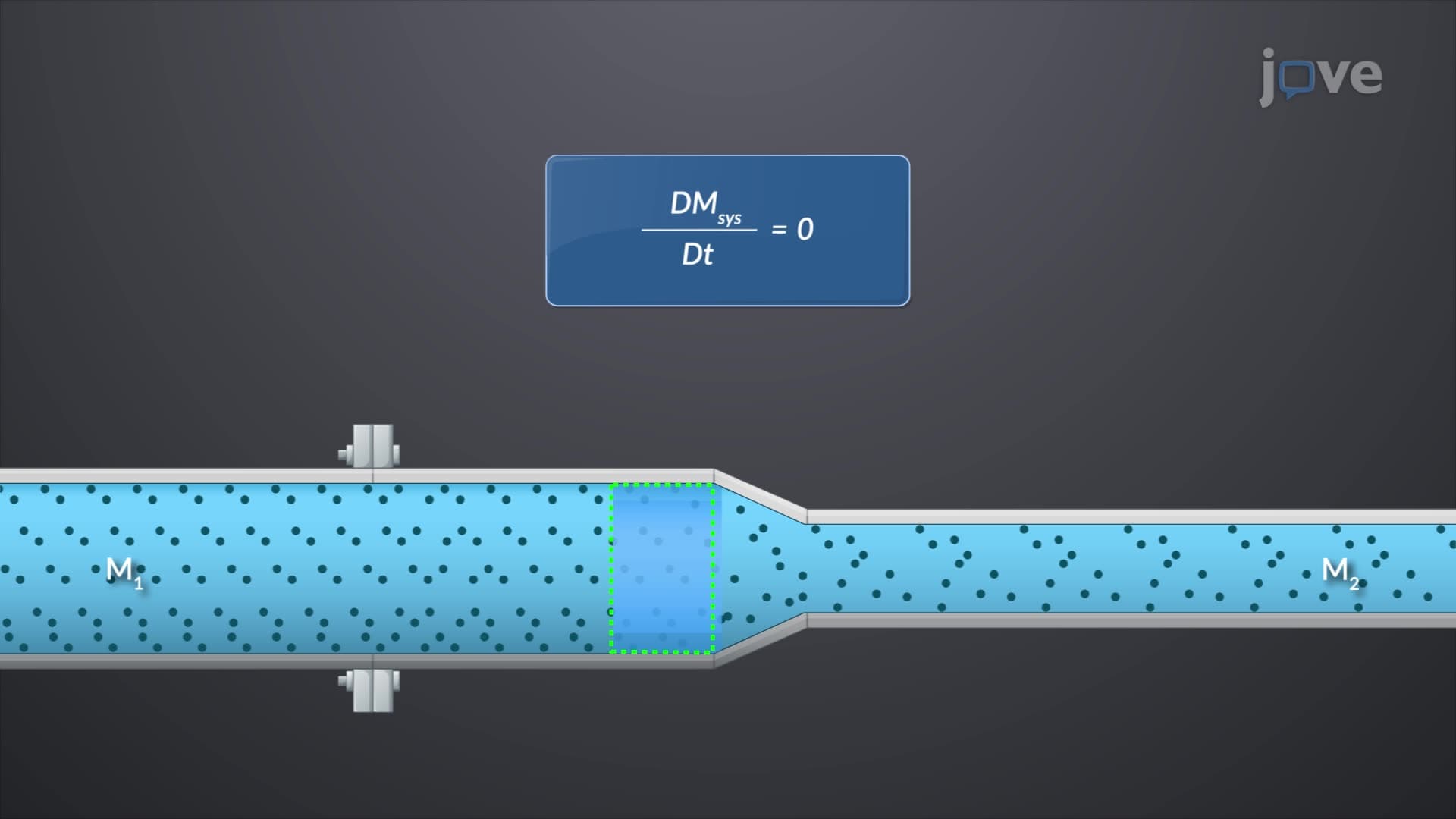
Mass conservation in finite control volumes forms the theoretical foundation for analyzing fluid behavior in bounded systems. When water flows from a pressurized fire extinguisher through its nozzle, the mass entering the control volume (the nozzle region) must equal the mass exiting, assuming no accumulation occurs within the system.
The continuity equation, ρ₁A₁V₁ = ρ₂A₂V₂, mathematically expresses this conservation principle. For incompressible fluids like water, density remains constant, simplifying the equation to A₁V₁ = A₂V₂. This relationship explains why water accelerates dramatically when forced through the smaller nozzle opening-the velocity must increase to maintain constant mass flow rate.
Fire departments across the United States rely on this principle for effective emergency response. The Los Angeles Fire Department's high-pressure pumper trucks use variable nozzle designs that exploit mass conservation principles to optimize water delivery for different fire scenarios. By adjusting nozzle diameter, firefighters control both flow rate and stream velocity.
Industrial applications include hydraulic systems in manufacturing plants throughout the Midwest, where pressurized fluids power heavy machinery. Understanding how to understand mass conservation in finite control volumes enables engineers to design efficient hydraulic circuits that minimize energy waste while maximizing power output.
Students preparing for AP Physics or college-level fluid mechanics courses encounter these concepts regularly. The MCAT includes questions about fluid dynamics that test understanding of mass conservation principles. Engineering programs at institutions like MIT and Stanford emphasize these fundamental concepts in their mechanical and civil engineering curricula, as they're essential for designing everything from water treatment facilities to aerospace propulsion systems.
Related Micro-courses