Loading subject page…


8,112 views


Video Summary: Moisture Content and Bulking of Aggregate Explained
Ever wonder why concrete mixtures at construction sites across America require constant adjustments for weather conditions? The moisture content and bulking of aggregate phenomenon directly impacts every concrete project, from sidewalks in Phoenix to skyscrapers in New York City. When sand absorbs water, it doesn't just get heavier-it actually expands in volume, forcing engineers to recalculate their mix designs. Understanding Moisture Content And Bulking of Aggregate Explained helps construction professionals maintain structural integrity and cost efficiency. Watch the full video on JoVE Coach to master this concept with expert-led visuals and step-by-step explanations.
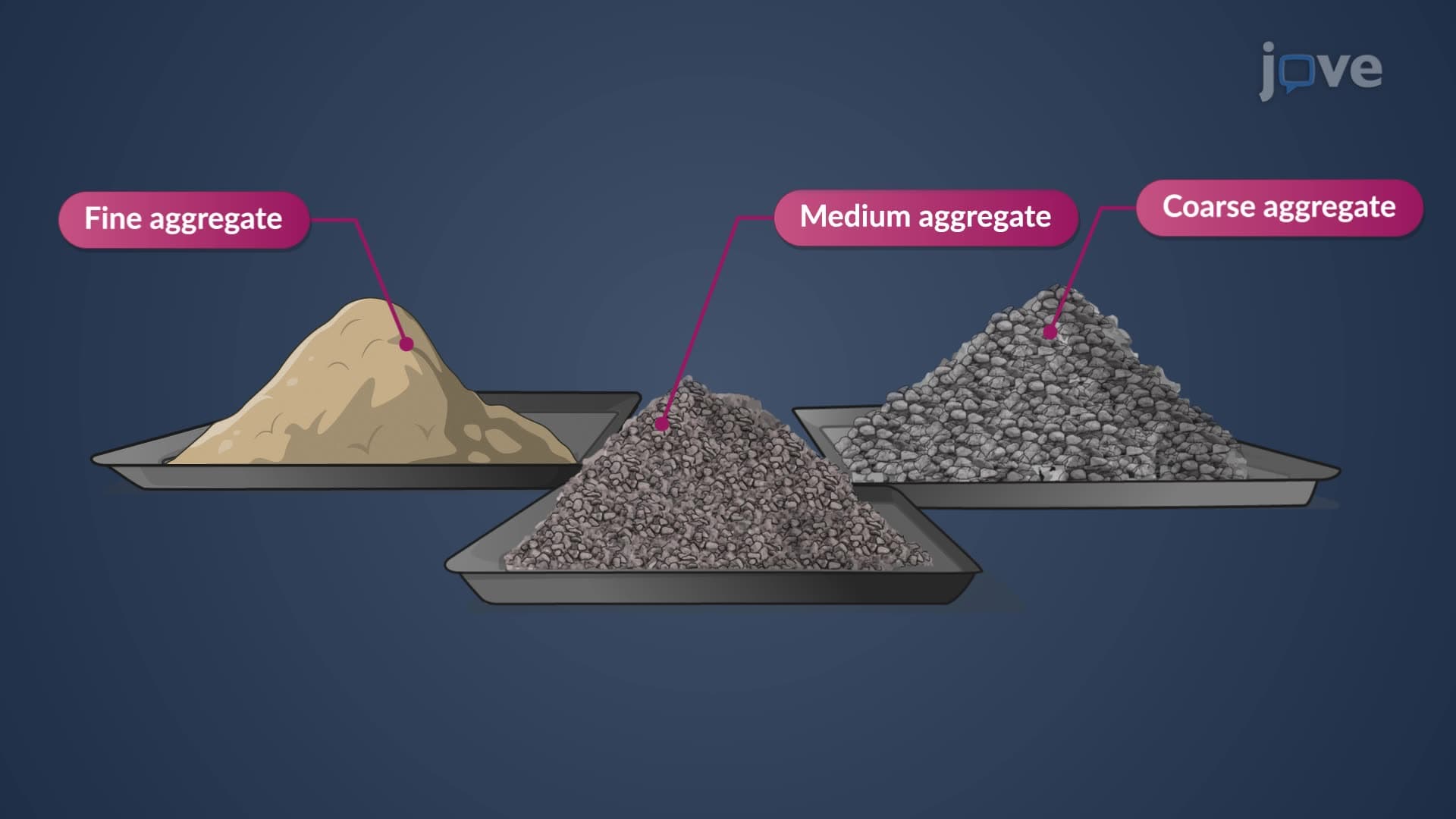
The moisture content and bulking of aggregate represents one of the most critical yet often overlooked aspects of concrete technology. Unlike simple water absorption, this phenomenon involves excess surface water that creates a thin film around individual aggregate particles. This surface moisture exists beyond the saturated surface-dry (SSD) condition, where aggregates have absorbed their maximum internal water capacity but maintain dry external surfaces.
Construction professionals across the United States encounter this challenge daily. At a typical ready-mix plant in Texas, operators must constantly monitor sand moisture levels as afternoon thunderstorms can dramatically alter aggregate properties within hours. The moisture content measurement requires precise laboratory techniques, including buoyancy meter tests that determine the specific gravity of wet aggregates compared to their dry counterparts.
Sand bulking occurs when free moisture creates microscopic barriers between individual grains, forcing them apart and increasing the overall volume of a given mass. This physical separation happens because water molecules form meniscus bridges between particles, creating surface tension forces that resist compaction. The result is counterintuitive: wet sand occupies more space than dry sand of identical weight.
Students preparing for AP Environmental Science or college-level Materials Engineering courses should understand that bulking typically peaks at moisture contents between 5-8% by weight. Beyond this range, additional water begins to fill the expanded voids, gradually reducing the bulking effect. This relationship follows a characteristic bell curve that construction engineers use to predict volume changes in aggregate stockpiles.
American construction standards, including those referenced in ASTM C128 and ASTM C566, provide specific protocols for measuring moisture content and accounting for bulking effects. Modern concrete plants utilize electronic moisture meters installed directly in storage bins, providing real-time data to automated batching systems. These devices use microwave or capacitance technology to instantly detect moisture changes and adjust mix proportions accordingly.
For students encountering this topic in college Materials Science courses or professional certification exams, understanding the compensation process is crucial. When weigh batching concrete, operators must add extra sand to achieve the design volume, then subtract equivalent water from the mix to maintain proper water-cement ratios. This dual adjustment ensures structural integrity while preventing costly material waste or performance failures in projects ranging from residential foundations to interstate highway construction.
Related Micro-courses