Loading…
Loading video…

5,215 views
Ever wondered why your phone charger delivers power most efficiently when perfectly matched to your device's requirements? The Maximum Power Transfer Theorem explains this fundamental principle in three phase circuits and electrical engineering. This theorem determines the optimal conditions for transferring maximum power from a source to a load, whether in power grids across Texas or wireless communication towers throughout California. Understanding three phase circuits and their power transfer characteristics is crucial for electrical engineering applications. Watch the full video on JoVE Coach to master this concept with expert-led visuals and step-by-step explanations.
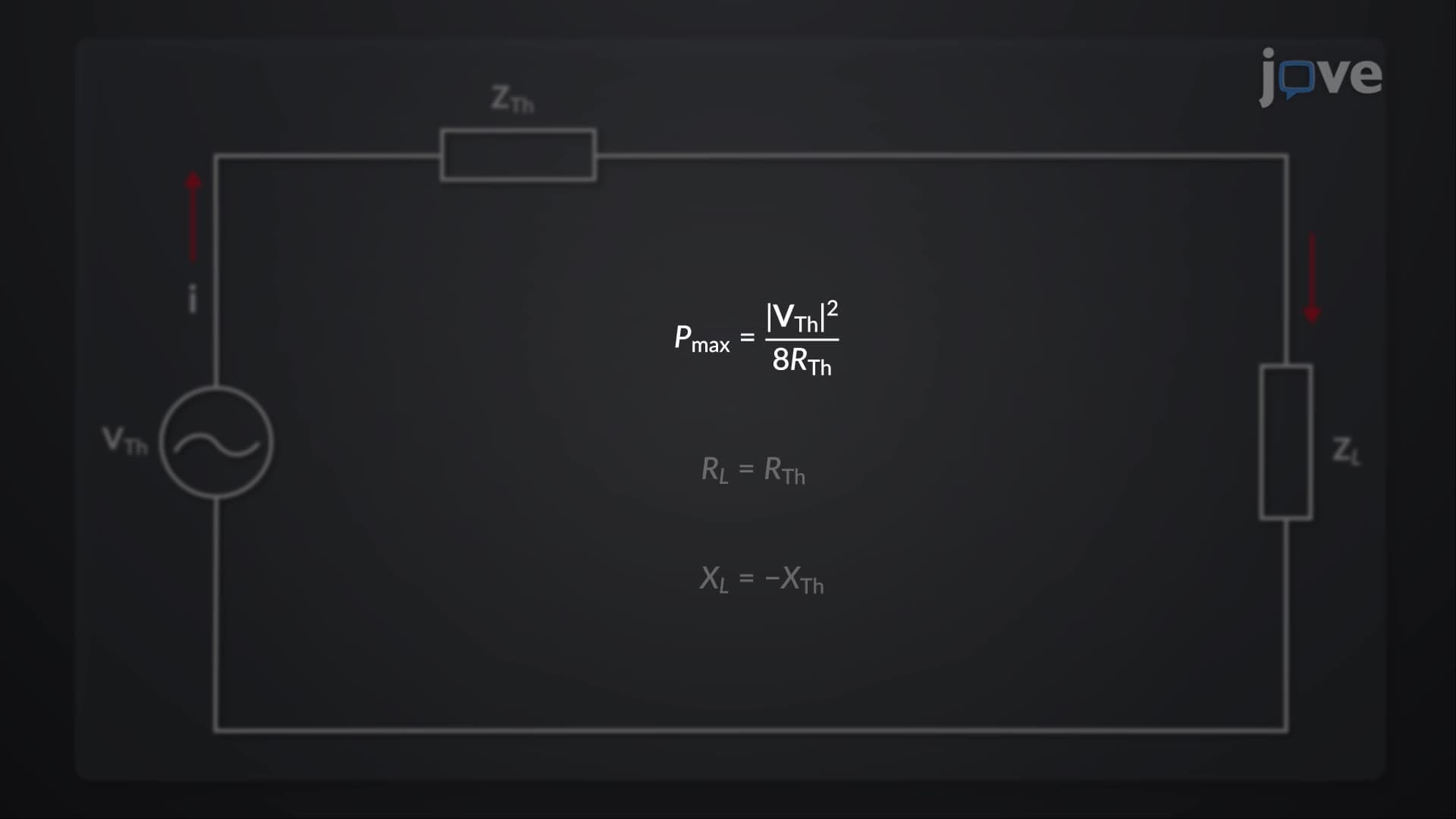
The Maximum Power Transfer Theorem represents one of the most important principles in electrical engineering, particularly when analyzing types of three phase circuits and complex electrical networks. This theorem states that maximum power is delivered from a source to a load when the load impedance equals the complex conjugate of the source impedance. For students preparing for AP Physics C or college-level circuit analysis courses, mastering this concept provides the foundation for understanding power optimization in electrical systems.
When working with three phase circuits overview, engineers must consider both resistive and reactive components of impedance. The theorem applies to linear circuits that can be represented by their Thevenin equivalent - a voltage source in series with an impedance. This simplification allows complex three-phase industrial systems, like those powering manufacturing facilities in Michigan or data centers in Virginia, to be analyzed using straightforward mathematical relationships.
The mathematical foundation involves expressing power in terms of load impedance components. For a Thevenin equivalent circuit with impedance ZTh = RTh + jXTh connected to a load ZL = RL + jXL, the current magnitude determines power delivery. Maximum power occurs when the derivative of power with respect to load resistance equals zero, yielding RL = RTh, and when load reactance XL = -XTh.
Students encountering this in SAT Subject Tests or college midterms should remember that three phase circuits basics require understanding both magnitude and phase relationships. The maximum power delivered equals VTh²/(4RTh), where VTh represents the Thevenin voltage. This relationship appears frequently in electrical engineering coursework and professional licensing examinations.
Understanding three phase circuits becomes critical when examining real-world applications. In wireless communication systems across the United States, antenna impedance matching ensures optimal signal transmission. Cell towers from AT&T, Verizon, and T-Mobile utilize these principles to maximize power transfer from transmitters to antennas, directly impacting call quality and coverage areas.
Power utility companies like ConEd in New York or PG&E in California apply these concepts when designing transmission systems. However, maximum power transfer doesn't always align with maximum efficiency - a crucial distinction for students studying three phase circuits study guide materials. While maximum power transfer occurs at 50% efficiency, practical systems often operate at higher efficiency levels with slightly reduced power transfer.
The three phase circuits concept extends beyond simple impedance matching when considering practical constraints. In battery-powered devices, maximizing efficiency often takes precedence over maximum power transfer to extend operating time. Electric vehicle charging systems, increasingly common throughout states like California and Texas, must balance power transfer optimization with thermal management and safety requirements.
For students preparing for engineering careers, recognizing when to apply maximum power transfer principles versus efficiency optimization represents a critical skill. MCAT preparation courses emphasize similar analytical thinking when evaluating biological systems, while engineering students must master these trade-offs for professional practice.
Frequently Asked Questions
The Maximum Power Transfer Theorem states that maximum power transfers from a source to a load when the load impedance equals the complex conjugate of the source impedance. It applies to linear circuits that can be represented by Thevenin equivalents, commonly used in power systems, communication circuits, and electronic device design. This principle helps engineers optimize power delivery in applications from smartphone chargers to industrial motor drives.
Exam questions typically involve calculating optimal load impedance for given source conditions, determining maximum power values, or comparing power transfer under matched versus unmatched conditions. Students might analyze circuits with complex impedances, derive conditions for maximum power mathematically, or solve problems involving antenna impedance matching. Practice problems often include three-phase power systems and AC circuit analysis scenarios.
Maximum power transfer occurs at 50% efficiency when load resistance equals source resistance, while maximum efficiency approaches 100% when load resistance is much larger than source resistance. Power utilities prioritize efficiency to minimize energy waste, while battery-powered devices balance both factors. Communication systems often prioritize power transfer for signal strength, accepting lower efficiency for optimal performance.
Cell phone networks, WiFi routers, and satellite communication systems match antenna impedances to transmission line impedances (typically 50 or 75 ohms) to maximize signal power transfer. This matching ensures optimal signal strength, reduces reflections that cause interference, and maximizes communication range. Companies like Qualcomm and Broadcom design circuits specifically optimized for these impedance matching requirements.
High school students with strong algebra and basic trigonometry skills can grasp the fundamental concepts and simpler mathematical relationships. While complex impedance calculations require more advanced mathematics, the core principle and resistive-only cases remain accessible. AP Physics C students regularly work with these concepts, and the practical applications help make abstract mathematics more concrete and meaningful.
Practice converting complex circuits to Thevenin equivalents first, then focus on impedance matching conditions systematically. Create formula sheets linking power expressions to impedance relationships, and work through problems involving both purely resistive and complex impedance scenarios. Use online circuit simulators to visualize how power changes with different load conditions, reinforcing mathematical concepts with graphical understanding.
This theorem provides foundation knowledge for RF circuit design, power electronics, signal processing, and electromagnetic field theory. Students progress to topics like Smith chart analysis for transmission lines, amplifier design for maximum power gain, and impedance matching networks for antenna systems. The concept also connects to control systems theory and power system stability analysis in graduate-level coursework.
Related Micro-courses
Related Subjects
 Civil Engineering 30 micro-courses›Mechanical Engineering 28 micro-courses›