Loading…
Loading video…

1,704 views
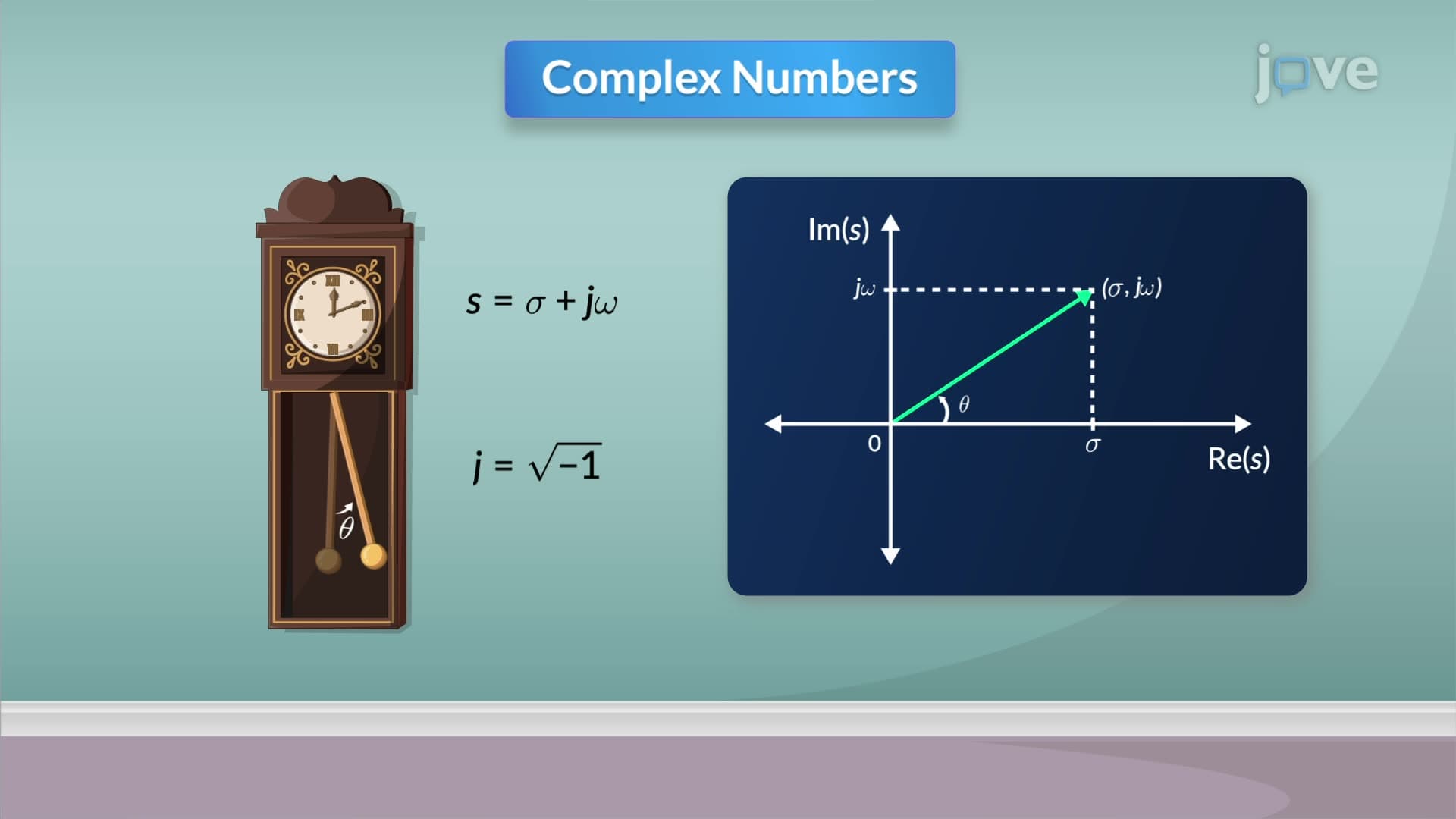
Ever wonder how NASA engineers navigate spacecraft through complex orbital calculations? The root locus method transforms abstract mathematical relationships into visual vector representations, making complex number analysis as intuitive as plotting points on a map. Boeing's flight control systems rely on these vector-based calculations to ensure aircraft stability during turbulent conditions. Vector Representation of Complex Numbers Explained reveals how mathematical functions become geometric tools for solving real engineering challenges. Watch the full video on JoVE Coach to master this concept with expert-led visuals and step-by-step explanations.
The root locus method fundamentally depends on visualizing complex numbers as vectors in the complex plane. This geometric approach transforms abstract mathematical operations into intuitive visual representations. When you plot a complex number like 3 + 4i, you're essentially drawing a vector from the origin to the point (3,4), where the magnitude equals 5 and the angle measures approximately 53.13 degrees from the positive real axis.
Complex numbers expressed in polar form reveal their true geometric nature. The magnitude represents the vector's length, while the phase angle indicates its direction. In engineering applications, such as analyzing AC circuits at General Electric or designing antenna arrays at Raytheon, engineers use these vector representations to understand signal behavior and system responses.
For any complex function, the output magnitude equals the product of distances from zeros divided by the product of distances from poles. This relationship proves crucial when analyzing control systems, where engineers must predict how changes in system parameters affect overall performance.
The phase angle calculation involves summing angles from zeros and subtracting angles from poles, all measured from the positive real axis. This geometric interpretation forms the foundation of the root locus method, widely used in control system design courses at MIT, Stanford, and other top engineering schools.
Students preparing for AP Physics C or college-level circuit analysis courses encounter these concepts when studying AC power systems, filter design, and stability analysis. The root locus method definition encompasses this vector-based approach to understanding how system poles and zeros influence overall behavior.
When solving complex functions at specific points, engineers draw vectors from each zero and pole to the point of interest. This visualization technique helps predict system behavior without complex algebraic manipulations. Companies like Texas Instruments use these methods when designing integrated circuits, while aerospace engineers at SpaceX apply similar principles when analyzing rocket guidance systems.
Frequently Asked Questions
Vector representation visualizes complex numbers as arrows in the complex plane, showing both magnitude and direction. The root locus method uses these vector concepts to analyze how system parameters affect stability and performance. This geometric approach makes abstract mathematical relationships intuitive and practical for engineering applications.
AP Physics C and engineering midterms frequently test vector representation through AC circuit problems, oscillation analysis, and control system questions. Students must convert between rectangular and polar forms, calculate magnitudes and phases, and interpret physical meanings. Practice problems often involve RLC circuits, mechanical vibrations, or signal processing applications.
MCAT physics sections may include basic complex number operations and wave analysis, while engineering exams focus on stability analysis and control system design. Key topics include pole-zero relationships, magnitude and phase calculations, and geometric interpretations of system behavior using vector methods.
NASA applies these concepts in orbital mechanics calculations, attitude control systems, and communication signal processing. Engineers visualize spacecraft orientation changes as complex rotations, analyze antenna beam patterns using vector mathematics, and design flight control systems that maintain stability through vector-based feedback analysis.
Basic algebra and trigonometry provide sufficient foundation for understanding vector representation concepts. While advanced applications require calculus, the fundamental geometric interpretation remains accessible to high school students. Focus on visualizing relationships rather than memorizing complex formulas.
Practice converting between rectangular and polar forms daily, sketch vector diagrams for every problem, and connect mathematical operations to physical interpretations. Use graphing calculators or software to visualize complex plane relationships, and work through real engineering examples from textbooks used at schools like Purdue or Georgia Tech.
Advanced control systems theory, digital signal processing, and complex analysis provide natural progressions. Students often continue with Laplace transforms, frequency domain analysis, and modern control theory. These topics appear in graduate-level courses and professional engineering licensing examinations.
Related Micro-courses


Related Subjects
 Civil Engineering 30 micro-courses›Mechanical Engineering 28 micro-courses›