Loading…
Loading video…

1,704 views
Ever wonder how NASA engineers ensure rocket guidance systems remain stable during launch? The secret lies in plotting and calibrating the root locus – a powerful graphical method that predicts how control systems behave as parameters change. Consider Boeing's autopilot systems: engineers use root locus construction to map exactly where system poles move as gain increases, ensuring aircraft maintain stable flight from takeoff to landing. Understanding the construction of root locus reveals the mathematical roadmap that transforms open-loop instability into closed-loop precision. Watch the full video on JoVE Coach to master this concept with expert-led visuals and step-by-step explanations.
The construction of root locus represents one of control theory's most elegant graphical techniques, providing engineers with a visual roadmap of system behavior. At its core, root locus construction maps the journey of closed-loop poles as system gain K increases from zero to infinity. This mathematical framework proves invaluable for students preparing for AP Physics C exams or engineering coursework, where understanding system stability determines success.
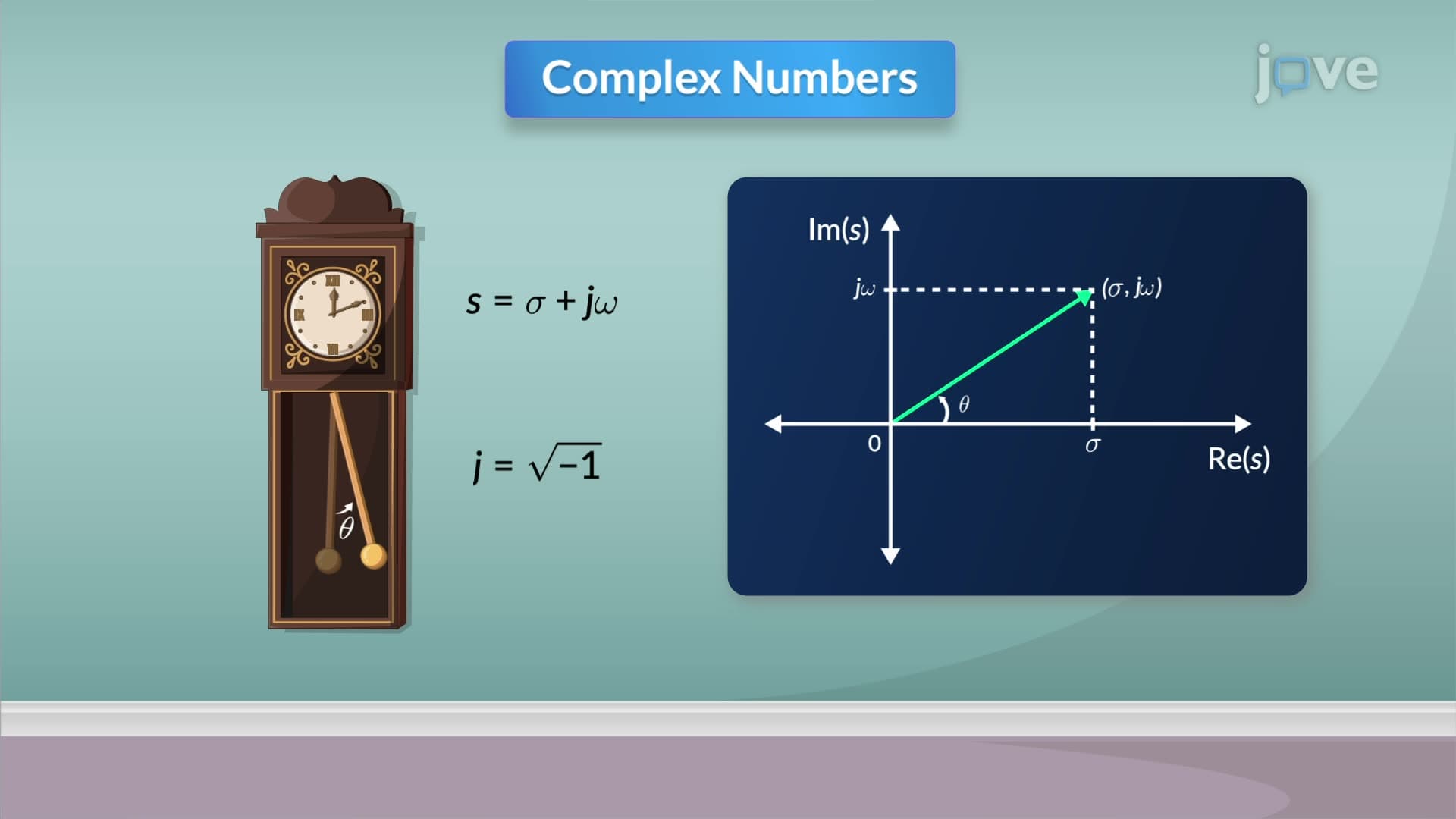
Root locus construction follows predictable geometric patterns that simplify complex analysis. The most fundamental rule establishes symmetry about the real axis – if a complex pole exists at location s = a + jb, its conjugate must exist at s = a - jb. This symmetry reflects the physical reality that real systems with real coefficients produce complex poles in conjugate pairs.
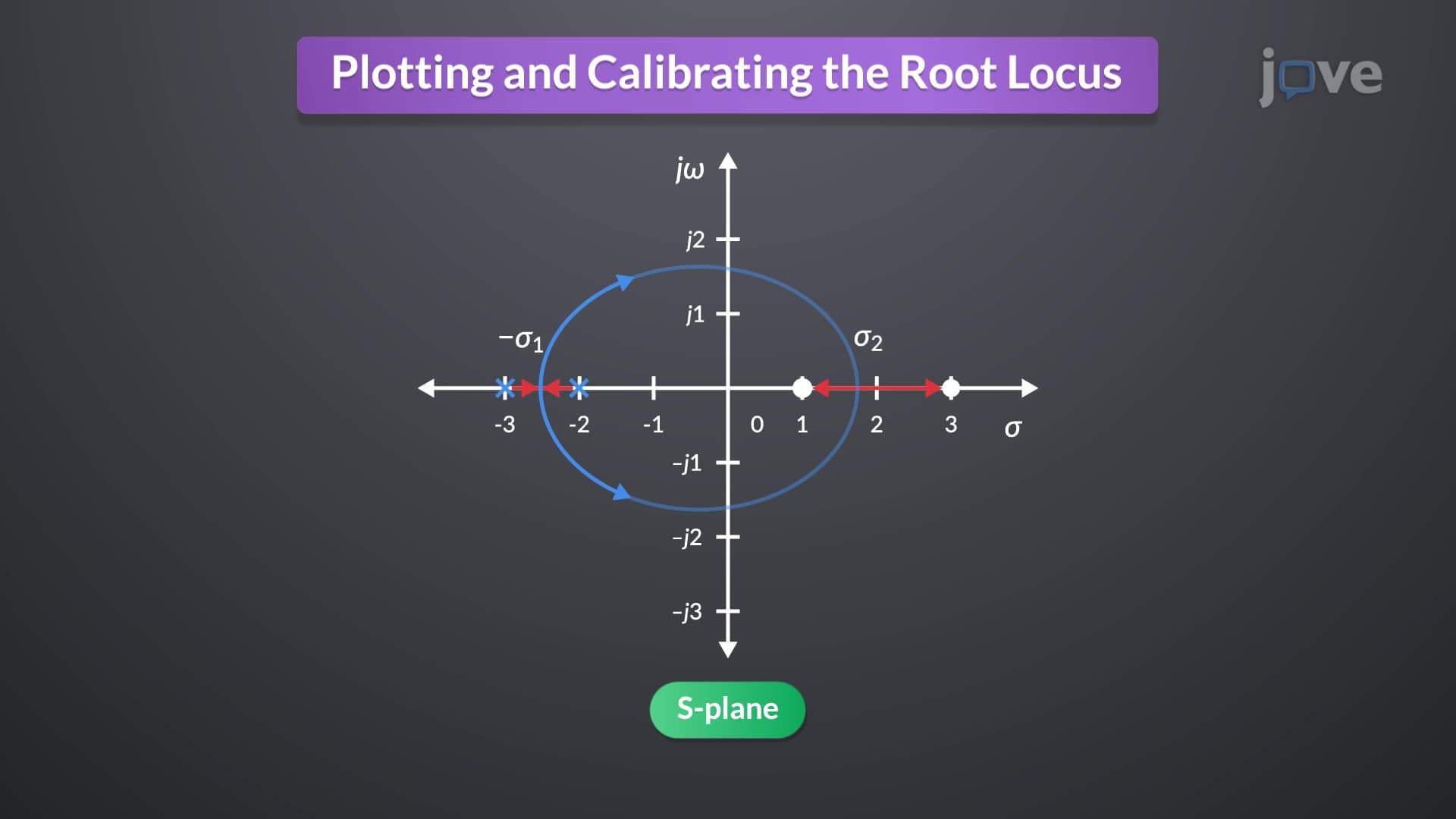
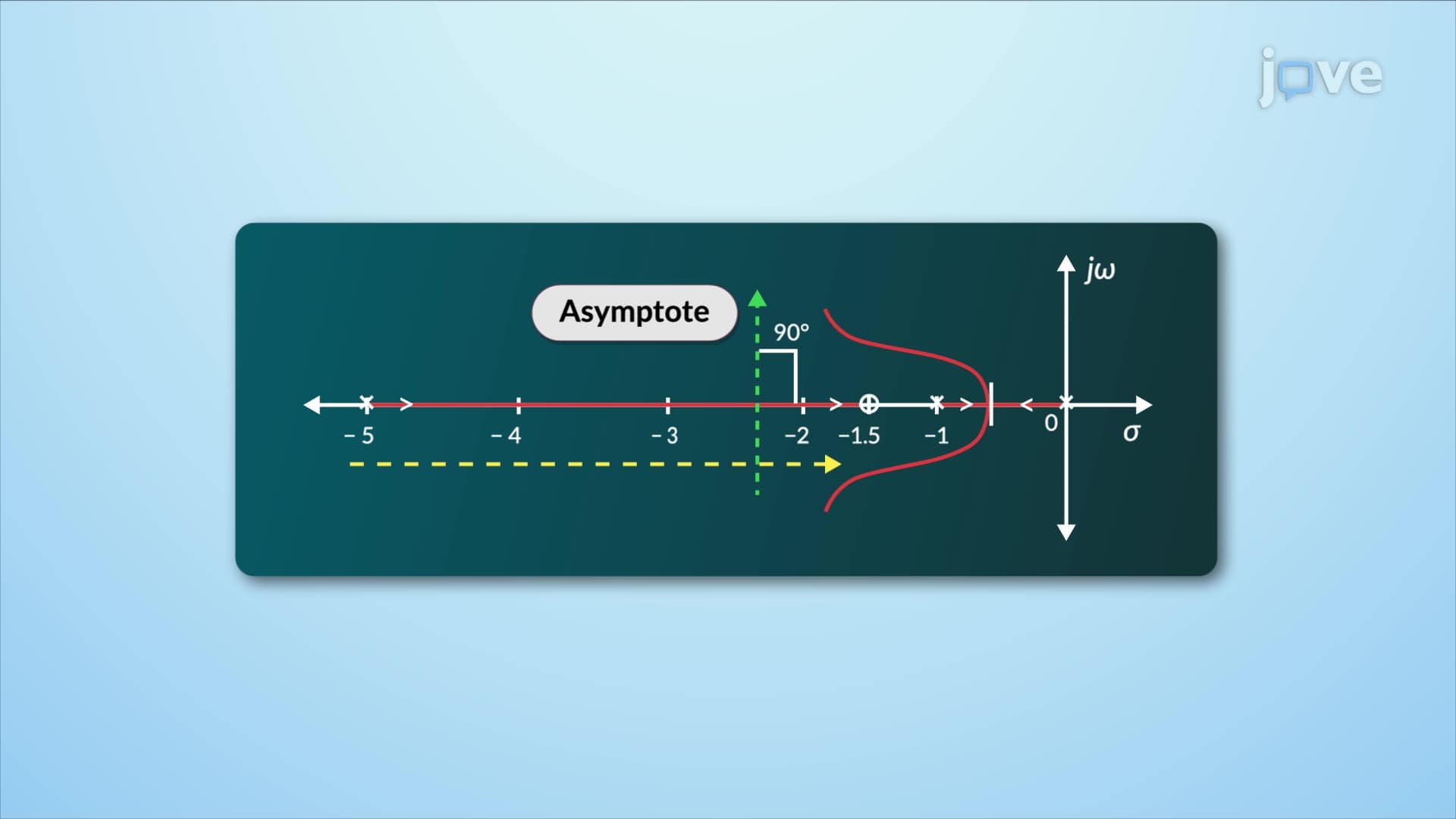
The real-axis rule provides another crucial construction guideline: root locus exists on real-axis segments where the total number of finite open-loop poles and zeros to the right sums to an odd number. For example, consider a system with poles at s = -1, -3, -5 and a zero at s = -2. The root locus exists between s = -2 and s = -3, and also between s = -5 and negative infinity, because these segments satisfy the odd-sum criterion.
As gain approaches infinity, root locus branches approach straight-line asymptotes. The number of asymptotes equals the difference between the number of finite poles and finite zeros. These asymptotes intersect the real axis at the centroid, calculated using: σ = (sum of pole locations - sum of zero locations)/(number of poles - number of zeros).
The asymptote angles follow the formula: θ = (2k + 1)180°/(n - m), where n represents poles, m represents zeros, and k = 0, 1, 2, ... This mathematical precision enables engineers at companies like Lockheed Martin to predict exactly how aircraft control systems will behave under varying conditions.
Root locus construction directly impacts real-world engineering decisions. Tesla's autopilot systems rely on these principles to maintain vehicle stability across varying speeds and road conditions. Similarly, medical device manufacturers use root locus analysis to ensure ventilators respond appropriately to patient breathing patterns without oscillation or instability.
Students encountering this material in college controls courses or preparing for the Fundamentals of Engineering exam will find root locus construction bridges theoretical mathematics with practical system design, making it an essential tool for aspiring engineers across aerospace, automotive, and biomedical industries.
Frequently Asked Questions
Construction of root locus is a graphical method that shows how closed-loop pole locations change as system gain varies from zero to infinity. It's crucial because it provides engineers with an immediate visual understanding of system stability margins and performance characteristics. This technique helps predict whether a control system will remain stable or become oscillatory under different operating conditions, making it indispensable for designing everything from aircraft autopilots to industrial process controls.
AP Physics and college exams typically test your ability to sketch root locus plots given pole-zero configurations and apply stability criteria. Common question formats include determining breakaway points, calculating asymptote angles, and predicting system behavior for specific gain values. Students often encounter problems asking them to design controllers that place closed-loop poles in desired locations using root locus principles.
Most students struggle with calculating breakaway/break-in points and understanding asymptotic behavior as gain approaches infinity. The mathematical complexity of finding exact breakaway points using derivatives often creates confusion. Additionally, visualizing how complex poles move in three-dimensional space while maintaining conjugate symmetry requires strong spatial reasoning skills that develop with practice.
The Fundamentals of Engineering (FE) exam extensively covers root locus principles in its control systems section. Graduate Record Examinations (GRE) subject tests in engineering occasionally include these concepts. Some advanced placement programs and college placement exams test basic stability concepts that connect to root locus theory, though typically at a more introductory level.
Boeing engineers use root locus analysis to design flight control systems that maintain aircraft stability across varying flight conditions, altitudes, and payload configurations. They analyze how autopilot gain changes affect pole locations, ensuring the aircraft responds predictably to pilot inputs without dangerous oscillations. This analysis directly influences the certification process with the Federal Aviation Administration, where stability margins must meet strict regulatory requirements.
While calculus helps with finding exact breakaway points and asymptote calculations, you can understand fundamental root locus concepts with algebra and basic complex number knowledge. Most introductory treatments focus on qualitative sketching rules and stability interpretation rather than rigorous mathematical derivations. Students typically encounter the more advanced mathematical aspects in upper-level undergraduate control theory courses.
Focus on memorizing the basic construction rules first, then practice sketching simple systems by hand before using computer tools. Create flashcards for asymptote formulas and real-axis rules, and work through progressively complex examples. Many students benefit from drawing root locus plots for the same system with different gain values to visualize pole movement patterns.
Natural progressions include frequency response methods like Bode plots and Nyquist criteria, which provide alternative perspectives on the same stability concepts. State-space analysis offers a more modern mathematical framework, while PID controller design builds directly on root locus principles for practical applications. These topics frequently appear together on engineering qualifying exams and professional certification tests.
Related Micro-courses


Related Subjects
 Civil Engineering 30 micro-courses›Mechanical Engineering 28 micro-courses›