Loading…
Loading video…
651 views
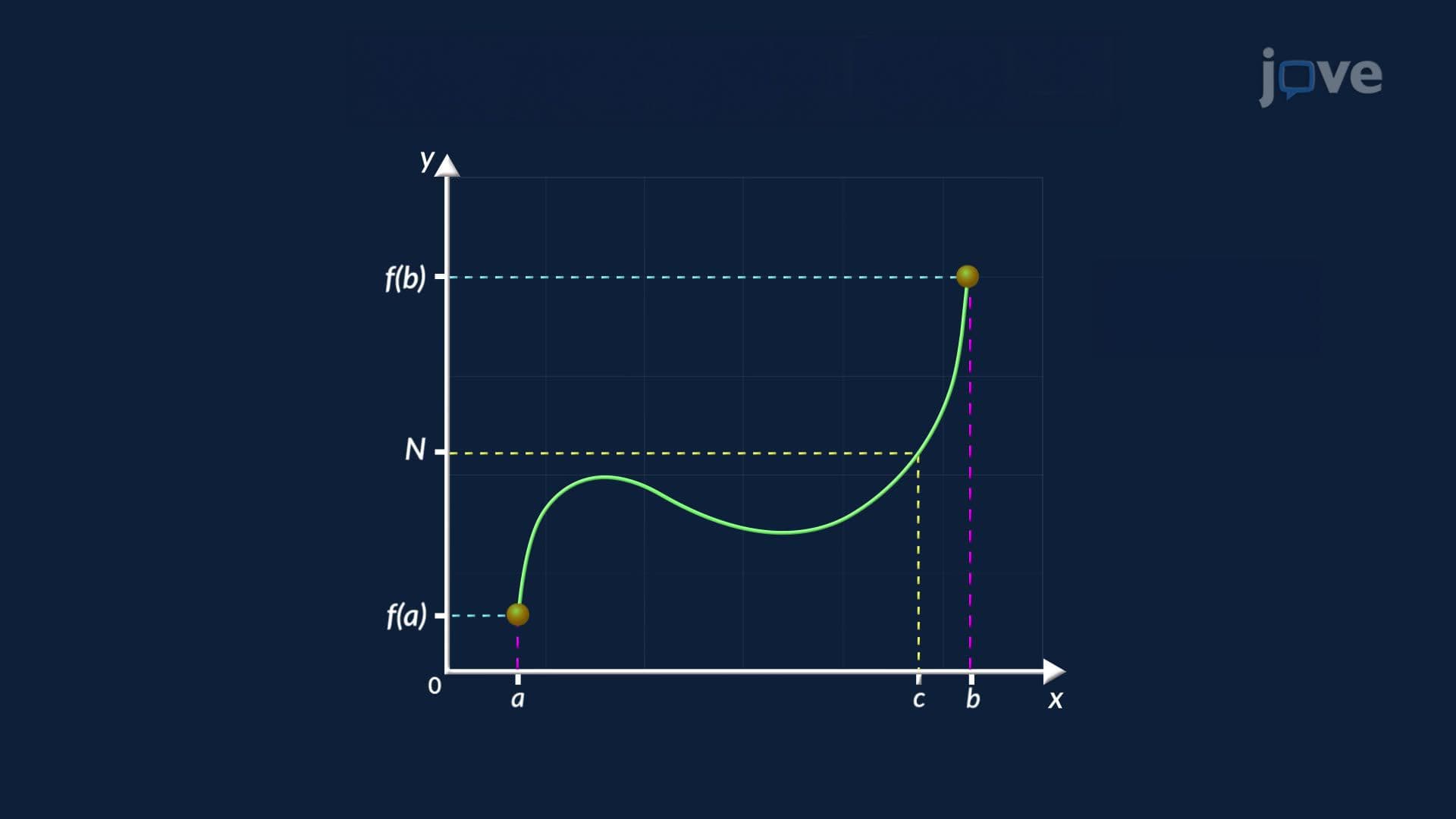
Ever wonder how NASA engineers guarantee a spacecraft will hit its target altitude during launch? The Intermediate Value Theorem explains why continuous functions must pass through every value between their endpoints. Consider a rocket's altitude function: if it starts at sea level (0 feet) and reaches 50,000 feet, this mathematical principle guarantees it crosses every altitude in between, including the critical 10,000-foot mark for stage separation. Watch the full video on JoVE Coach to master this concept with expert-led visuals and step-by-step explanations.
The Intermediate Value Theorem represents one of calculus's most intuitive yet powerful principles. This theorem bridges the gap between abstract mathematical theory and practical problem-solving, making it essential for students preparing for AP Calculus, SAT Subject Tests, and college-level mathematics courses.
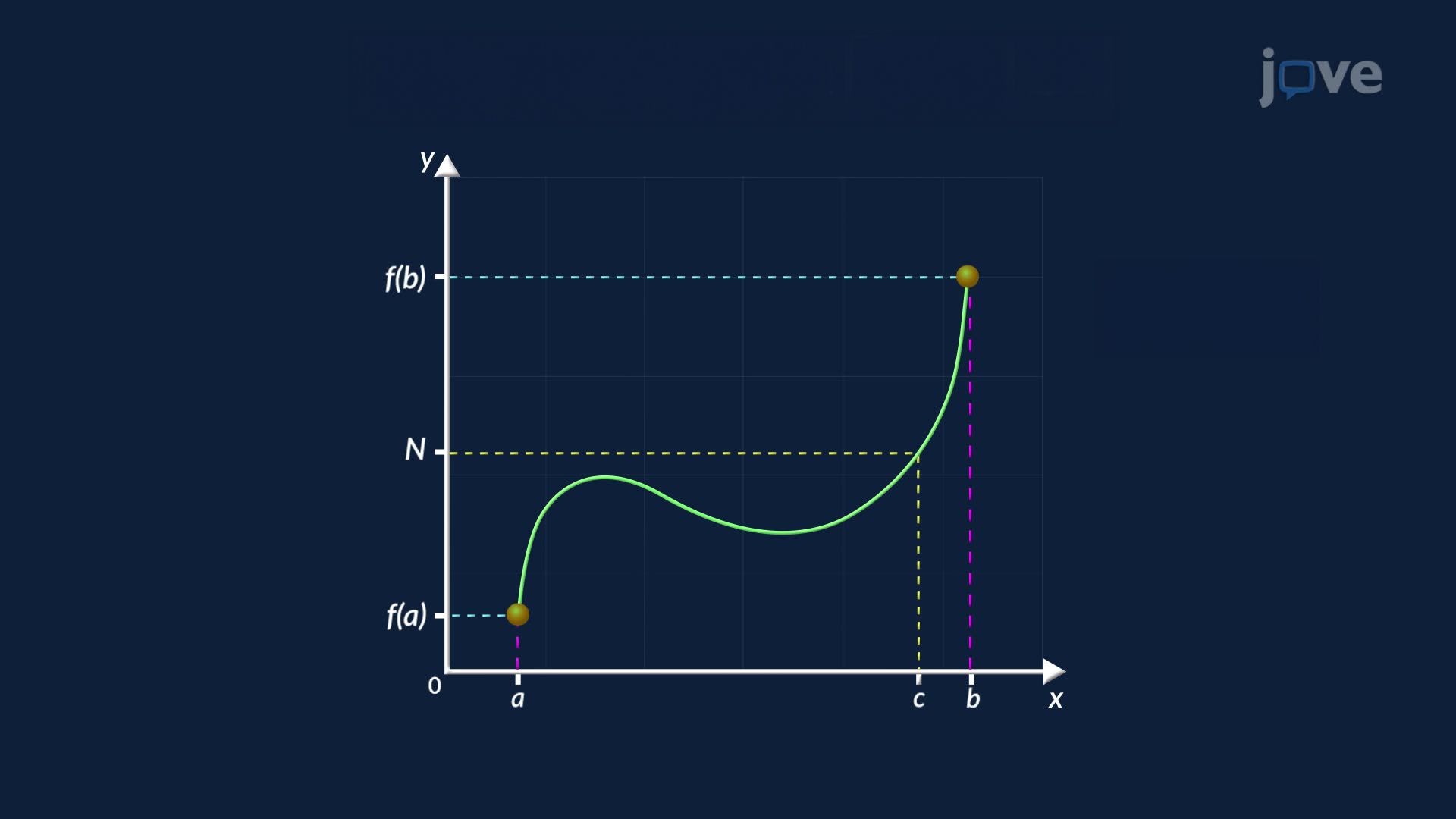
The theorem's formal statement requires three key conditions: a function f must be continuous on a closed interval [a, b], and for any value N between f(a) and f(b), there exists at least one point c in the open interval (a, b) where f(c) = N. This seemingly simple statement has profound implications for mathematical analysis and real-world applications.
Understanding the intermediate value theorem definition begins with recognizing why continuity is crucial. Continuous functions have no breaks, jumps, or holes in their graphs. This property ensures that as the function moves from one value to another, it must pass through every intermediate value along the way.
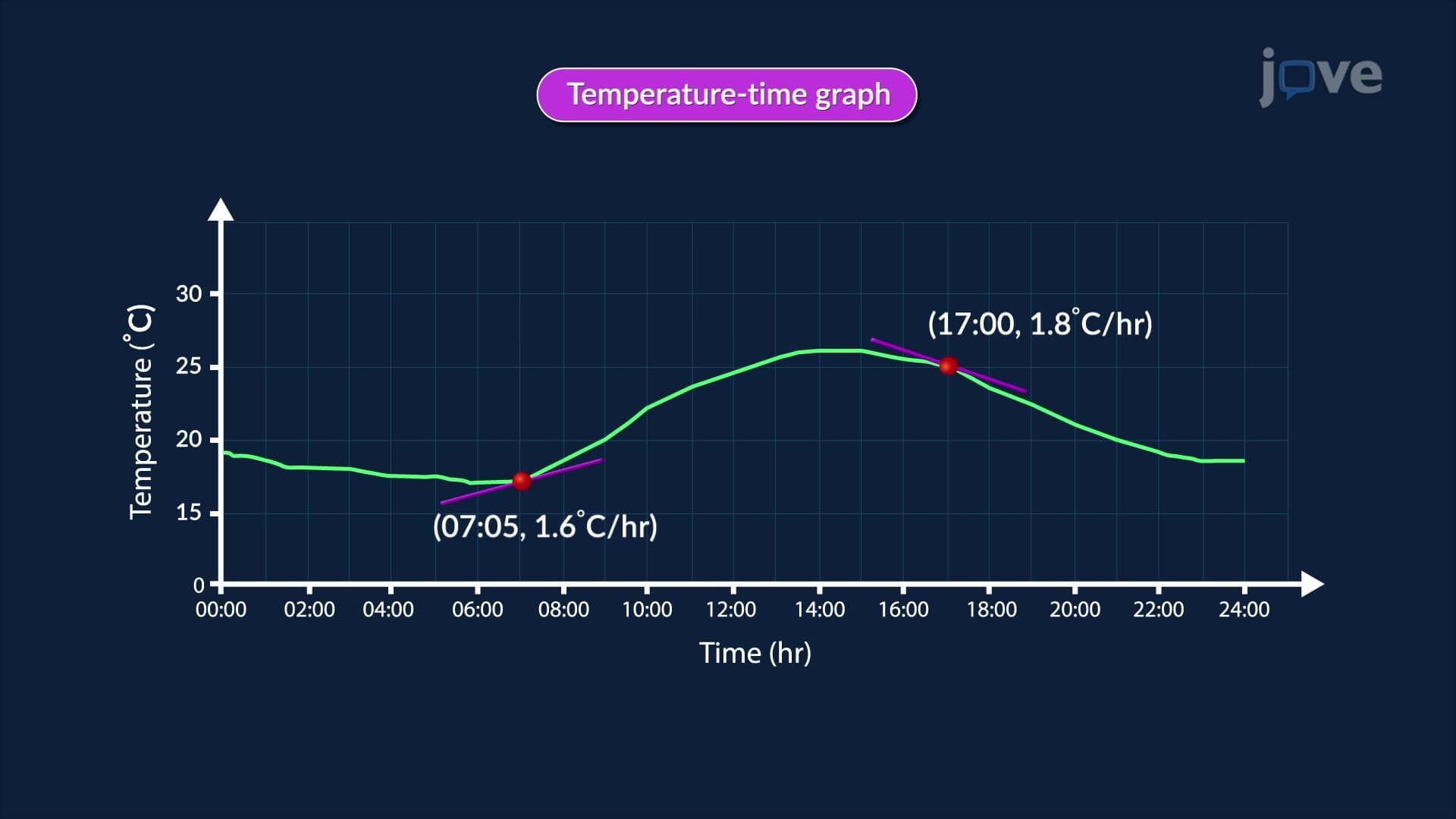
Consider a temperature function modeling weather patterns in Chicago throughout a day. If the temperature is 32°F at 6 AM and 68°F at 6 PM, and temperature changes continuously, the Intermediate Value Theorem guarantees that every temperature between 32°F and 68°F occurred at some point during the day. This includes the critical 50°F mark that determines whether morning frost forms.
What is the intermediate value theorem in detail becomes clearer when examining its role in locating function zeros. This application proves invaluable for engineering calculations, economic modeling, and scientific research. If a polynomial function has negative values at one endpoint and positive values at another, the theorem guarantees at least one zero exists within that interval.
For instance, engineers designing suspension bridges use polynomial functions to model cable tension under various load conditions. When analyzing safety factors, they need to find where stress functions equal zero to identify equilibrium points. The Intermediate Value Theorem provides mathematical certainty that these critical points exist.
Students encountering this theorem in AP Calculus AB/BC exams or college midterms should focus on identifying the three essential components: continuity, closed interval, and intermediate values. Practice problems often involve polynomial, trigonometric, or exponential functions where students must verify continuity and apply the theorem to locate specific values or prove existence statements.
The theorem also appears frequently in MCAT Physical Sciences sections, where understanding continuous functions helps solve physics problems involving motion, thermodynamics, and wave behavior.
Frequently Asked Questions
The Intermediate Value Theorem states that continuous functions on closed intervals must take on every value between their endpoints. This theorem is fundamental because it guarantees the existence of solutions without requiring us to find them explicitly. It's essential for understanding function behavior, solving equations, and appears frequently on AP Calculus exams and college placement tests.
In simple terms, if you have a continuous curve connecting two points, it must cross every horizontal line between those points' heights. Think of drawing a line from the bottom of a hill to the top—your pencil must pass through every elevation in between. Mathematically, this means continuous functions cannot "skip over" any values in their range.
AP Calculus exams frequently test this theorem through existence proofs and root-finding problems. Students might need to prove a function has a zero in a given interval or explain why a specific value must occur. Free-response questions often combine this theorem with graphical analysis, requiring students to justify their reasoning using mathematical principles.
College calculus exams typically feature interval bisection problems, existence proofs for equations, and applications to optimization. Students might encounter problems involving polynomial roots, trigonometric equations, or real-world scenarios like population models where specific values must be achieved within given time frames.
Engineers use this theorem in structural analysis, fluid dynamics, and control systems. For example, when designing aircraft wings, engineers model lift coefficients as continuous functions and use the theorem to guarantee that desired performance values are achievable within operational parameters. NASA applies similar principles in trajectory planning for spacecraft missions.
Not at all! This theorem is accessible to anyone comfortable with basic function concepts and graphing. The key prerequisite is understanding what "continuous" means—essentially, functions you can draw without lifting your pencil. High school algebra and pre-calculus provide sufficient background for grasping the theorem's core ideas.
Focus on three-step verification: check continuity, identify the interval, and locate the target value between endpoints. Practice with polynomial functions first, then advance to trigonometric and exponential examples. Create visual aids showing horizontal line intersections with continuous curves, and work through past AP or college exam problems for authentic practice.
Build on this foundation by exploring the Mean Value Theorem, Rolle's Theorem, and the Extreme Value Theorem. These theorems form a connected framework for understanding function behavior. Also investigate numerical methods like bisection algorithms, which use the Intermediate Value Theorem computationally to approximate solutions in engineering and scientific applications.
Related Micro-courses


Related Subjects
 Physics 33 micro-courses›
 Statistics 17 micro-courses›