Loading subject page…

- Microeconomics
- Game Theory
- Mixed Strategies
Micro-course: Game Theory
5,003 views
Learn key concepts and earn your certificate.

















Mixed Strategies

00:00
01:22
Video Summary: What are Mixed Strategies
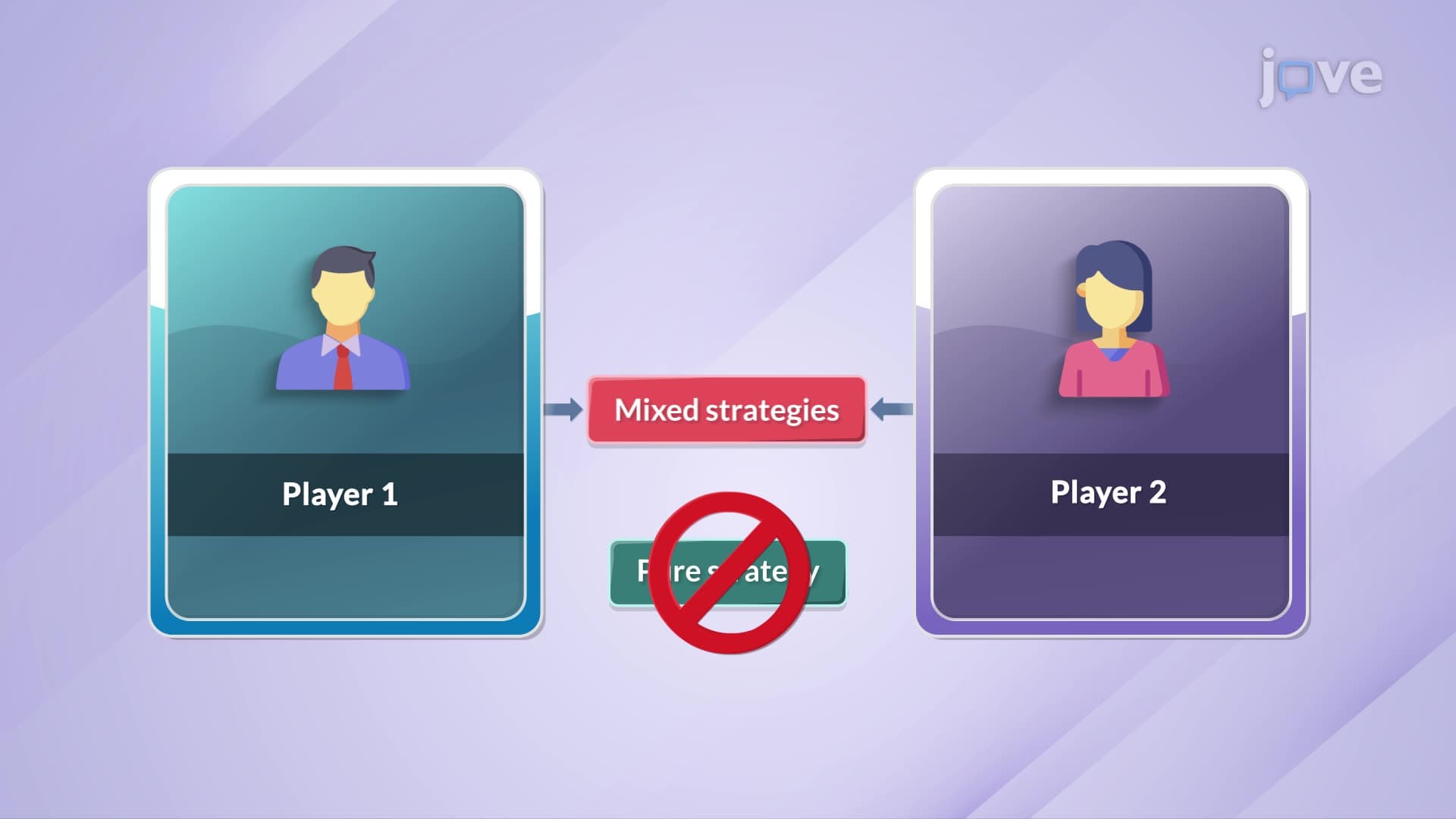
Ever wonder why NFL quarterbacks sometimes fake handoffs or why poker players bluff? Mixed strategies explain this randomness in competitive situations. Mixed strategies occur when players intentionally randomize their choices instead of selecting one specific action, making their moves unpredictable to opponents. The classic penalty kick scenario in soccer perfectly illustrates this concept-both the kicker and goalkeeper must vary their choices randomly to avoid being exploited. Watch the full video on JoVE Coach to master this concept with expert-led visuals and step-by-step explanations.
- Understand what mixed strategies are and how they differ from pure strategies in game theory scenarios
- Identify situations where mixed strategies represent the optimal solution when pure strategy equilibria don't exist
- Analyze the penalty kick example to recognize how randomization prevents opponents from gaining advantages
- Apply the concept of mixed strategy Nash equilibrium to determine optimal probability distributions
- Evaluate why players choose unpredictable strategies in competitive environments
- Compare mixed strategies to pure strategies and understand when each approach is most effective
- Recognize real-world applications of mixed strategies in business, sports, and economics
- Explore how randomization creates stability in strategic interactions between rational players
Understanding What Are Mixed Strategies
Mixed strategies represent a fundamental concept in game theory where players deliberately randomize their choices rather than consistently selecting the same action. Unlike pure strategies, where players commit to one specific course of action, mixed strategies involve probability distributions over available options. This randomization becomes essential in competitive situations where predictability leads to exploitation by opponents.
The Mathematics Behind Mixed Strategy Equilibrium
In mixed strategy Nash equilibrium, each player chooses their actions according to specific probabilities that make their opponent indifferent between their available strategies. Consider the penalty kick scenario: when both the kicker and goalkeeper choose left or right with 50% probability, neither player can improve their expected payoff by changing strategies. This mathematical balance ensures that no player has incentive to deviate from their randomization pattern.
For AP Economics or college-level game theory courses, students learn to calculate these equilibrium probabilities using expected value equations. The key insight is that in equilibrium, each player's mixed strategy makes their opponent's pure strategies yield equal expected payoffs.
Real-World Applications in American Markets
Mixed strategies appear throughout American business and sports. NFL defensive coordinators randomize blitz packages to keep quarterbacks guessing. Investment firms diversify portfolios partly to avoid predictable patterns that competitors might exploit. Even retailers use mixed strategies when timing sales events-too much predictability allows competitors to coordinate their own promotions accordingly.
In Silicon Valley tech companies, product launch timing often involves strategic randomization. Companies can't always launch at the "obvious" optimal moment because competitors anticipate these moves. Mixed strategies help maintain competitive advantage through unpredictability.
Study Applications for US Students
Students encounter mixed strategies in various contexts. AP Microeconomics courses cover basic game theory applications. College economics, business strategy, and mathematics courses explore more sophisticated applications. The MCAT occasionally includes game theory scenarios in psychology and sociology sections, testing students' understanding of strategic behavior and decision-making under uncertainty.
Frequently Asked Questions
Mixed strategies involve deliberately randomizing your choices in competitive situations to stay unpredictable. Instead of always choosing the same action, you use probability to vary your decisions, preventing opponents from exploiting predictable patterns in your behavior.
AP Microeconomics exams often include game theory questions featuring mixed strategies, particularly in market competition scenarios. Students must identify when pure strategy equilibria don't exist and calculate optimal randomization probabilities. Practice with penalty kick and matching pennies examples helps prepare for these questions.
Most intermediate microeconomics courses cover mixed strategies as part of game theory units. Expect questions calculating Nash equilibria, determining optimal probability distributions, and analyzing real-world strategic interactions. The mathematical approach varies by course level, from basic probability to more advanced optimization techniques.
Mixed strategies appear in advertising timing, product launches, pricing decisions, and competitive responses. For example, Coca-Cola and Pepsi randomize promotional campaigns to avoid predictable competitive patterns. Airlines use mixed strategies when adjusting routes and pricing to prevent competitors from anticipating moves.
Basic probability and algebra suffice for introductory mixed strategy concepts. High school students can grasp fundamental ideas using simple examples like coin flips and sports scenarios. More advanced applications require calculus and linear algebra, but core concepts remain accessible to students with standard math backgrounds.
Focus on understanding why randomization creates strategic advantages rather than memorizing formulas. Practice identifying scenarios where mixed strategies emerge, work through penalty kick and matching pennies examples, and connect concepts to real-world situations. Drawing payoff matrices helps visualize strategic interactions.
Sequential games, repeated games, and evolutionary game theory build naturally from mixed strategy foundations. Behavioral game theory explores how real people deviate from theoretical predictions. Advanced topics include mechanism design, auction theory, and information economics applications in business and policy contexts.
Related Micro-courses