Loading subject page…


5,003 views

Video Summary: What Is Nash Equilibrium
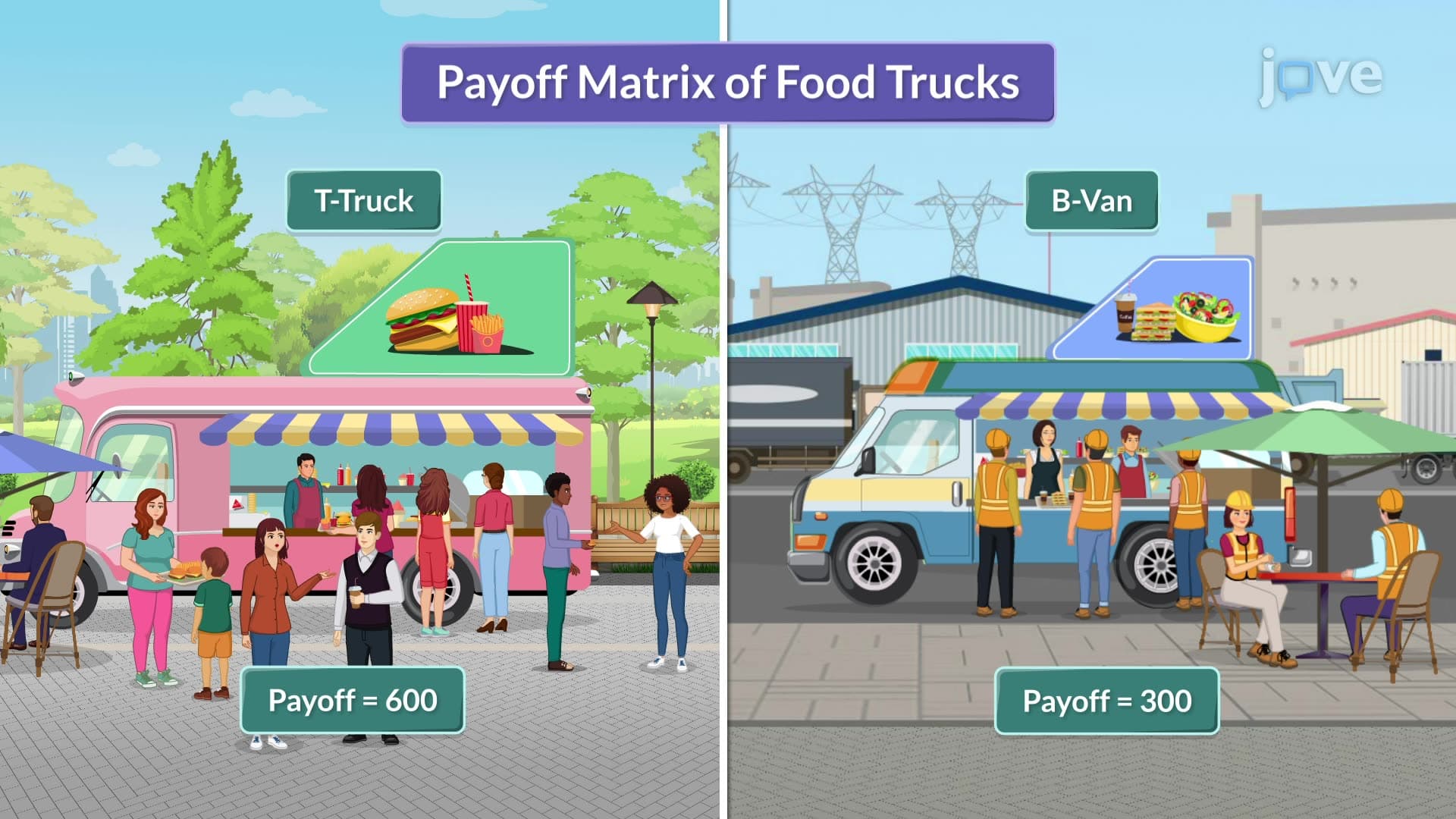
Ever wonder why gas stations cluster at intersections, or why Netflix and Hulu release competing shows simultaneously? Nash equilibrium explains these strategic decisions where no player benefits from changing their choice unilaterally. Using mobile food trucks competing for downtown versus industrial area customers, this concept reveals how T-Truck's dominant strategy leads to a stable outcome where neither competitor wants to switch locations. Watch the full video on JoVE Coach to master this concept with expert-led visuals and step-by-step explanations.
Nash equilibrium represents a cornerstone concept in game theory where each player chooses their optimal strategy given the strategies chosen by all other players. Named after mathematician John Nash, this equilibrium occurs when no player can unilaterally improve their payoff by changing their strategy alone. In the mobile catering example, T-Truck downtown and B-Van in the industrial area creates this stable state-neither would benefit from switching locations after learning their competitor's choice.
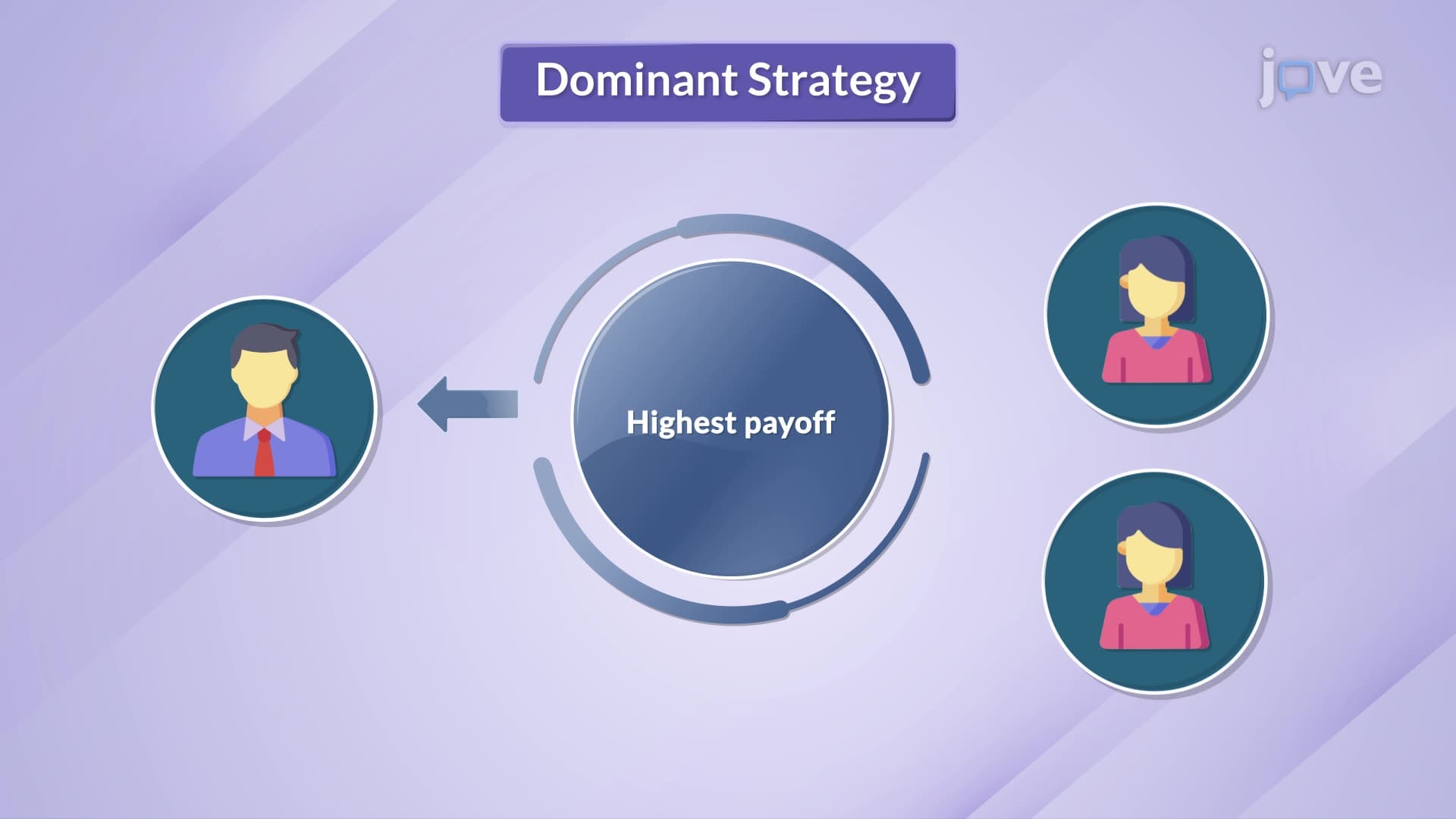
This nash equilibrium definition explained becomes clearer when we consider that each player's strategy must be a best response to the other players' strategies. Unlike dominant strategies (where one choice is always best regardless of opponents' actions), Nash equilibrium requires mutual best responses. T-Truck's dominant strategy of choosing downtown, combined with B-Van's best response of choosing the industrial area, creates the equilibrium outcome.
The nash equilibrium concept explained extends far beyond academic theory into everyday American business decisions. Consider major retailers like Target and Walmart-they often locate stores near each other because the Nash equilibrium involves competing for the same customer base while benefiting from increased foot traffic. Similarly, political candidates often adopt centrist positions during elections, representing a Nash equilibrium where moving too far left or right would lose moderate voters.
In technology, the smartphone operating system competition between Apple's iOS and Google's Android represents a Nash equilibrium. Each company maintains its strategy (premium vs. open-source) because switching would likely reduce market share given consumer expectations and developer ecosystems.
To find Nash equilibrium solutions, students must analyze each player's best responses systematically. Start by examining one player's optimal choices for each possible action by opponents, then repeat for all players. The intersection of mutual best responses indicates equilibrium points.
For AP Economics and college microeconomics courses, students encounter Nash equilibrium in pricing games, advertising decisions, and market entry problems. On standardized tests, questions typically provide payoff matrices and ask students to identify equilibrium outcomes or explain why certain strategy combinations represent stable solutions.
While the nash equilibrium study guide often emphasizes conceptual understanding, mathematical notation helps clarify relationships. In a two-player game, Nash equilibrium occurs when Player 1's strategy s1* and Player 2's strategy s2* satisfy: s1* maximizes Player 1's payoff given s2*, and s2* maximizes Player 2's payoff given s1*.
Students preparing for economics exams should practice identifying Nash equilibria in various game formats, from simple 2x2 matrices to more complex scenarios involving multiple players or continuous strategies. Understanding when games have no equilibrium, unique equilibrium, or multiple equilibria becomes crucial for advanced coursework and graduate school preparation.
Related Micro-courses