Loading subject page…


5,987 views

Video Summary: Elasticity of Supply Through Percentage Method Guide
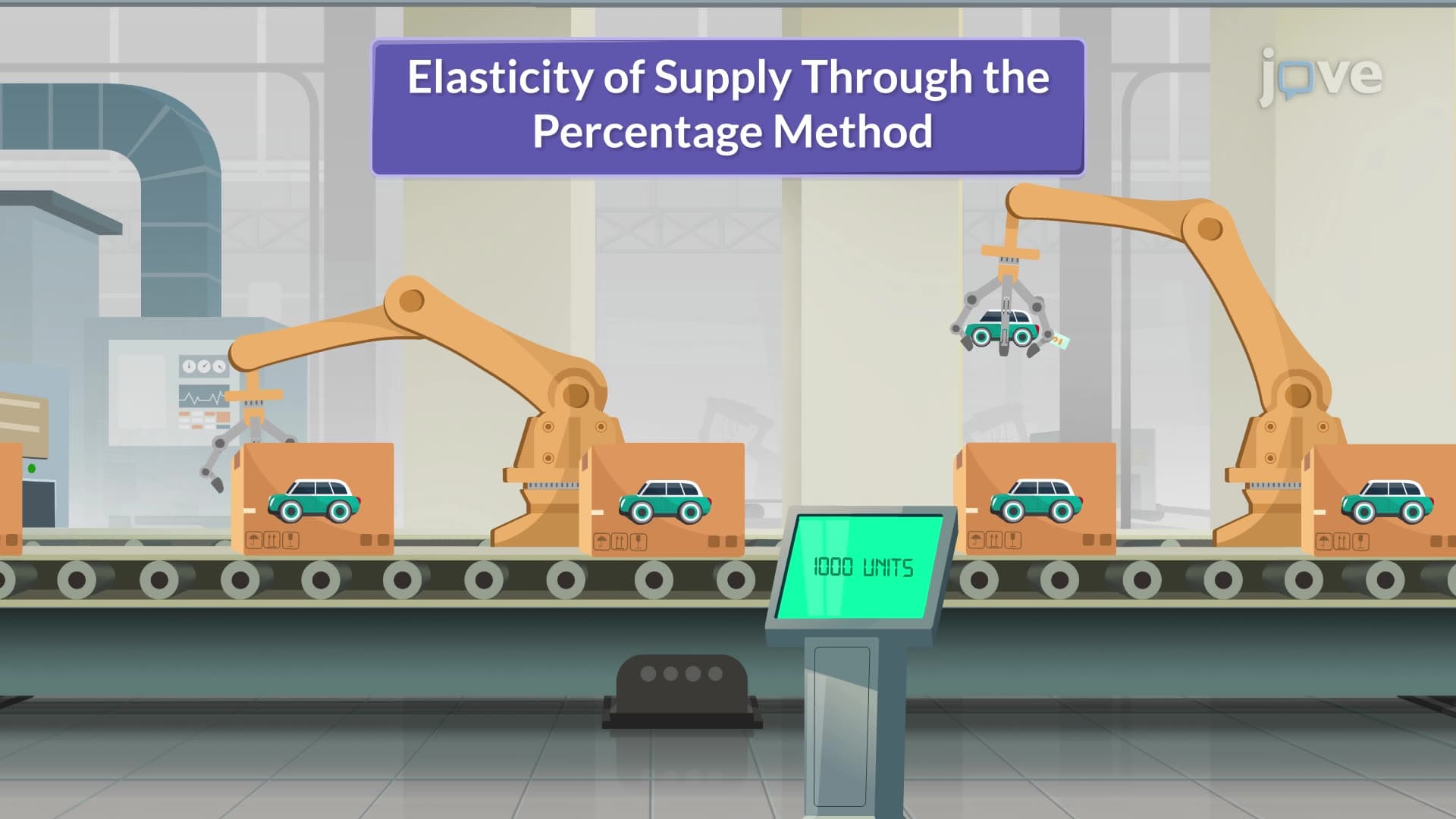
Ever wonder why gas stations can't instantly double their fuel supply when prices spike? Elasticity supply through percentage reveals how businesses respond to price changes in measurable terms. The Elasticity of Supply Through Percentage Method Guide demonstrates this using simple calculations-like how a toy manufacturer might increase production from 1,000 to 1,200 cars when prices rise from $10 to $12. Watch the full video on JoVE Coach to master this concept with expert-led visuals and step-by-step explanations.
The elasticity of supply through percentage method serves as economics' measuring stick for producer responsiveness. Unlike simple supply and demand curves, this method provides precise numerical values that economists, business analysts, and policymakers use to predict market behavior. When Starbucks decides whether to expand coffee bean sourcing based on price increases, they're essentially calculating supply elasticity.
The core formula divides percentage change in quantity supplied by percentage change in price. For instance, if Apple's iPhone component supplier increases production by 15% when Apple raises component prices by 10%, the elasticity equals 1.5 (15% ÷ 10%). This elastic supply (>1) indicates strong producer responsiveness. Students encounter this concept in AP Economics courses, where understanding percentage calculations becomes crucial for exam success.
Elastic supply (elasticity > 1) characterizes industries like fast food, where restaurants can quickly adjust staffing and ingredient orders. Inelastic supply (elasticity < 1) describes oil refineries or pharmaceutical manufacturing, where production changes require significant time and investment. Unitary elastic supply (elasticity = 1) represents the theoretical balance point, like the toy car example where both price and quantity changed by 20%.
College microeconomics courses emphasize supply elasticity's role in tax policy analysis. When governments consider excise taxes on cigarettes or gasoline, economists calculate supply elasticity to predict producer responses. SAT Subject Tests in Economics may include elasticity calculations, making percentage method mastery essential. Business students apply these concepts in operations management, determining optimal production scaling strategies based on market price fluctuations.
Understanding supply elasticity helps explain why concert ticket prices vary dramatically (inelastic venue capacity) while food truck quantities can adjust rapidly to demand spikes (elastic supply). This knowledge proves invaluable for students pursuing economics, business administration, or public policy careers.
Related Micro-courses