Loading video…


 12 Concepts
 6K views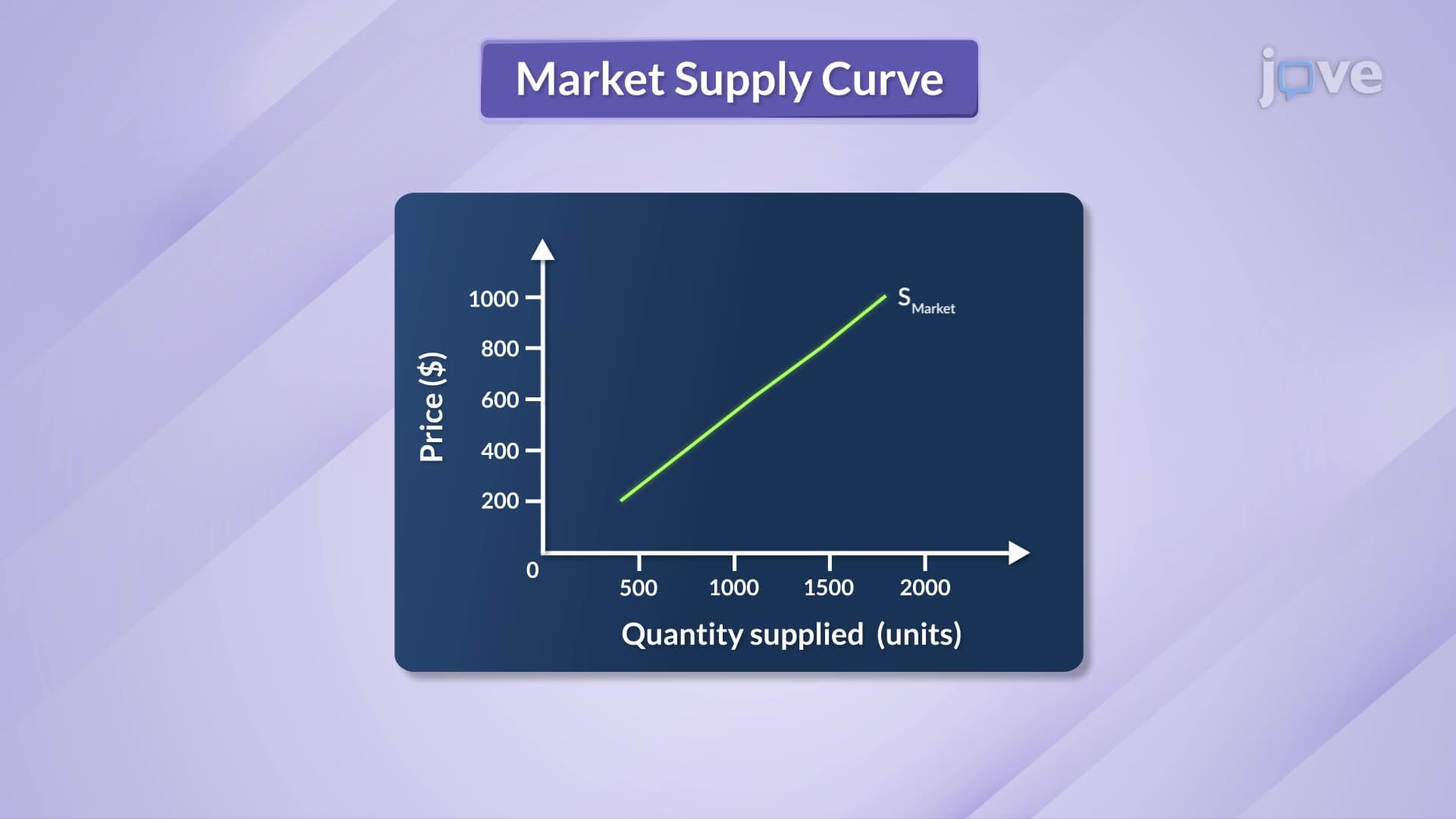

Video Summary: What Is Market Supply
Ever wonder why iPhone prices drop when Samsung releases a new model? Market supply represents the total quantity of goods that all producers in an economy are willing to sell at different price levels. When Apple, Google, and Samsung combine their smartphone production, they create the US smartphone market supply. Understanding What is Market Supply helps explain how multiple producers influence pricing and availability in competitive markets like the $200 billion US smartphone industry. Watch the full video on JoVE Coach to master this concept with expert-led visuals and step-by-step explanations.
Market supply represents the collective willingness of all producers in an industry to provide goods or services at various price points during a specific time period. Unlike individual supply, which focuses on one company's production decisions, market supply aggregates the output decisions of every participant in an industry. This aggregation creates a comprehensive picture of total availability that drives competitive pricing and consumer access.
The construction of market supply involves horizontally adding individual supply curves-a process economists call "horizontal summation." For example, if Ford plans to produce 500,000 trucks at $30,000 each, General Motors targets 400,000 trucks at the same price, and Ram schedules 300,000 trucks, the market supply at $30,000 equals 1.2 million trucks. This mathematical aggregation applies across all price levels to create the complete market supply schedule.
Market supply analysis proves essential in understanding major US industries. Consider the pharmaceutical sector, where companies like Pfizer, Johnson & Johnson, and Merck collectively determine medication availability. When COVID-19 vaccines emerged, market supply represented the combined production capacity of all authorized manufacturers, directly affecting nationwide distribution and pricing policies.
Agricultural markets provide another compelling example. US corn production involves thousands of farmers from Iowa to Nebraska, each making individual planting decisions based on expected prices. The Department of Agriculture aggregates these individual choices to forecast total corn market supply, which influences everything from livestock feed costs to ethanol production capacity.
Students encounter market supply extensively in AP Economics courses, where it appears in both multiple-choice and free-response questions. College-level microeconomics courses expand this foundation, requiring students to calculate market equilibrium points and analyze supply shifts. Business school candidates preparing for GMAT quantitative sections frequently solve market supply problems involving multiple producers and changing market conditions.
Professional economists use market supply models to advise corporations and government agencies. The Federal Reserve examines housing market supply when setting interest rates, while the Department of Energy monitors oil market supply to predict gasoline price fluctuations. Understanding these applications helps students connect classroom theory with real economic decision-making.
Several factors can shift entire market supply curves. Technological improvements typically increase market supply by reducing production costs across all firms. The smartphone industry exemplifies this pattern-advances in semiconductor manufacturing have enabled companies to produce more devices at lower costs, shifting the entire market supply curve rightward.
Government regulations can also dramatically affect market supply. Environmental regulations might reduce market supply by increasing compliance costs, while subsidies can expand supply by lowering production expenses. The renewable energy sector demonstrates both effects, with tax credits encouraging wind farm development while environmental reviews potentially constraining project timelines.
Related Micro-courses