Loading video…


 15 Concepts
 116.4K views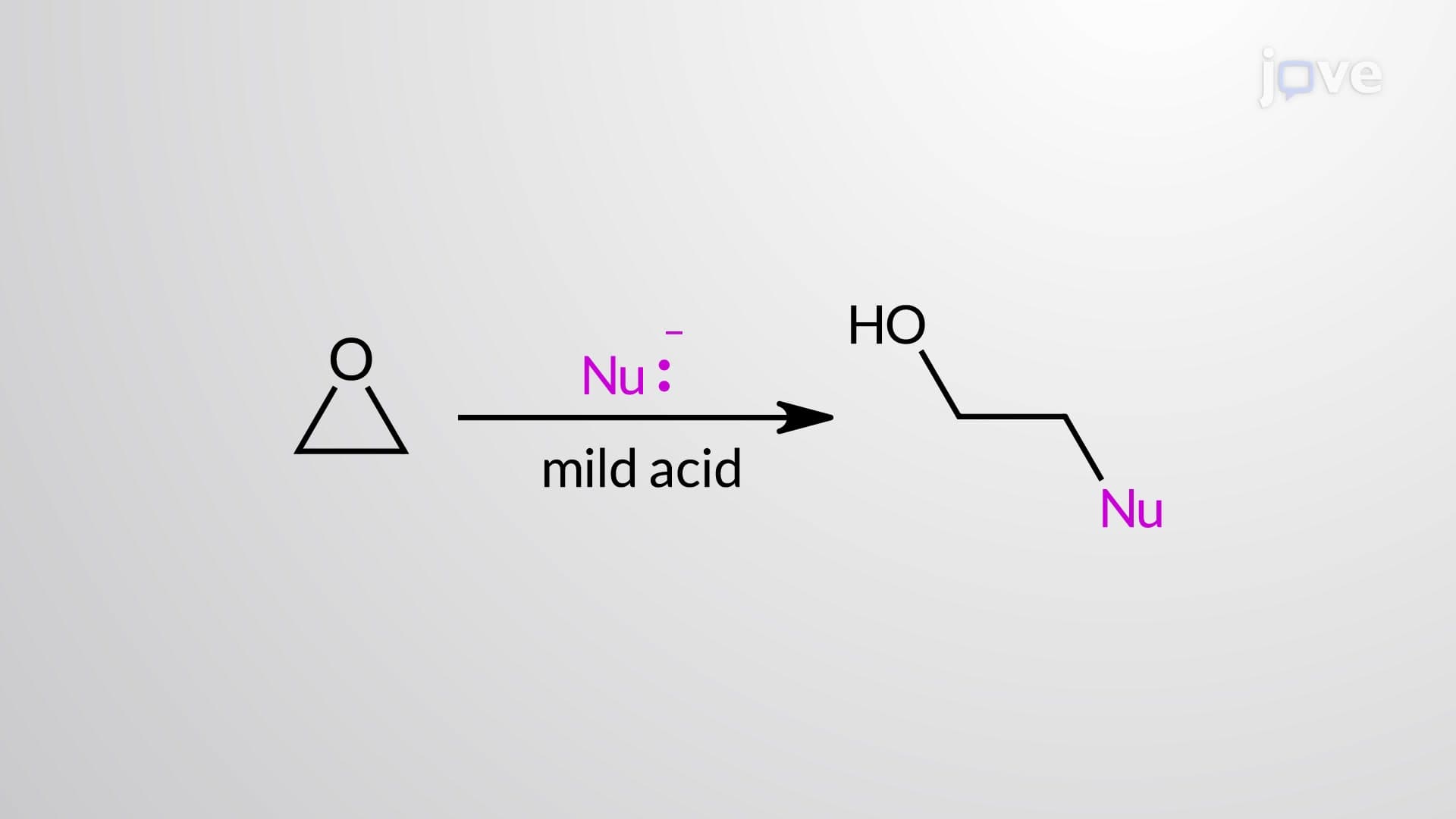

Video Summary: Acid Catalyzed Ring Opening of Epoxides Explained
Ever wonder why cleaning products containing epoxides work so effectively? The acid catalyzed ring opening reaction breaks these highly strained three-membered rings under mild conditions, making them incredibly useful in pharmaceutical manufacturing and polymer chemistry. Companies like DowDuPont rely on this mechanism to produce specialty chemicals used in everything from adhesives to medical devices. Acid Catalyzed Ring Opening of Epoxides Explained reveals how protonation weakens the ring structure, allowing nucleophiles to attack and form valuable products through predictable stereochemical pathways. Watch the full video on JoVE Coach to master this concept with expert-led visuals and step-by-step explanations.
The acid catalyzed ring opening mechanism represents a cornerstone reaction in organic chemistry, particularly valuable for students preparing for AP Chemistry, college organic chemistry courses, and pre-medical studies. Unlike base-catalyzed conditions, acid catalysis offers unique regioselectivity patterns that make it indispensable in synthetic chemistry.
Epoxides contain approximately 27 kcal/mol of ring strain, making them among the most reactive organic compounds. The mechanism begins with protonation of the epoxide oxygen by acids like HCl, HBr, or even weak acids like water in the presence of sulfuric acid. This protonation step is crucial-it transforms the poor leaving group (alkoxide) into an excellent one (alcohol).
The resulting bridged oxonium ion experiences significant electrophilic character at both carbons. Students often struggle with this intermediate, but understanding it explains why epoxides react under such mild conditions compared to regular ethers. For MCAT preparation, remember that this protonation step is reversible and represents the rate-determining step in most cases.
The beauty of acid catalyzed ring opening lies in its predictable regioselectivity. When epoxides contain only primary and secondary carbons, steric hindrance dominates, directing nucleophilic attack to the less-substituted carbon (SN2-like pathway). This follows Fürst-Plattner rules and appears frequently on college organic chemistry exams.
However, tertiary carbons change everything. Electronic stabilization of the partial positive charge becomes paramount, favoring attack at the more-substituted position (SN1-like pathway). Pharmaceutical companies like Pfizer exploit this selectivity in drug synthesis, particularly for creating complex natural product analogs.
The stereochemistry follows SN2 principles-inversion of configuration occurs at the carbon undergoing nucleophilic attack. This anti-relationship between incoming nucleophile and departing oxygen proves essential in synthesizing specific stereoisomers for drug development.
Industrial applications abound in the United States chemical industry. Epoxy resins used in aerospace applications (Boeing, Lockheed Martin) rely on controlled ring-opening polymerization. Similarly, pharmaceutical intermediates for cholesterol-lowering drugs often involve epoxide opening reactions under carefully controlled acidic conditions.
Related Micro-courses